
Key Takeaways
Table of Contents
- An Opening Range Breakout Is Simple. Knowing Which One to Trust Isn’t.
- How Does the Opening Range Lock?
- Why Does ORB AI Score Breakouts Instead of Just Detecting Them?
- How Does the Regime Engine Change the Threshold?
- What Is the KNN Lorentzian ML Engine and How Does It Learn?
- What Do the Signals, Zones, and Dashboard Show You?
- What Are the Take-Profit and Stop-Loss Options?
- How Do You Use ORB AI to Trade?
- How Do You Automate ORB AI Signals with PickMyTrade?
- What Are ORB AI’s Limitations?
- Key Settings
- Full Pine Script Source
- You May Also Like
- Frequently Asked Questions
- Is ORB AI really free?
- Does it repaint?
- What’s the difference between the Rule Confidence score and the KNN vote?
- Does ORB AI work on crypto and forex?
- How long until the KNN engine is “ready”?
- Can I use ORB AI without the ML engine?
- Get the Indicator
- ORB AI locks a configurable opening range (Exchange Session, New York 09:30, London, Tokyo, or a custom anchor) and scores every breakout candidate across seven independent factors — Trend, Momentum, Volume, Volatility, Structure, Breakout Quality, and Liquidity — instead of firing on a single range-break condition.
- A market-regime engine (Strong Trend, Trending, Weak Trend, Range, Choppy, High/Low Volatility) adjusts the confidence threshold bar by bar, so the same breakout is held to a stricter standard in chop than in a confirmed trend.
- A built-in KNN engine using Lorentzian distance — the same distance metric behind TradingView’s most-used ML classifier — compares every new breakout to the chart’s own resolved history and shows what the K nearest historical analogues actually did, without ever blocking a signal unless you opt into Gate mode.
- False breakouts, retests, and liquidity sweeps are tagged directly on the chart (BO / RT / FBO / Sweep), and three take-profit methods — R Ladder, OR Width Projection, or ATR-scaled EMA trailing — let the exit style match the breakout style.
- Everything runs non-repainting on confirmed closes, with 19
alertcondition()calls that produce automation-ready JSON payloads for PickMyTrade webhooks.
An Opening Range Breakout Is Simple. Knowing Which One to Trust Isn’t.
Mark the high and low of the first N minutes. Buy the break of the high, sell the break of the low. It’s one of the oldest ideas in day trading, and it still works — reward-to-risk, not accuracy, is the actual edge in ORB trading, with realistic win rates sitting around 40–60% by design (TradingStats.net, 6,142-day ES & NQ study).
The problem was never the concept. It’s that a raw range break tells you nothing about which breakouts are worth taking. Independent research across thousands of trading days found that on a 5-minute opening range, 74.3% of days see both sides of the range breached — the market frequently fakes one way before committing to the other (TradingStats.net). Widen to a 30-minute range with a 5-minute confirmation filter and the picture improves — continuation rates as high as 71.5% on NQ — but that improvement comes entirely from added context, not from the breakout condition itself (TradingStats.net; ORB Setups: false-breakout research).
ORB AI [PickMyTrade] builds that context directly into the signal instead of leaving it to discretion. Every qualified breakout is scored across seven structural factors, adjusted for the current market regime, and cross-checked against a self-learning K-Nearest-Neighbors library built from the chart’s own past breakouts — all free, all in Pine Script v6, all non-repainting.
How Does the Opening Range Lock?
The range can anchor to five different session starts:
- Exchange Session — the symbol’s own listed session open (RTH for stocks, Globex 18:00 ET for CME futures, daily rollover for crypto)
- New York 09:30 — the classic US cash-market open, read explicitly in
America/New_Yorktime so it stays correct on CME futures (whose exchange clock is Chicago) and immune to daylight-saving drift - New York 08:30 (data) — the US economic-data release window
- London 08:00 / Tokyo 09:00 — those markets’ own cash opens, in their own timezones
- Custom — any session string and IANA timezone you specify
The range length is configurable from 1 to 120 minutes. If the chart’s own timeframe is coarser than the selected range (a 15-minute range on a 30-minute chart, for instance), the range automatically expands to one full bar rather than silently producing a broken chart — and the dashboard flags exactly when this override is active.
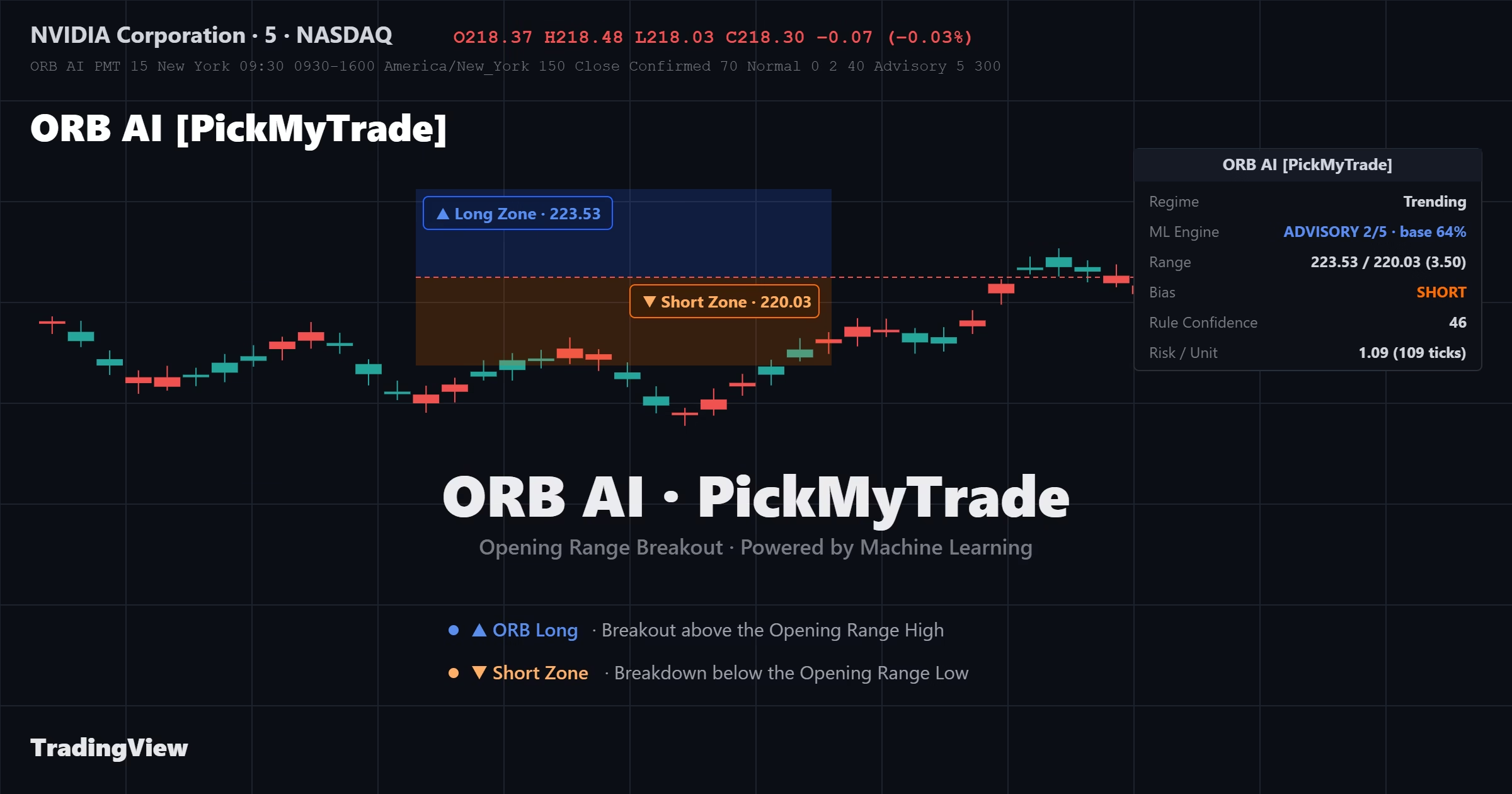
Once locked, the range draws as two shaded zones — a Long Zone above the midpoint and a Short Zone below it — with the boundary itself carrying the trigger price for each side.
Why Does ORB AI Score Breakouts Instead of Just Detecting Them?
Because a level break by itself carries almost no information about whether it will hold. ORB AI runs every qualified candidate through seven weighted 0–100 scores:
| Factor | What It Measures |
|---|---|
| Trend | 35% EMA alignment (fast/mid/slow), 25% ADX strength, 25% higher-timeframe close vs. HTF EMA (read from closed bars only), 15% EMA slope |
| Momentum | RSI level and acceleration, MACD histogram expansion, rate of change, and candle body strength, all ATR-normalised |
| Volume | Relative volume vs. its 20-bar average, volume percentile rank, and OBV direction — requires a symbol with real volume data |
| Volatility | ATR expansion, Bollinger Band width expansion, and bar-range expansion vs. their own 20-bar averages |
| Structure | VWAP position, “room to run” before the nearest resistance/support (prior-day high/low, confirmed swing pivots, premarket extremes), and gap alignment |
| Breakout Quality | Breakout distance in ATRs, candle body ratio, consecutive closes beyond the range, and how fast the breakout occurred (measured in minutes, not bars, so “fast” means the same thing on a 1-minute chart and a 1-hour chart) |
| Liquidity | Whether the opposite side of the range was recently swept (a classic liquidity-grab precursor) and proximity to equal highs/lows |
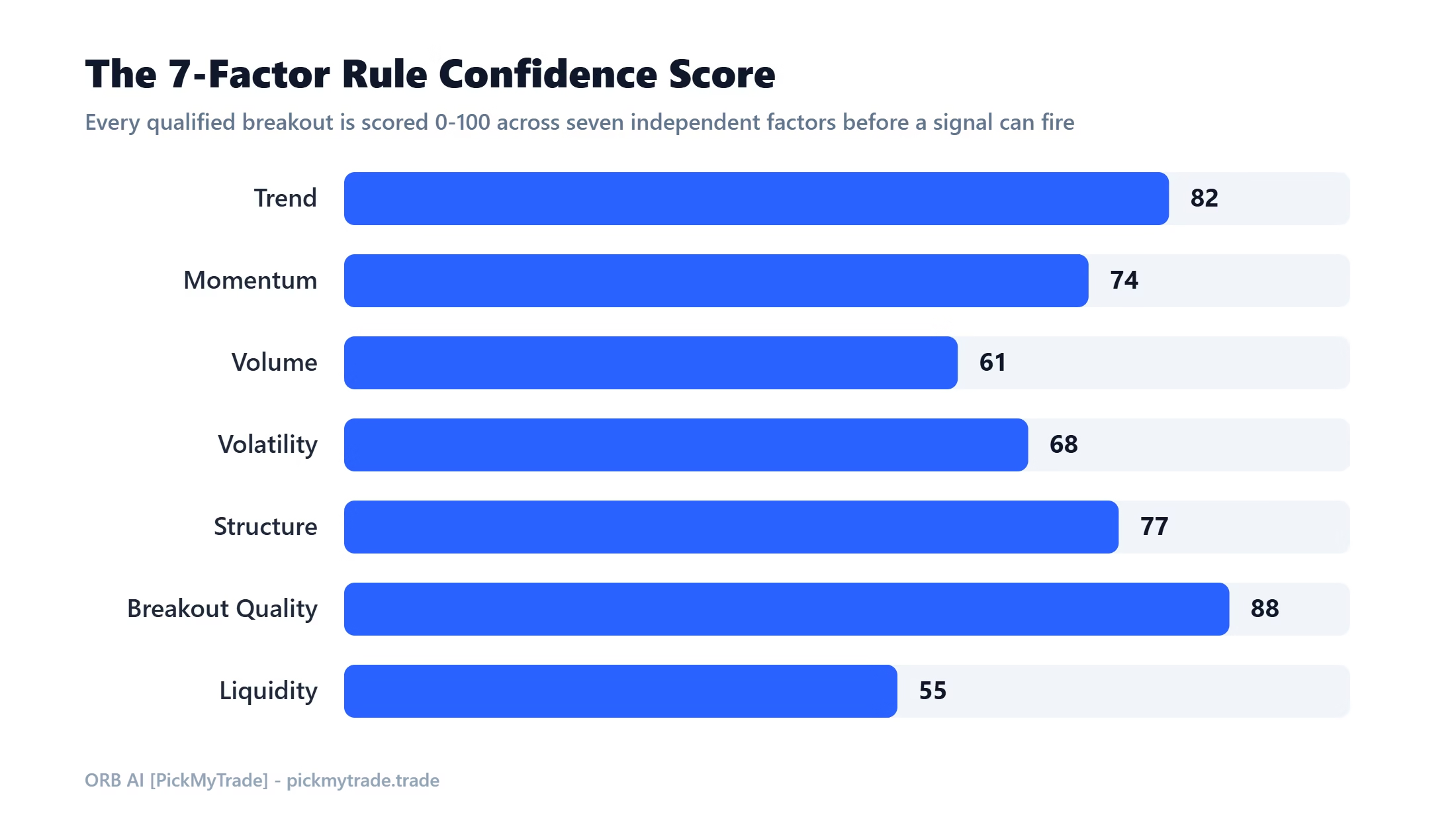
The seven scores combine into a single confidence number, weighted dynamically by the detected market regime — the same breakout quality reading is trusted more in a confirmed trend and held to a higher bar in chop.
How Does the Regime Engine Change the Threshold?
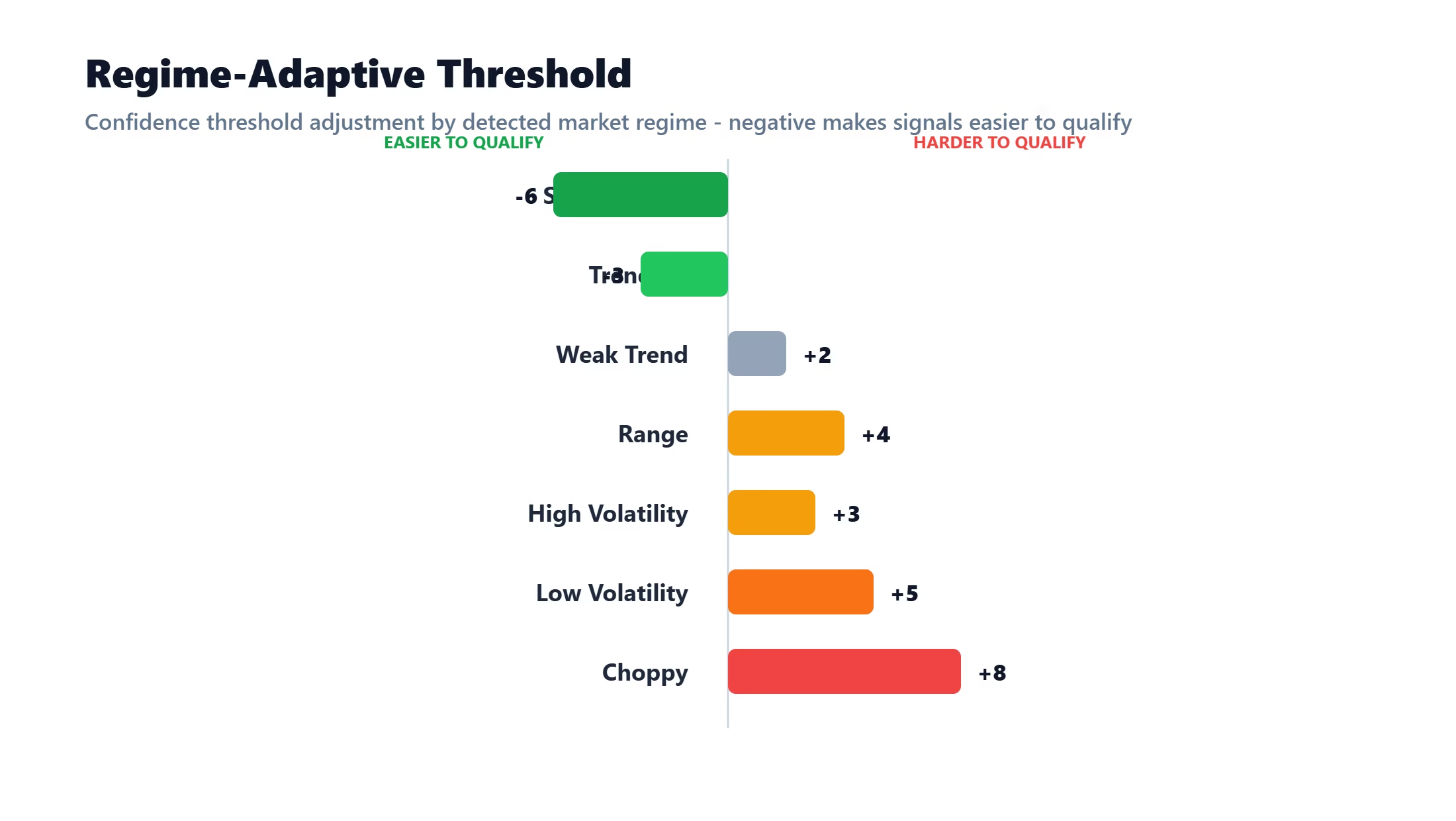
ORB AI classifies the current market into one of six regimes using ADX and the ATR ratio (current ATR vs. its 20-bar average):
ADX ≥ 32 and ATR ratio ≥ 1.05  →  Strong Trend      (threshold −6)
ADX ≥ 25                       →  Trending          (threshold −3)
ADX ≥ 18                       →  Weak Trend        (threshold +2)
Chop score ≥ 61.8               →  Choppy            (threshold +8)
ATR ratio ≥ 1.35                →  High Volatility   (threshold +3)
ATR ratio ≤ 0.70                →  Low Volatility    (threshold +5)
otherwise                       →  Range             (threshold +4)
A lower adjustment makes signals easier to qualify; a higher one makes them harder. In a Strong Trend regime the confidence threshold drops, because trend-following breakouts deserve more benefit of the doubt. In a Choppy regime it rises by 8 points, directly targeting the exact condition responsible for the 40–45% false-breakout rate documented in independent ORB research (ORB Setups). A detected “Breakout Day” (today’s range is unusually narrow vs. its 10-session average) tightens the threshold by another 4 points, since narrow-range days statistically precede the cleanest directional moves.
The regime also reweights the seven factors themselves — Trend and Momentum count for more in trending regimes; Breakout Quality and Liquidity count for more in range and chop, where the quality of the individual break matters more than broad directional bias.
What Is the KNN Lorentzian ML Engine and How Does It Learn?
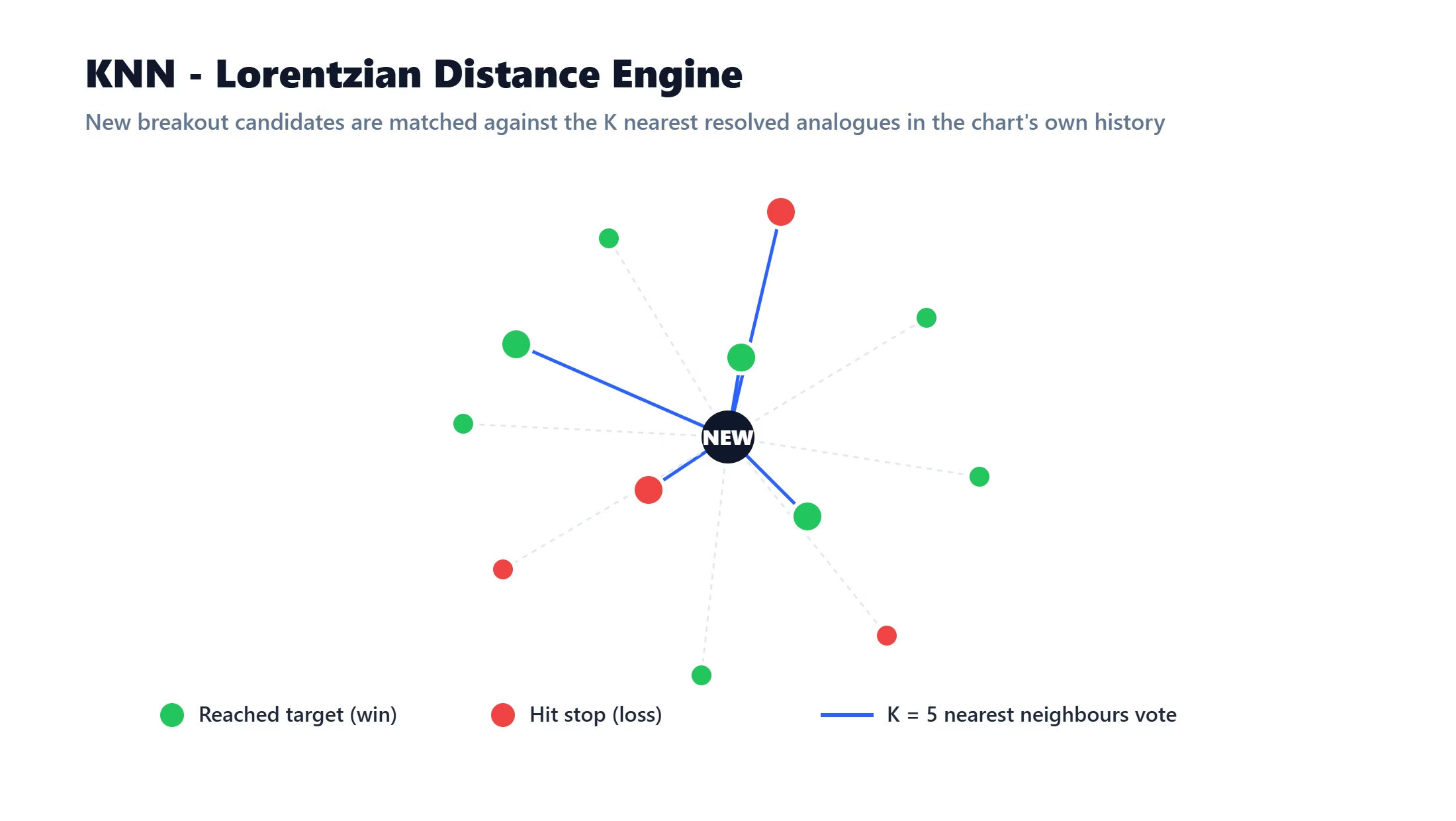
This is the layer that turns “here’s a score” into “here’s what happened last time the chart looked like this.”
The fingerprint. Every rule-qualified breakout candidate is reduced to a 6-feature, trade-direction-oriented fingerprint: Trend, Momentum, Volume, Volatility, Structure, and Breakout Quality, each normalised 0–1.
Resolving the outcome. Each logged candidate is tracked forward. If price reaches the 1R target before the stop, it’s a win; if the stop comes first, it’s a loss; the stop is checked first on any bar that touches both levels, the conservative reading. If neither level is touched within the outcome window (default 150 minutes), the candidate is discarded as undecided rather than counted as a loss — so the library’s base rate reflects only decisive breakouts, not drifts.
The distance metric. New candidates are compared to the stored library using Lorentzian distance — Σ log(1 + |feature_a − feature_b|) across all six dimensions — rather than plain Euclidean distance. This is the same metric behind TradingView’s widely-used Lorentzian Classification indicator by jdehorty, chosen specifically because it compresses large outlier differences instead of letting a single extreme feature dominate the similarity score — a property shown to outperform Euclidean, Manhattan, and several other standard distance metrics on time-series classification tasks (LuxAlgo Library).
The vote. The K nearest resolved analogues (3–15, default 5) vote by their win/loss label. The vote share — what fraction of the closest past breakouts actually reached target — is what shows on the signal label and dashboard.
Advisory vs. Gate. By default the vote is Advisory: displayed as context, never blocking a signal, so the set of signalling bars stays fully deterministic regardless of how much chart history is loaded. Gate mode (opt-in) also requires the vote to clear a minimum share before a signal fires — and doesn’t activate until the library holds enough records (configurable, default 150) for a K-of-5 vote to actually carry information rather than just removing signals at random.
Sample-size honesty, stated plainly in the script itself: with six features, the nearest neighbours of a few-hundred-record library span roughly half of each feature’s range. The vote is a coarse regional tendency, not a precise analogue match — which is exactly why Advisory is the default and per-signal vote display is opt-in (Show Analogue Votes On Signals, off by default) until the library is genuinely large.
What Do the Signals, Zones, and Dashboard Show You?
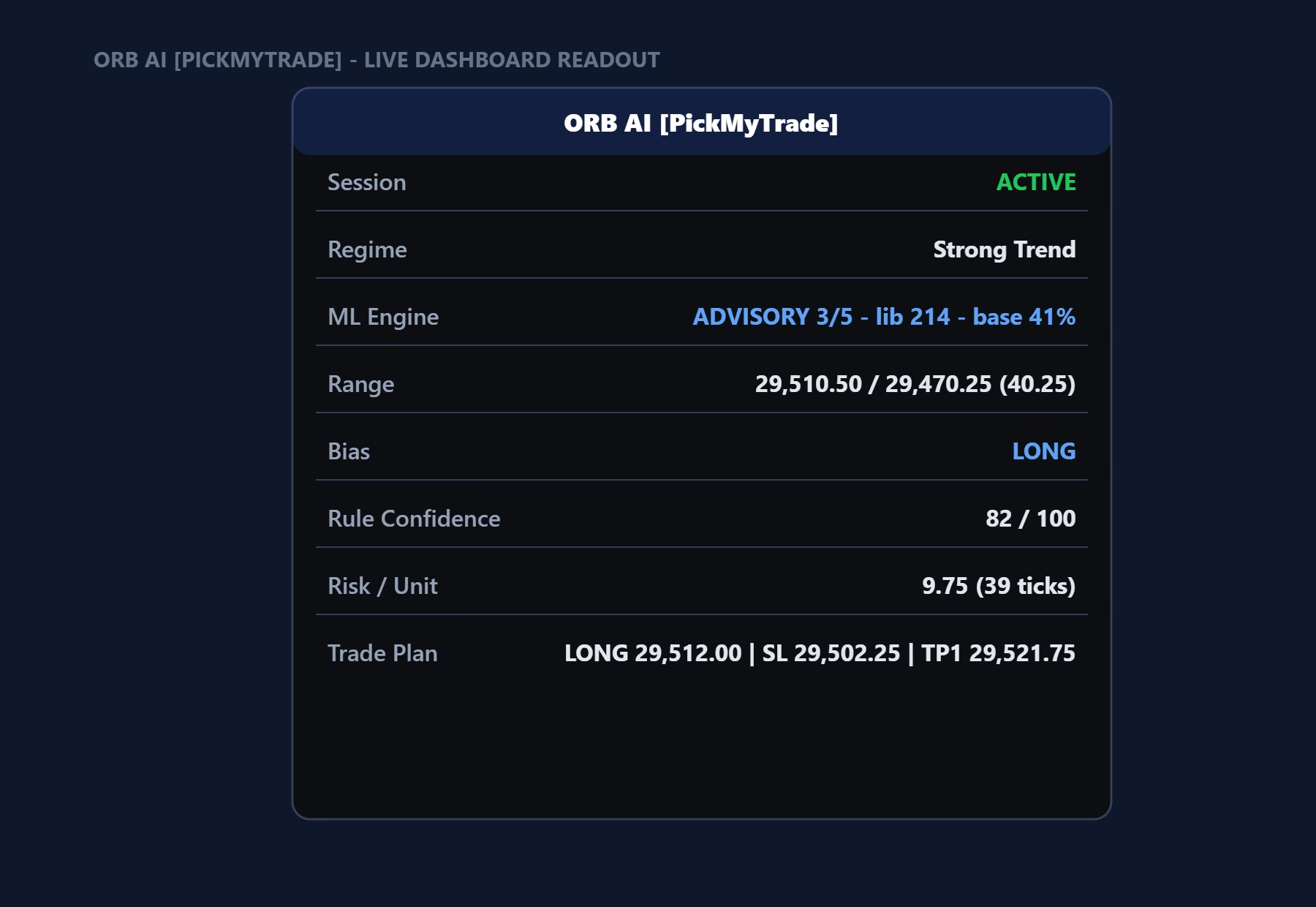
Long Zone / Short Zone shading — the opening range splits at its midpoint into two translucent boxes that extend live through the session, freezing at session close.
WATCH / ARMED labels — a text tag appears on the range boundary once a side’s confidence comes within 10 points of the effective threshold (WATCH), and again once it clears it (ARMED) — a live read on how close a breakout is to qualifying, without opening the input panel.
Flow marks — BO / RT / FBO / Sweep:
- BO tags the first confirmed close beyond the range
- RT ×N tags a retest of the broken level that holds, with a running counter
- FBO tags a breakout that closed back inside the range within the false-breakout window — a fakeout, not a loss judgment
- Sweep tags a wick that pierced an edge and closed back inside — liquidity taken without a directional close
The dashboard (Compact or Full, positionable in any corner) shows session state, detected regime, ML engine status (library size, base rate, live vote), the locked range, directional bias, the 7-factor rule confidence meter, risk-per-unit with a position-size readout, and the live trade plan — entry, stop, and TP1 in one line.
What Are the Take-Profit and Stop-Loss Options?
Stop-loss basis — four choices: ATR multiple from entry, the range midpoint, the opposite side of the range (widest), or the breakout candle’s own high/low (tightest).
Take-profit method — three choices:
- R Ladder — fixed multiples (TP1 = 1R always, TP2 and TP3 configurable, default 2R/3R)
- OR Width Projection — the classic measured-move approach, projecting 0.5×/1.0×/1.5× the opening range’s own width beyond the broken level
- Dynamic (EMA) — profits book when price closes back through the fast EMA while in profit, ATR-scaled so exits stretch on trend days and cut early when momentum fades
The ML engine always learns on the fixed 1R outcome regardless of which TP method is active on the chart, so the learning library stays consistent even if you’re trading a different exit style.
Adaptive stop — once TP1 is touched, the suggested stop can move to breakeven automatically (Adaptive SL), and same-bar TP+SL ambiguity resolves “stop first” by default — the conservative reading, and the same convention the KNN engine uses internally to label its own stored outcomes, so what the chart shows and what the model learns from always agree.
How Do You Use ORB AI to Trade?
A signal requires all of the following at once — dropping any one of them is why a visible range break on the chart doesn’t always produce a signal label:
- The range is locked and you’re inside the “no new signals after N minutes” window (default 150 minutes from the open).
- All hard filters pass — ATR%, relative volume, trend alignment (if enabled), VWAP position (if enabled as a gate rather than a score input), and the wide-range-OR filter (which stands aside when today’s range is unusually wide relative to its own history or ATR, since a wide range leaves poor reward-to-risk for continuation).
- Rule confidence clears the effective threshold — base threshold adjusted for risk mode (Aggressive/Normal/Conservative) and detected regime.
- Veto count stays within the mode’s tolerance — up to 4 independent vetoes (excessive wick, weakening momentum, extension from EMA, insufficient room to the next level) are checked per direction; Conservative mode tolerates zero, Normal tolerates one, Aggressive tolerates two.
- If Gate mode is on, the KNN vote clears the minimum share — ignored entirely in the default Advisory mode.
Read the dashboard’s Bias and Rule Confidence meter before every session, watch for WATCH → ARMED transitions near the range edges, and treat the KNN vote (once the library is past warm-up) as a sanity check against the rule score — not a replacement for it.
How Do You Automate ORB AI Signals with PickMyTrade?
Every qualified long or short signal fires a machine-readable payload through alert(), carrying entry, stop, all three take-profit levels, risk in ticks, the rule score, and — once the library is warmed up — the KNN vote, all as JSON. Combined with 19 alertcondition() triggers covering entries, false breakouts, retests, sweeps, take-profit and stop touches, session-end exits, and reversals, wiring any of them into a TradingView webhook alert routes straight into a live order.
Ready to turn regime-aware ORB signals into executed trades? Connect ORB AI to pickmytrade.trade for Tradovate futures. No manual order entry, no missed opens while you’re away from the desk.
What Are ORB AI’s Limitations?
The KNN library needs real time to grow. Roughly one resolved record is logged per breakout episode, not per bar — so warm-up is closer to “N trading sessions” than “N bars,” and a fast intraday timeframe fills the library sooner in wall-clock terms than a slow one, simply because more sessions’ worth of episodes accumulate per unit of chart history available.
Six-feature sparsity. As disclosed directly in the script’s own tooltips, the nearest neighbours of a few-hundred-record library cover roughly half of each feature’s range — read the KNN vote as a regional tendency, not a precise probabilistic forecast, and leave per-signal vote display off until the library is genuinely large (150+ records).
Requires volume data. The Volume factor and its downstream OBV/relative-volume scoring need a symbol with real volume reporting — stocks, futures, and major crypto pairs qualify; volume-less feeds (some cash indices, spot FX) will score that factor as neutral by design rather than fail outright.
Loading more history changes the vote, not the signal (in Advisory mode). Because the KNN library is instance-based and rebuilds from whatever chart history is loaded, the displayed vote can shift with more or less history loaded — the entry, stop, and target levels never do, since they come from the rule engine alone. This is inherent to on-chart learning and is disclosed rather than hidden, matching the same trade-off documented for PickMyTrade’s other KNN-based tools.
A realistic ORB win rate is 40–60%, by design. ORB AI improves which breakouts you take — it does not, and cannot, turn a reward-to-risk strategy into a high-accuracy one. Independent research on raw ORB signals puts win rates in that same 40–60% band even with confirmation filters applied (TradingStats.net); position sizing and independent risk management remain the trader’s responsibility, not something the dashboard’s Risk/Unit readout decides for you.
Key Settings
| Setting | What It Does |
|---|---|
| Opening Range (minutes) | Length of the range from the session anchor: 1/3 for gapper style, 5–30 for classic intraday ORB, 60/120 for swing |
| Session Anchor | Exchange Session, New York 09:30/08:30, London, Tokyo, or Custom |
| Entry Trigger | Close Confirmed (later, fewer fakeouts) vs. Intrabar Touch (earliest fill, stop-order style) |
| Min Rule Confidence | Base threshold for the 7-factor score before regime/mode adjustments |
| Risk Mode | Aggressive / Normal / Conservative — controls threshold offset and veto tolerance |
| Retests Required | Wait for N confirmed retests of the broken level before entering |
| KNN Mode | Advisory (default, never blocks) / Gate (opt-in filter) / Off |
| K Neighbors / History Length | Size of the KNN vote and the maximum library depth (up to 300 records) |
| Outcome Window (minutes) | How long a logged candidate has to resolve before being discarded as undecided |
| Stop-Loss Basis | ATR / ORB Midpoint / ORB Opposite Side / Breakout Candle |
| TP Method | R Ladder / OR Width Projection / Dynamic (EMA) |
| Max Signals Per Session | Hard cap on entries per session, for whipsaw days |
| Sweep-Reversal Signals | Off by default — opt-in fade-the-first-move entries on a liquidity sweep |
Full Pine Script Source
The complete v6 source for ORB AI [PickMyTrade], exactly as it runs on the chart. Copy it into Pine Editor, or add the indicator directly from the TradingView script page.
//@version=6
// ===============================================================
// ORB AI [PickMyTrade]
// Opening Range Breakout with a KNN (Lorentzian distance) engine
// that learns from the outcomes of this chart's own past breakouts.
//
// HOW THE ML WORKS (instance-based learning, 100% inside Pine):
// 1. Every rule-qualified breakout candidate gets a 6-feature
// fingerprint (trend, momentum, volume, volatility, structure,
// breakout quality — all trade-direction oriented).
// 2. Its outcome is measured forward: reached TP1 (1R) before the
// stop = win; stop first = loss; NEITHER within the outcome
// window = discarded as undecided (drifts must not deflate the
// base rate). Resolved bar-by-bar, stop checked first.
// 3. A new candidate is compared to the stored library with
// Lorentzian distance; the K nearest past breakouts vote.
// The vote share — the percentage of the closest past
// analogues that reached their target — is shown on the label.
// By DEFAULT this is advisory: it is displayed as context and
// never blocks a signal, so the set of signalling bars stays
// fully deterministic. Gate mode (opt-in) also filters on it.
// 4. ALL qualified candidates are recorded — accepted or not —
// so the library grows without selection bias and the engine
// never cold-start deadlocks.
//
// NON-REPAINTING: signals evaluate on confirmed closes only;
// locked range levels never change; HTF data reads closed bars
// ([1] + lookahead_off); pivots are used only after confirmation.
// The KNN library is built strictly from already-resolved past
// outcomes — no future data is ever read.
// Note: because the engine learns as history replays, loading a
// different amount of chart history can produce a different VOTE.
// In the default Advisory mode that only changes a displayed
// number — entries, stops and targets are unaffected. In Gate mode
// it can also change which candidates pass, so Gate mode trades
// some determinism for selectivity. This is inherent to on-chart
// learning and is disclosed rather than hidden.
// Sample-size honesty: with 6 features, the nearest neighbours of
// a few-hundred-record library span roughly half of each feature's
// range, so the vote is a coarse regional tendency, not a precise
// analogue match. It is read as context, which is why Advisory is
// the default and Gate is opt-in.
// Requires a symbol with volume data (stocks, futures, crypto) —
// volume-less feeds (some cash indices / spot FX) cannot render it.
//
// TP methods: fixed R ladder, classic OR-width measured-move
// projection, or EMA-dynamic trailing (ATR-scaled). Gap context
// (open vs previous close / PDH / PDL) feeds the structure score;
// a wide-range-OR filter stands aside when the range is too wide
// for breakout continuation to offer acceptable reward-to-risk.
//
// Recommended alert setting: "Once Per Bar Close".
// ===============================================================
indicator("ORB AI [PickMyTrade]", shorttitle = "ORB AI PMT", overlay = true, max_boxes_count = 200, max_labels_count = 300, max_lines_count = 100)
// ===============================================================
// INPUTS
// ===============================================================
var string G_ORB = "Opening Range"
var string G_SIG = "Signal Engine"
var string G_KNN = "KNN · ML Engine"
var string G_FILT = "Filters"
var string G_TREND = "Trend / Momentum"
var string G_RISK = "Risk Management"
var string G_DISP = "Display"
i_or_min = input.int (15, "Opening Range (minutes)", options = [1, 3, 5, 10, 15, 30, 60, 120], group = G_ORB, tooltip = "Length of the opening range, measured from the session anchor. 1/3 serve the 1-minute gapper style; 5-30 is the classic intraday ORB on a 1-15 minute chart. If the chart timeframe is coarser than this, the range automatically expands to one full chart bar and the dashboard notes the effective duration.")
i_anchor = input.string("New York 09:30", "Session Anchor", options = ["New York 09:30", "New York 08:30 (data)", "London 08:00", "Tokyo 09:00", "Exchange Session", "Custom"], group = G_ORB, tooltip = "Where the opening range starts. New York 09:30 (default): the classic US cash-market open, read in America/New_York time explicitly — correct on CME futures (whose exchange clock is Chicago) and immune to daylight-saving shifts. New York 08:30: the US economic-data release window. London 08:00 and Tokyo 09:00: those markets' cash opens in their own timezones. Exchange Session: the symbol's own regular session open (RTH for stocks, GLOBEX 18:00 ET for CME futures, daily rollover for crypto). Custom: the window below in the timezone below.")
i_custom_ses = input.session("0930-1600", "Custom Session", group = G_ORB, tooltip = "Only used when Session Anchor is Custom.")
i_custom_tz = input.string("America/New_York", "Custom Session Timezone", group = G_ORB, tooltip = "IANA timezone the Custom Session times are read in — e.g. America/New_York, Europe/London, Asia/Tokyo. Session strings without an explicit timezone are read in the EXCHANGE's timezone, which on CME futures is Chicago — the classic source of ranges anchored an hour off. An explicit zone also handles daylight-saving for you.")
i_late_min = input.int (150, "No New Signals After (min)", minval = 30, maxval = 720, group = G_ORB, tooltip = "No new signals after this many minutes from the session open — restricts entries to the earlier part of the session.")
i_trigger = input.string("Close Confirmed", "Entry Trigger", options = ["Close Confirmed", "Intrabar Touch"], group = G_SIG, tooltip = "Close Confirmed (default): a bar must CLOSE beyond the range — later entry, far fewer fakeouts. Intrabar Touch: the entry is modeled at the range level itself, stop-order style, on the first bar whose extreme crosses it — the earliest possible fill, disclosed honestly: the signal still finalises at that bar's close and still requires the bar to pass scoring, so a bar that pierces the level but scores badly does not signal (a real resting stop order would have filled anyway). Fakeout rate is higher by construction.")
i_thresh = input.int (70, "Min Rule Confidence", minval = 0, maxval = 100, group = G_SIG, tooltip = "Base threshold for the 7-factor rule score. The effective threshold also includes the regime and risk-mode adjustments (shown on the dashboard).")
i_mode = input.string("Normal", "Risk Mode", options = ["Aggressive", "Normal", "Conservative"], group = G_SIG, tooltip = "Aggressive: lower threshold, tolerates 2 soft warnings. Normal: base threshold, 1 warning. Conservative: higher threshold, zero warnings, and requires 2 consecutive closes beyond the range or a retest.")
i_retests = input.int (0, "Retests Required", minval = 0, maxval = 3, group = G_SIG, tooltip = "Entries wait for this many retests of the broken level (price wicks back to the level and closes beyond it). 0 = enter on the breakout close. Higher = fewer, later, cleaner entries.")
i_rearm = input.bool (true, "Re-Arm After False Breakout", group = G_SIG, tooltip = "ON = when a signal is tagged as a false breakout (close back inside the range), that direction may signal again later in the session.")
i_max_sigs = input.int (2, "Max Signals Per Session", minval = 1, maxval = 6, group = G_SIG, tooltip = "Hard cap on total entries per session — limits churn on whipsaw days where price breaks one side and then the other.")
i_fbo_min = input.int (40, "False-Breakout Window (minutes)", minval = 5, maxval = 240, group = G_SIG, tooltip = "A signal is tagged as a false breakout if price closes back inside the range within this long after entry (unless TP1 was already reached). Measured in MINUTES so the window means the same thing on every chart timeframe — a bar count would silently become an all-session window on 1-hour charts and tag almost every trade.")
i_sweep_rev = input.bool (false, "Sweep-Reversal Signals", group = G_SIG, tooltip = "OFF by default. Fade-the-first-move entries: when a wick sweeps beyond one range edge but the bar closes back inside (liquidity sweep), a REVERSAL signal in the opposite direction can fire on a confirmed close through the range midpoint within the false-breakout window. The stop for reversal entries is the sweep extreme. Scoring and filters still apply.")
i_first_only = input.bool (false, "First Break Direction Only", group = G_SIG, tooltip = "ON = once one side of the range has broken, the opposite direction — including Sweep-Reversal entries — is disabled for the rest of the session, by whichever side broke first. OFF = both directions stay available up to the session signal cap.")
i_ml_mode = input.string("Advisory", "KNN Mode", options = ["Advisory", "Gate", "Off"], group = G_KNN, tooltip = "Advisory (default): the KNN vote is measured and displayed on the signal label and dashboard, but never blocks a signal — so which bars signal is fully deterministic. Gate: the vote must also clear the minimum below for a signal to fire; this suppresses signals and is only worth enabling once the library is large (see Warm-Up tooltip). Off: no KNN at all.")
i_k = input.int (5, "K Neighbors", minval = 3, maxval = 15, group = G_KNN, tooltip = "Number of nearest historical analogues that vote on each new breakout.")
i_knn_len = input.int (300, "History Length", minval = 50, maxval = 500, group = G_KNN, tooltip = "Maximum resolved breakout outcomes stored in the learning library.")
i_conf_min = input.float(0.60, "Min ML Vote", minval = 0.5, maxval = 1.0, step = 0.05, group = G_KNN, tooltip = "Minimum fraction of the K neighbors that must be winners. Only enforced in Gate mode. Note the arithmetic: with K=5 this means at least 3 of 5 neighbors, which even an uninformative library would satisfy roughly 40-50% of the time — so treat Gate mode as a signal-frequency reducer, not a guarantee.")
i_out_min = input.int (150, "Outcome Window (minutes)", minval = 15, maxval = 600, group = G_KNN, tooltip = "How long a recorded breakout has to resolve. Reaches the 1R target first: recorded as a win. Hits the stop first: recorded as a loss. Touches NEITHER within this window: discarded as undecided — drifts are not counted as losses, so the library's base rate reflects only decisive breakouts. In MINUTES so the learning horizon is identical on every chart timeframe.")
i_warmup = input.int (30, "Warm-Up Outcomes", minval = 5, maxval = 200, group = G_KNN, tooltip = "Until the library holds this many resolved outcomes the vote is not shown, and labels read 'learning'. Sample-size honesty: the library gains roughly one row per breakout episode, so about one per trading day — warm-up therefore needs roughly that many sessions of chart history. Your plan's bar limit sets the ceiling: a 5-minute RTH chart holds around 256 sessions on Premium but a 1-minute chart holds only about 51 (and far fewer on lower plans), so on fast timeframes the library stays small. The dashboard always shows the current library size.")
i_gate_min = input.int (150, "Gate: Min Library", minval = 50, maxval = 500, group = G_KNN, tooltip = "Gate mode does not filter anything until the library reaches this size — below it, a K-of-5 vote from a sparse 6-dimensional library would remove signals without carrying real information, so the script keeps behaving as Advisory. Raise it if you want gating to be conservative; it cannot make gating start earlier than Warm-Up.")
i_show_vote = input.bool (false, "Show Analogue Votes On Signals", group = G_KNN, tooltip = "OFF (default): signal labels show the rule score; the library's aggregate statistics stay on the dashboard (size and base rate), where sample size makes them meaningful. ON: each signal label also shows how many of the K nearest past breakouts reached their target. A single vote of 5 neighbours moves ±20 points per neighbour, so per-signal votes are statistical context for a LARGE library (150+ records), not a per-trade prediction — leave this off until the library is big.")
i_f_trend = input.bool (true, "Trend Filter", group = G_FILT, tooltip = "Blocks longs when the directional trend score is below 35 (and shorts when above 65).")
i_f_vol = input.bool (true, "Volume Filter", group = G_FILT, tooltip = "Blocks signals when breakout-bar relative volume is below the minimum. Note: the indicator needs a symbol that provides volume data (stocks, futures, crypto).")
i_vol_min = input.float(0.8, "Min Relative Volume", minval = 0.1, step = 0.1, group = G_FILT)
i_f_atr = input.bool (true, "ATR Filter", group = G_FILT, tooltip = "Blocks signals when ATR as a percent of price is below the minimum — avoids dead, low-range conditions.")
i_atr_min = input.float(0.03, "Min ATR % of Price", minval = 0.0, step = 0.01, group = G_FILT)
i_f_wide = input.bool (true, "Wide-Range OR Filter", group = G_FILT, tooltip = "Blocks signals when the opening range is unusually wide (vs its 10-session average or vs ATR). A wide range leaves poor reward-to-risk for breakout continuation; the dashboard shows the filtered state.")
i_news_off = input.bool (false, "Stand Aside Today (news)", group = G_FILT, tooltip = "Manual kill-switch for FOMC/CPI/major-news days — blocks all new signals while ON. Levels, scores and the dashboard keep updating so you can still observe.")
i_f_vwap = input.bool (false, "VWAP Filter", group = G_FILT, tooltip = "ON = enforce the taught alignment rule as a hard gate: longs only when price is above session VWAP, shorts only below. OFF (default) = VWAP position stays a weighted part of the structure score instead of a veto. Ignored on symbols without volume data.")
i_blackout = input.session("0000-0000", "Signal Blackout Window", group = G_FILT, tooltip = "No new signals inside this window, read in the session anchor's timezone — e.g. 0955-1005 to stand aside around the 10:00 ET data releases. Leave 0000-0000 for no blackout.")
i_ema_fast = input.int (9, "EMA Fast", minval = 2, group = G_TREND)
i_ema_mid = input.int (21, "EMA Mid", minval = 2, group = G_TREND)
i_ema_slow = input.int (50, "EMA Slow", minval = 2, group = G_TREND)
i_htf = input.timeframe("60", "Higher Timeframe", group = G_TREND, tooltip = "Trend on this timeframe feeds the trend score. Read from CLOSED higher-timeframe bars only (no lookahead). Ignored if the chart timeframe is not below it.")
i_htf_ema = input.int (20, "Higher-TF EMA Length", minval = 2, group = G_TREND)
i_swing = input.int (5, "Swing Pivot Strength", minval = 2, maxval = 20, group = G_TREND, tooltip = "Bars each side to confirm a swing high/low. Confirmed pivots feed the structure score.")
i_sl_basis = input.string("ATR", "Stop-Loss Basis", options = ["ATR", "ORB Midpoint", "ORB Opposite Side", "Breakout Candle"], group = G_RISK, tooltip = "ATR: entry -/+ ATR multiple. ORB Midpoint: middle of the range. ORB Opposite Side: the far side of the range (widest). Breakout Candle: the low/high of the entry bar (tightest).")
i_sl_mult = input.float(1.5, "SL ATR Multiplier", minval = 0.5, maxval = 5.0, step = 0.25, group = G_RISK)
i_tp_method = input.string("R Ladder", "TP Method", options = ["R Ladder", "OR Width Projection", "Dynamic (EMA)"], group = G_RISK, tooltip = "R Ladder: targets at fixed R multiples. OR Width Projection: the classic measured move — targets at 0.5x / 1.0x / 1.5x the opening-range width beyond the broken level. Dynamic (EMA): profits are booked when price closes back through the fast EMA while in profit (ATR-scaled), so exits stretch on trend days and cut when momentum fades. The ML engine always learns on the fixed 1R outcome regardless of this setting.")
i_tp2_r = input.float(2.0, "TP2 (R multiple)", minval = 1.25, maxval = 10.0, step = 0.25, group = G_RISK, tooltip = "TP1 is always 1R (and is what the ML engine learns on). TP2 and TP3 are R-multiple extensions. Used by the R Ladder method.")
i_tp3_r = input.float(3.0, "TP3 (R multiple)", minval = 1.5, maxval = 15.0, step = 0.25, group = G_RISK)
i_adapt_sl = input.bool (true, "Adaptive SL (BE after TP1)", group = G_RISK, tooltip = "ON = after TP1 is touched, the suggested stop moves to the entry price (break-even).")
i_amb = input.string("Stop first", "Same-Bar TP+SL Resolution", options = ["Stop first", "Target first"], group = G_RISK, tooltip = "When one bar's range covers BOTH the target and the stop, bar data cannot tell you which came first. Stop first (default) assumes the adverse fill — the conservative reading, and the same convention the KNN engine uses to label its stored outcomes, so the chart and the learning agree. Target first assumes the favourable fill and will make results look better than they were.")
i_trail_len = input.int (10, "Trail Lookback (bars)", minval = 2, group = G_RISK)
i_trail_mult = input.float(3.0, "Trail ATR Multiplier", minval = 0.5, step = 0.25, group = G_RISK, tooltip = "Chandelier-style trailing suggestion plotted while a trade plan is active.")
i_acct = input.float(10000, "Account Size ($)", minval = 100, group = G_RISK, tooltip = "Used only for the dashboard position-size readout — nothing is traded.")
i_risk_pct = input.float(0.5, "Risk % Per Trade", minval = 0.05, maxval = 5.0, step = 0.05, group = G_RISK, tooltip = "The dashboard converts the current Risk/Unit into a suggested position size: floor(account x risk% / dollar-risk-per-unit). Futures use the contract point value; stocks and crypto use 1.")
i_dash_on = input.bool (true, "Show Dashboard", group = G_DISP)
i_dash_mode = input.string("Compact", "Dashboard Detail", options = ["Full", "Compact"], group = G_DISP, tooltip = "Compact (default) shows the 9 rows you actually trade from — session, regime, ML state, the range on one line, bias, confidence, risk and the live trade plan. Full adds the seven factor meters plus gap, threshold, trade quality, position size, plan-outcome counts and the active rule set. Compact is the default because the full table covers a large slice of a small chart.")
i_dash_pos = input.string("Top Right", "Dashboard Position", options = ["Top Right", "Top Left", "Bottom Right", "Bottom Left"], group = G_DISP)
i_dash_size = input.string("Small", "Dashboard Text Size", options = ["Small", "Normal"], group = G_DISP)
i_show_box = input.bool (true, "Shade Opening Range", group = G_DISP)
i_show_zone = input.bool (true, "Show Arming Labels", group = G_DISP, tooltip = "A small text tag on the ORB High/Low line reporting the live score once a side is close to firing: WATCH within 10 points of the effective threshold, ARMED at or above it. Nothing is shown while a side is inactive.")
i_show_pt = input.bool (false, "Show Range-Multiple Targets", group = G_DISP, tooltip = "The classic ORB measured-move levels: 50% and 100% of the range width projected beyond each edge. Reference targets for manual trade management, independent of the signal engine's TP ladder. OFF by default to keep the chart to the core range levels; when ON, the levels draw for the session window on roughly the last 25 sessions (older ones age out of the line budget).")
i_show_ptx = input.bool (false, "Extended Targets (150/200%)", group = G_DISP)
i_show_flow = input.bool (true, "Show Breakout/Retest Flow Marks", group = G_DISP, tooltip = "Marks the classic manual workflow: 'BO' where price first closed beyond the range, and 'RT xN' — a single counter that slides to the latest retest and shows how many times the broken level has been retested. A retest = price returns to the broken level and closes back beyond it; more retests usually means a level being defended. Context only — entry labels still require the full signal criteria.")
i_show_pm = input.bool (false, "Show Premarket High/Low", group = G_DISP, tooltip = "Premarket levels always feed the structure score automatically; enable this to also plot them. Requires extended-hours data on the chart.")
i_show_ema = input.bool (false, "Show EMAs", group = G_DISP)
i_show_vwap = input.bool (false, "Show Session VWAP", group = G_DISP)
i_bg_trend = input.bool (false, "Trend Background Tint", group = G_DISP, tooltip = "Off by default. It tints whole stretches of bars by trend direction, which duplicates the Trend score already shown on the dashboard and, on futures, layers on top of TradingView's own extended-hours shading. Enable it only if you prefer the trend read on the chart rather than in the panel.")
i_bg_sess = input.bool (true, "Opening-Range Window Tint", group = G_DISP)
i_zen = input.bool (false, "Zen Mode", group = G_DISP, tooltip = "Hide all visuals except the range levels and signal labels — clean look for screenshots.")
i_c_bull = input.color(color.new(#2962FF, 0), "Bull Colour", group = G_DISP, tooltip = "Applied to everything on the long side: the ORB high, the long breakout zone, long signals, take-profit levels and the bullish trend tint.")
i_c_bear = input.color(color.new(#FF6D00, 0), "Bear Colour", group = G_DISP, tooltip = "Applied to everything on the short side: the ORB low, the short breakout zone, short signals, the suggested stop and the bearish trend tint.")
i_c_range = input.color(color.new(color.gray, 0), "Neutral / Range", group = G_DISP, tooltip = "Applied to direction-neutral elements: the opening-range box and midpoint, premarket levels, the entry line and session-exit markers.")
// ===============================================================
// GUARDS & HELPERS
// ===============================================================
if barstate.isfirst and timeframe.isdwm
runtime.error("ORB AI [PickMyTrade] works on intraday chart timeframes only — an opening range cannot be measured from daily or higher bars.")
// If the chart timeframe is coarser than the selected duration, the range auto-expands to
// one full chart bar instead of erroring out to a blank chart — the dashboard notes it.
chartMins = math.ceil(timeframe.in_seconds() / 60.0)
effOrMin = math.max(i_or_min, chartMins)
// Time-based windows converted to this chart's bar count, so every duration in the script
// means the same wall-clock span on a 1-minute chart as on a 1-hour chart.
fboBars = math.max(1, math.round(i_fbo_min / chartMins))
outBars = math.max(2, math.round(i_out_min / chartMins))
f_clamp(x) => math.max(0.0, math.min(100.0, x))
// JSON-safe number for webhook payloads: an absent level must serialise as null, never
// as 0, so an automation consumer cannot mistake "no target" for a price of zero.
f_jnum(float v) => na(v) ? "null" : str.tostring(v, format.mintick)
// Stepwise quality of breakout distance in ATRs: rewards decisive-but-not-overextended closes.
f_distQ(d) => d <= 0 ? 0.0 : d < 0.1 ? 55.0 : d <= 0.8 ? 90.0 : d <= 1.5 ? 65.0 : 30.0
f_pos(p) => p == "Top Left" ? position.top_left : p == "Bottom Left" ? position.bottom_left : p == "Bottom Right" ? position.bottom_right : position.top_right
f_meter(sc) =>
int blocks = math.round(f_clamp(nz(sc, 0.0)) / 10)
string m = ""
for i = 1 to 10
m := m + (i <= blocks ? "█" : "░")
m
// ===============================================================
// BASE CALCULATIONS (all computed every bar)
// ===============================================================
atr = ta.atr(14)
atrAvg = ta.sma(atr, 20)
atrRatio = na(atrAvg) or atrAvg == 0 ? 1.0 : atr / atrAvg
atrPct = close > 0 ? atr / close * 100 : 0.0
emaFastV = ta.ema(close, i_ema_fast)
emaMidV = ta.ema(close, i_ema_mid)
emaSlowV = ta.ema(close, i_ema_slow)
[diP, diM, adxV] = ta.dmi(14, 14)
rsiV = ta.rsi(close, 14)
[macdL, sigL, histL] = ta.macd(close, 12, 26, 9)
volSma = ta.sma(volume, 20)
hasVol = not na(volSma) and volSma > 0
relVolRaw = hasVol ? volume / volSma : 1.0
volPrRaw = ta.percentrank(volume, 20)
obvV = ta.obv
obvEma = ta.ema(obvV, 20)
vwapV = ta.vwap
bbBasis = ta.sma(close, 20)
bbSd = ta.stdev(close, 20)
bbw = na(bbBasis) or bbBasis == 0 ? 0.0 : 4 * bbSd / bbBasis
bbwAvg = ta.sma(bbw, 20)
barRange = high - low
rangeAvg = ta.sma(barRange, 20)
chopSumTr = math.sum(ta.tr(true), 14)
chopHH = ta.highest(high, 14)
chopLL = ta.lowest(low, 14)
chopV = na(chopHH) or chopHH - chopLL <= 0 ? 50.0 : 100 * math.log10(chopSumTr / (chopHH - chopLL)) / math.log10(14)
// Higher-timeframe trend: closed HTF bars only ([1] + lookahead_off = non-repainting).
htfOk = timeframe.in_seconds() < timeframe.in_seconds(i_htf)
[htfCloseV, htfEmaV] = request.security(syminfo.tickerid, i_htf, [close[1], ta.ema(close, i_htf_ema)[1]], lookahead = barmerge.lookahead_off)
htfBull = htfOk and not na(htfCloseV) and not na(htfEmaV) and htfCloseV > htfEmaV
htfBear = htfOk and not na(htfCloseV) and not na(htfEmaV) and htfCloseV < htfEmaV
// Confirmed swing pivots (acted on only after i_swing bars — no repaint).
phV = ta.pivothigh(high, i_swing, i_swing)
plV = ta.pivotlow(low, i_swing, i_swing)
var float lastPH = na
var float lastPL = na
if not na(phV)
lastPH := phV
if not na(plV)
lastPL := plV
// Previous-day high/low tracked locally (no security call needed).
dayChange = timeframe.change("D")
var float pdh = na
var float pdl = na
var float dHi = na
var float dLo = na
if dayChange
pdh := dHi
pdl := dLo
dHi := high
dLo := low
else
dHi := na(dHi) ? high : math.max(dHi, high)
dLo := na(dLo) ? low : math.min(dLo, low)
// Premarket high/low (extended-hours charts only; na on RTH-only feeds — harmless).
var float pmHi = na
var float pmLo = na
if dayChange
pmHi := na
pmLo := na
if session.ispremarket
pmHi := na(pmHi) ? high : math.max(pmHi, high)
pmLo := na(pmLo) ? low : math.min(pmLo, low)
// ===============================================================
// OPENING RANGE STATE MACHINE
// ===============================================================
// All session tests run unconditionally every bar; the anchor mode just selects one.
// Every preset window carries an explicit IANA timezone — session strings without one are
// read in the exchange's clock (Chicago on CME), which anchors a "0930" range at 10:30 ET.
inNYSess = not na(time(timeframe.period, "0930-1600", "America/New_York"))
inNYDataSess = not na(time(timeframe.period, "0830-1600", "America/New_York"))
inLdnSess = not na(time(timeframe.period, "0800-1630", "Europe/London"))
inTokSess = not na(time(timeframe.period, "0900-1530", "Asia/Tokyo"))
inCustSess = not na(time(timeframe.period, i_custom_ses, i_custom_tz))
inAnchorSess = i_anchor == "New York 09:30" ? inNYSess : i_anchor == "New York 08:30 (data)" ? inNYDataSess : i_anchor == "London 08:00" ? inLdnSess : i_anchor == "Tokyo 09:00" ? inTokSess : i_anchor == "Custom" ? inCustSess : false
// A new session starts either by ENTERING the window (24-hour feeds: futures, crypto,
// extended-hours charts) or by the anchor-timezone DATE rolling over. The second edge is
// essential: on a regular-hours stock chart every bar already sits inside 09:30-16:00, so
// the enter-the-window edge never occurs and the range would never form at all.
// A custom window that crosses midnight (start > end, e.g. 1800-0300) must not be split by
// the date rollover — such windows always leave out-of-session bars, so the first edge
// already covers them.
// Exchange Session anchors to the SYMBOL's own clock, so every other time window read in
// the anchor's timezone (the blackout below) must follow it there — falling through to New
// York would read a blackout typed in exchange time an hour or more off on any non-US feed.
tzAnchor = i_anchor == "Custom" ? i_custom_tz : i_anchor == "London 08:00" ? "Europe/London" : i_anchor == "Tokyo 09:00" ? "Asia/Tokyo" : i_anchor == "Exchange Session" ? syminfo.timezone : "America/New_York"
newAnchorDay = dayofmonth(time, tzAnchor) != dayofmonth(nz(time[1], time), tzAnchor)
custCrossMid = i_anchor == "Custom" and str.length(i_custom_ses) >= 9 and nz(str.tonumber(str.substring(i_custom_ses, 0, 4)), 0) > nz(str.tonumber(str.substring(i_custom_ses, 5, 9)), 0)
sessFirstBar = i_anchor == "Exchange Session" ? session.isfirstbar_regular : inAnchorSess and (not inAnchorSess[1] or (newAnchorDay and not custCrossMid))
// Session-anchored gap context, measured at whatever session anchor the ORB itself uses.
// Under the default New York anchor this is the 09:30 ET gap vs the previous NY session's
// last close — on stocks AND on CME futures alike. Under Exchange Session on futures the
// anchor is the Globex open, where the measured gap is naturally near zero.
inSessNow = i_anchor == "Exchange Session" ? session.ismarket : inAnchorSess
var float sessOpen = na
var float prevSessClose = na
var float lastSessClose = na
if sessFirstBar
prevSessClose := lastSessClose
sessOpen := open
if inSessNow
lastSessClose := close
var float orbHigh = na
var float orbLow = na
var int sessStartTime = na
var int orbEndBar = na
var bool orbLocked = false
var bool longUsed = false
var bool shortUsed = false
var int sigCount = 0
// All-history outcome counters for the dashboard — factual event counts, no P&L claims.
var int planCount = 0
var int tp1Count = 0
var int fboCount = 0
var bool longBrokeOnce = false
var bool shortBrokeOnce = false
var int longRetests = 0
var int shortRetests = 0
var bool longInRetest = false
var bool shortInRetest = false
var bool sweptHigh = false
var bool sweptLow = false
var float sweepHiPx = na
var float sweepLoPx = na
var int sweepHiBar = na
var int sweepLoBar = na
var int longFirstBreakBar = na
var int shortFirstBreakBar = na
// True when the active plan was filled by an Intrabar Touch whose bar closed back INSIDE
// the range — the canonical touch-mode fakeout, which the close[1]-based FBO test misses.
var bool longTouchInside = false
var bool shortTouchInside = false
var int longSigBar = na
var int shortSigBar = na
var box orBoxCur = na
var box orBoxBot = na
var label orBoxTopLbl = na
var label orBoxBotLbl = na
var float[] orWidthHist = array.new_float()
// Active trade-plan state (display + management only — ML learns from its own queue).
var int activeDir = 0
var int tradeStartBar = na
var float entryPx = na
var float slDynPx = na
var float tp1Px = na
var float tp2Px = na
var float tp3Px = na
var bool tp1Hit = false
var bool tp2Hit = false
var bool tp3Hit = false
orMs = effOrMin * 60 * 1000
// A plan still open at the session rollover is formally closed (Flux-style session exit)
// so the alert stream never silently loses a trade.
bool sessExitEvt = false
if sessFirstBar
sessExitEvt := activeDir != 0
sessStartTime := time
orbHigh := high
orbLow := low
orbLocked := false
orbEndBar := na
longUsed := false
shortUsed := false
sigCount := 0
longBrokeOnce := false
shortBrokeOnce := false
longRetests := 0
shortRetests := 0
longInRetest := false
shortInRetest := false
sweptHigh := false
sweptLow := false
sweepHiPx := na
sweepLoPx := na
sweepHiBar := na
sweepLoBar := na
longTouchInside := false
shortTouchInside := false
longFirstBreakBar := na
shortFirstBreakBar := na
longSigBar := na
shortSigBar := na
activeDir := 0
tradeStartBar := na
tp1Hit := false
tp2Hit := false
tp3Hit := false
inOR = not na(sessStartTime) and not orbLocked and time - sessStartTime < orMs
if inOR and not sessFirstBar
orbHigh := math.max(orbHigh, high)
orbLow := math.min(orbLow, low)
lockNow = not orbLocked and not na(sessStartTime) and time - sessStartTime >= orMs and not na(orbHigh)
if lockNow
orbLocked := true
orbEndBar := bar_index
array.push(orWidthHist, orbHigh - orbLow)
if array.size(orWidthHist) > 10
array.shift(orWidthHist)
if i_show_box and not i_zen
float _mid = (orbHigh + orbLow) / 2
orBoxCur := box.new(
left = sessStartTime,
top = orbHigh,
right = time,
bottom = _mid,
xloc = xloc.bar_time,
border_color = color.new(i_c_bull, 30),
border_width = 1,
bgcolor = color.new(i_c_bull, 83))
orBoxBot := box.new(
left = sessStartTime,
top = _mid,
right = time,
bottom = orbLow,
xloc = xloc.bar_time,
border_color = color.new(i_c_bear, 30),
border_width = 1,
bgcolor = color.new(i_c_bear, 83))
label.delete(orBoxTopLbl)
label.delete(orBoxBotLbl)
orBoxTopLbl := label.new(bar_index, (orbHigh + _mid) / 2,
"▲ Long Zone · " + str.tostring(orbHigh, format.mintick),
xloc=xloc.bar_index, style=label.style_label_right,
color=color.new(i_c_bull, 75), textcolor=color.new(color.white, 0),
size=size.small)
orBoxBotLbl := label.new(bar_index, (_mid + orbLow) / 2,
"▼ Short Zone · " + str.tostring(orbLow, format.mintick),
xloc=xloc.bar_index, style=label.style_label_right,
color=color.new(i_c_bear, 75), textcolor=color.new(color.white, 0),
size=size.small)
orbMid = orbLocked ? (orbHigh + orbLow) / 2 : na
orbWidth = orbLocked ? orbHigh - orbLow : na
minsFromOpen = na(sessStartTime) ? na : (time - sessStartTime) / 60000.0
lateBlock = not na(minsFromOpen) and minsFromOpen > i_late_min
barsFromLock = orbLocked and not na(orbEndBar) ? bar_index - orbEndBar : 0
avgORW = array.size(orWidthHist) >= 3 ? array.avg(orWidthHist) : na
isBreakoutDay = orbLocked and not na(avgORW) and avgORW > 0 and orbWidth < 0.65 * avgORW
wideOR = orbLocked and ((not na(avgORW) and avgORW > 0 and orbWidth > 1.75 * avgORW) or (atr > 0 and orbWidth > 2.5 * atr))
// Session-scoped breakout micro-state (sweeps, first breaks, retest counting, consecutive closes).
// The sweep extreme and bar are captured for the optional sweep-reversal entries: the
// extreme becomes the reversal stop, the bar starts the reversal arming window.
if orbLocked and high > orbHigh and close <= orbHigh and not sweptHigh
sweptHigh := true
sweepHiPx := high
sweepHiBar := bar_index
if orbLocked and low < orbLow and close >= orbLow and not sweptLow
sweptLow := true
sweepLoPx := low
sweepLoBar := bar_index
if orbLocked and close > orbHigh and not longBrokeOnce
longBrokeOnce := true
longFirstBreakBar := bar_index
if orbLocked and close < orbLow and not shortBrokeOnce
shortBrokeOnce := true
shortFirstBreakBar := bar_index
// One increment per retest EPISODE, not per qualifying bar. The latch clears only once
// price has left the tolerance band again, so a pullback that hovers at the broken level
// for several bars counts once — otherwise "Retests Required" would be satisfied by a
// single slow pullback and the retest alert would repeat every bar.
if longInRetest and (na(atr) or na(orbHigh) or low > orbHigh + 0.1 * atr)
longInRetest := false
if shortInRetest and (na(atr) or na(orbLow) or high < orbLow - 0.1 * atr)
shortInRetest := false
if not longInRetest and longBrokeOnce and not na(longFirstBreakBar) and bar_index > longFirstBreakBar and close > orbHigh and low <= orbHigh + 0.1 * atr
longRetests := longRetests + 1
longInRetest := true
if not shortInRetest and shortBrokeOnce and not na(shortFirstBreakBar) and bar_index > shortFirstBreakBar and close < orbLow and high >= orbLow - 0.1 * atr
shortRetests := shortRetests + 1
shortInRetest := true
longRetestOK = longRetests >= 1
shortRetestOK = shortRetests >= 1
var int longConsec = 0
var int shortConsec = 0
longConsec := orbLocked and close > orbHigh ? longConsec + 1 : 0
shortConsec := orbLocked and close < orbLow ? shortConsec + 1 : 0
// ===============================================================
// 7-FACTOR RULE SCORES (0-100)
// ===============================================================
alignBull = emaFastV > emaMidV and emaMidV > emaSlowV
alignBear = emaFastV < emaMidV and emaMidV < emaSlowV
alignS = alignBull ? 100.0 : alignBear ? 0.0 : 50.0
adxStr = math.min(100.0, nz(adxV, 0.0) * 2.2)
adxS = 50.0 + (nz(diP, 0.0) >= nz(diM, 0.0) ? 1.0 : -1.0) * adxStr / 2.0
htfS = htfBull ? 100.0 : htfBear ? 0.0 : 50.0
slopeNorm = atr > 0 ? (emaFastV - nz(emaFastV[3], emaFastV)) / atr : 0.0
slopeS = f_clamp(50.0 + slopeNorm * 60.0)
trendScore = 0.35 * alignS + 0.25 * adxS + 0.25 * htfS + 0.15 * slopeS
rsiAccel = rsiV - nz(rsiV[3], rsiV)
rsiS = f_clamp(50.0 + (nz(rsiV, 50.0) - 50.0) * 1.1 + rsiAccel * 2.0)
histNorm = atr > 0 ? nz(histL, 0.0) / atr : 0.0
histExpand = math.abs(nz(histL, 0.0)) > math.abs(nz(histL[1], 0.0))
histS = f_clamp(50.0 + histNorm * 100.0 + (histExpand ? (nz(histL, 0.0) > 0 ? 10.0 : -10.0) : 0.0))
rocNorm = atr > 0 ? (close - nz(close[10], close)) / atr : 0.0
rocS = f_clamp(50.0 + rocNorm * 15.0)
bodyNorm = atr > 0 ? (close - open) / atr : 0.0
bodyS = f_clamp(50.0 + bodyNorm * 35.0)
momScore = 0.3 * rsiS + 0.3 * histS + 0.2 * rocS + 0.2 * bodyS
relVolS = f_clamp((relVolRaw - 0.5) * 66.7)
volSpike = relVolRaw >= 1.5
volPrS = hasVol ? nz(volPrRaw, 50.0) : 50.0
volBase = 0.45 * relVolS + 0.35 * volPrS + 0.2 * (volSpike ? 100.0 : 40.0)
obvBull = hasVol and not na(obvEma) and obvV > obvEma
obvBear = hasVol and not na(obvEma) and obvV < obvEma
volLongS = hasVol ? f_clamp(0.8 * volBase + 0.2 * (obvBull ? 90.0 : 25.0)) : 50.0
volShortS = hasVol ? f_clamp(0.8 * volBase + 0.2 * (obvBear ? 90.0 : 25.0)) : 50.0
atrExpS = f_clamp((atrRatio - 0.6) * 100.0)
bbwExpS = na(bbwAvg) or bbwAvg == 0 ? 50.0 : f_clamp((bbw / bbwAvg - 0.6) * 100.0)
rngExpS = na(rangeAvg) or rangeAvg == 0 ? 50.0 : f_clamp((barRange / rangeAvg - 0.5) * 66.7)
volatScore = 0.4 * atrExpS + 0.3 * bbwExpS + 0.3 * rngExpS
vwapLongS = hasVol and not na(vwapV) ? (close > vwapV ? 75.0 : 25.0) : 50.0
vwapShortS = hasVol and not na(vwapV) ? (close < vwapV ? 75.0 : 25.0) : 50.0
float resAbove = na
if not na(pdh) and pdh > close
resAbove := pdh
if not na(lastPH) and lastPH > close and (na(resAbove) or lastPH < resAbove)
resAbove := lastPH
if not na(pmHi) and pmHi > close and (na(resAbove) or pmHi < resAbove)
resAbove := pmHi
float supBelow = na
if not na(pdl) and pdl < close
supBelow := pdl
if not na(lastPL) and lastPL < close and (na(supBelow) or lastPL > supBelow)
supBelow := lastPL
if not na(pmLo) and pmLo < close and (na(supBelow) or pmLo > supBelow)
supBelow := pmLo
roomLongAtr = na(resAbove) or atr <= 0 ? na : (resAbove - close) / atr
roomShortAtr = na(supBelow) or atr <= 0 ? na : (close - supBelow) / atr
roomLongS = na(roomLongAtr) ? 90.0 : roomLongAtr >= 1.5 ? 85.0 : roomLongAtr >= 0.8 ? 65.0 : roomLongAtr >= 0.4 ? 45.0 : 25.0
roomShortS = na(roomShortAtr) ? 90.0 : roomShortAtr >= 1.5 ? 85.0 : roomShortAtr >= 0.8 ? 65.0 : roomShortAtr >= 0.4 ? 45.0 : 25.0
aboveSwingS = not na(lastPH) and close > lastPH ? 85.0 : 40.0
belowSwingS = not na(lastPL) and close < lastPL ? 85.0 : 40.0
// Gap context: gap-and-go alignment (open beyond the previous day's extreme) strengthens
// the breakout side; a strong gap against the trade direction weakens it.
gapAtr = na(prevSessClose) or na(sessOpen) or atr <= 0 ? 0.0 : (sessOpen - prevSessClose) / atr
openAbovePDH = not na(pdh) and not na(sessOpen) and sessOpen > pdh
openBelowPDL = not na(pdl) and not na(sessOpen) and sessOpen < pdl
gapLongS = openAbovePDH ? 90.0 : gapAtr >= 0.3 ? 70.0 : gapAtr <= -0.3 ? 25.0 : 50.0
gapShortS = openBelowPDL ? 90.0 : gapAtr <= -0.3 ? 70.0 : gapAtr >= 0.3 ? 25.0 : 50.0
structLongS = 0.30 * vwapLongS + 0.40 * roomLongS + 0.15 * aboveSwingS + 0.15 * gapLongS
structShortS = 0.30 * vwapShortS + 0.40 * roomShortS + 0.15 * belowSwingS + 0.15 * gapShortS
bodyRatio = barRange > 0 ? math.abs(close - open) / barRange : 0.0
bodyRatioS = f_clamp(bodyRatio * 125.0)
// Scored in minutes since the range locked, not bars, so "a fast breakout" means the same
// elapsed time regardless of chart timeframe.
minsFromLock = barsFromLock * chartMins
speedS = minsFromLock <= 15 ? 90.0 : minsFromLock <= 50 ? 75.0 : minsFromLock <= 100 ? 55.0 : 35.0
distLongS = atr > 0 and orbLocked ? f_distQ((close - orbHigh) / atr) : 0.0
distShortS = atr > 0 and orbLocked ? f_distQ((orbLow - close) / atr) : 0.0
consecLS = longConsec >= 3 ? 90.0 : longConsec == 2 ? 75.0 : longConsec == 1 ? 55.0 : 0.0
consecSS = shortConsec >= 3 ? 90.0 : shortConsec == 2 ? 75.0 : shortConsec == 1 ? 55.0 : 0.0
qualLongS = orbLocked and close > orbHigh ? f_clamp(0.25 * distLongS + 0.25 * bodyRatioS + 0.20 * consecLS + 0.15 * speedS + 0.15 * (longRetestOK ? 90.0 : 45.0)) : 50.0
qualShortS = orbLocked and close < orbLow ? f_clamp(0.25 * distShortS + 0.25 * bodyRatioS + 0.20 * consecSS + 0.15 * speedS + 0.15 * (shortRetestOK ? 90.0 : 45.0)) : 50.0
hh20 = ta.highest(high, 20)
ll20 = ta.lowest(low, 20)
eqHighs = not na(pdh) and atr > 0 and math.abs(hh20 - pdh) <= 0.15 * atr
eqLows = not na(pdl) and atr > 0 and math.abs(ll20 - pdl) <= 0.15 * atr
liqLongS = f_clamp(50.0 + (sweptLow ? 25.0 : 0.0) + (eqHighs ? 10.0 : 0.0) - (sweptHigh ? 12.0 : 0.0))
liqShortS = f_clamp(50.0 + (sweptHigh ? 25.0 : 0.0) + (eqLows ? 10.0 : 0.0) - (sweptLow ? 12.0 : 0.0))
// ===============================================================
// MARKET REGIME → adaptive weights & threshold
// ===============================================================
string regime = "Range"
if nz(adxV, 0.0) >= 32 and atrRatio >= 1.05
regime := "Strong Trend"
else if nz(adxV, 0.0) >= 25
regime := "Trending"
else if chopV >= 61.8
regime := "Choppy"
else if atrRatio >= 1.35
regime := "High Volatility"
else if atrRatio <= 0.7
regime := "Low Volatility"
else if nz(adxV, 0.0) >= 18
regime := "Weak Trend"
regimeAdj = switch regime
"Strong Trend" => -6.0
"Trending" => -3.0
"Weak Trend" => 2.0
"Range" => 4.0
"Choppy" => 8.0
"High Volatility" => 3.0
"Low Volatility" => 5.0
=> 0.0
if isBreakoutDay
regimeAdj := regimeAdj - 4.0
float wT = 0.20
float wM = 0.18
float wVm = 0.15
float wVt = 0.10
float wS = 0.12
float wQ = 0.15
float wL = 0.10
if regime == "Strong Trend" or regime == "Trending"
wT := wT + 0.06
wQ := wQ - 0.03
wL := wL - 0.03
if regime == "Range" or regime == "Choppy"
wT := wT - 0.06
wQ := wQ + 0.04
wL := wL + 0.02
wSum = wT + wM + wVm + wVt + wS + wQ + wL
modeAdj = i_mode == "Aggressive" ? -8.0 : i_mode == "Conservative" ? 7.0 : 0.0
maxVetoes = i_mode == "Aggressive" ? 2 : i_mode == "Normal" ? 1 : 0
effThresh = f_clamp(i_thresh + modeAdj + regimeAdj)
confLong = f_clamp((wT * trendScore + wM * momScore + wVm * volLongS + wVt * volatScore + wS * structLongS + wQ * qualLongS + wL * liqLongS) / wSum)
confShort = f_clamp((wT * (100.0 - trendScore) + wM * (100.0 - momScore) + wVm * volShortS + wVt * volatScore + wS * structShortS + wQ * qualShortS + wL * liqShortS) / wSum)
// ===============================================================
// VETOES & HARD FILTERS
// ===============================================================
upWickRatio = barRange > 0 ? (high - math.max(close, open)) / barRange : 0.0
dnWickRatio = barRange > 0 ? (math.min(close, open) - low) / barRange : 0.0
vetoLongWick = upWickRatio > 0.55
vetoLongMom = nz(histL, 0.0) < nz(histL[1], 0.0) and nz(histL[1], 0.0) < nz(histL[2], 0.0)
vetoLongExt = atr > 0 and (close - emaFastV) / atr > 2.5
vetoLongRes = not na(resAbove) and atr > 0 and resAbove - close < 0.5 * atr
longVetoCount = (vetoLongWick ? 1 : 0) + (vetoLongMom ? 1 : 0) + (vetoLongExt ? 1 : 0) + (vetoLongRes ? 1 : 0)
vetoShortWick = dnWickRatio > 0.55
vetoShortMom = nz(histL, 0.0) > nz(histL[1], 0.0) and nz(histL[1], 0.0) > nz(histL[2], 0.0)
vetoShortExt = atr > 0 and (emaFastV - close) / atr > 2.5
vetoShortSup = not na(supBelow) and atr > 0 and close - supBelow < 0.5 * atr
shortVetoCount = (vetoShortWick ? 1 : 0) + (vetoShortMom ? 1 : 0) + (vetoShortExt ? 1 : 0) + (vetoShortSup ? 1 : 0)
hardBlockAtr = i_f_atr and atrPct < i_atr_min
hardBlockVol = i_f_vol and hasVol and relVolRaw < i_vol_min
hardBlockTrndL = i_f_trend and trendScore < 35
hardBlockTrndS = i_f_trend and trendScore > 65
hardBlockVwapL = i_f_vwap and hasVol and not na(vwapV) and close < vwapV
hardBlockVwapS = i_f_vwap and hasVol and not na(vwapV) and close > vwapV
// ===============================================================
// KNN · LORENTZIAN ML ENGINE
// Library: resolved outcomes of past qualified breakouts.
// Pending: candidates waiting for their outcome (TP1 vs SL),
// resolved bar-by-bar with the stop checked first (conservative).
// ===============================================================
var float[] h_f1 = array.new_float(0)
var float[] h_f2 = array.new_float(0)
var float[] h_f3 = array.new_float(0)
var float[] h_f4 = array.new_float(0)
var float[] h_f5 = array.new_float(0)
var float[] h_f6 = array.new_float(0)
var int[] h_lbl = array.new_int(0)
var int[] p_dir = array.new_int(0)
var int[] p_bar = array.new_int(0)
var float[] p_tp = array.new_float(0)
var float[] p_sl = array.new_float(0)
var float[] p_f1 = array.new_float(0)
var float[] p_f2 = array.new_float(0)
var float[] p_f3 = array.new_float(0)
var float[] p_f4 = array.new_float(0)
var float[] p_f5 = array.new_float(0)
var float[] p_f6 = array.new_float(0)
// Resolve pending candidates against this bar (before any new candidate is added).
// Note: Pine's `by` step is always a positive magnitude — direction (here, descending,
// since we remove-while-iterating) is inferred automatically from start > end.
if array.size(p_bar) > 0
for i = array.size(p_bar) - 1 to 0 by 1
pDir = array.get(p_dir, i)
pTp = array.get(p_tp, i)
pSl = array.get(p_sl, i)
pBar = array.get(p_bar, i)
int lbl = -1
bool drop = false
if bar_index > pBar
hitSL = pDir == 1 ? low <= pSl : high >= pSl
hitTP = pDir == 1 ? high >= pTp : low <= pTp
if hitSL
lbl := 0
else if hitTP
lbl := 1
else if bar_index - pBar >= outBars
// Timed out with NEITHER level touched: genuinely undecided. Discarded,
// not counted as a loss — counting drifts as losses deflated the library
// base rate and made every displayed vote read far more bearish than the
// decisive evidence supports. Only target-or-stop resolutions teach.
drop := true
if lbl >= 0
array.push(h_f1, array.get(p_f1, i))
array.push(h_f2, array.get(p_f2, i))
array.push(h_f3, array.get(p_f3, i))
array.push(h_f4, array.get(p_f4, i))
array.push(h_f5, array.get(p_f5, i))
array.push(h_f6, array.get(p_f6, i))
array.push(h_lbl, lbl)
if array.size(h_lbl) > i_knn_len
array.shift(h_f1)
array.shift(h_f2)
array.shift(h_f3)
array.shift(h_f4)
array.shift(h_f5)
array.shift(h_f6)
array.shift(h_lbl)
if lbl >= 0 or drop
array.remove(p_dir, i)
array.remove(p_bar, i)
array.remove(p_tp, i)
array.remove(p_sl, i)
array.remove(p_f1, i)
array.remove(p_f2, i)
array.remove(p_f3, i)
array.remove(p_f4, i)
array.remove(p_f5, i)
array.remove(p_f6, i)
// Lorentzian distance over the 6-feature fingerprint.
f_lor(a1, a2, b1, b2, c1, c2, d1, d2, e1, e2, g1, g2) => math.log(1.0 + math.abs(a1 - a2)) + math.log(1.0 + math.abs(b1 - b2)) + math.log(1.0 + math.abs(c1 - c2)) + math.log(1.0 + math.abs(d1 - d2)) + math.log(1.0 + math.abs(e1 - e2)) + math.log(1.0 + math.abs(g1 - g2))
// Vote of the K nearest resolved breakouts to the given fingerprint.
f_knn(q1, q2, q3, q4, q5, q6) =>
n = array.size(h_lbl)
if n < i_k
0.0
else
tmp_d = array.new_float(0)
tmp_l = array.copy(h_lbl)
for j = 0 to n - 1
d = f_lor(q1, array.get(h_f1, j), q2, array.get(h_f2, j), q3, array.get(h_f3, j), q4, array.get(h_f4, j), q5, array.get(h_f5, j), q6, array.get(h_f6, j))
array.push(tmp_d, d)
int wins = 0
int total = 0
kUse = math.min(i_k, n)
for _ = 1 to kUse
int minI = 0
float minV = array.get(tmp_d, 0)
if array.size(tmp_d) > 1
for j = 1 to array.size(tmp_d) - 1
if array.get(tmp_d, j) < minV
minV := array.get(tmp_d, j)
minI := j
wins := wins + array.get(tmp_l, minI)
total := total + 1
array.remove(tmp_d, minI)
array.remove(tmp_l, minI)
total > 0 ? wins * 1.0 / total : 0.0
mlLib = array.size(h_lbl)
// Library base rate, computed globally: a vote only means something RELATIVE to this.
// With a base of ~35%, "2/5 analogues" is neutral, not bearish — so every place the vote
// is shown, the base is shown beside it.
basePctG = mlLib > 0 ? math.round(array.sum(h_lbl) * 100.0 / mlLib) : 0
mlOn = i_ml_mode != "Off"
mlGate = i_ml_mode == "Gate"
mlReady = mlOn and mlLib >= math.max(i_k, i_warmup)
// Gating needs a far larger library than display does: a 5-of-K vote drawn from a small
// 6-D library would cull signals without carrying information, so Gate mode behaves as
// Advisory until the library clears the higher bar.
mlGateOn = mlGate and mlLib >= math.max(i_gate_min, math.max(i_k, i_warmup))
// ===============================================================
// SIGNALS — rule gate → (optional) KNN gate
// ===============================================================
longConfirmOK = i_mode != "Conservative" or longConsec >= 2 or longRetestOK
shortConfirmOK = i_mode != "Conservative" or shortConsec >= 2 or shortRetestOK
// Rule quality of the breakout itself. Deliberately independent of trading PERMISSION
// (direction already taken, per-session cap, news switch) so that the learning library
// keeps growing from every genuine breakout episode, not only from the ones traded.
// Directional trigger. Close Confirmed: the bar closes beyond the range. Intrabar Touch:
// the bar's extreme crosses the level (fill modeled at the level, stop-order style).
// Sweep-reversal (opt-in): a prior sweep of the OPPOSITE edge plus a confirmed close
// through the midpoint within the false-breakout window — the fade-the-first-move entry.
brkLong = i_trigger == "Intrabar Touch" ? high > orbHigh : close > orbHigh
brkShort = i_trigger == "Intrabar Touch" ? low < orbLow : close < orbLow
revLongTrig = i_sweep_rev and sweptLow and not na(sweepLoBar) and bar_index - sweepLoBar <= fboBars and close > orbMid
revShortTrig = i_sweep_rev and sweptHigh and not na(sweepHiBar) and bar_index - sweepHiBar <= fboBars and close < orbMid
qualLong = orbLocked and not lateBlock and not hardBlockAtr and not hardBlockVol and not hardBlockTrndL and not hardBlockVwapL and not (i_f_wide and wideOR) and (brkLong or revLongTrig) and longConfirmOK and longRetests >= i_retests and not na(confLong) and confLong >= effThresh and longVetoCount <= maxVetoes and barstate.isconfirmed
qualShort = orbLocked and not lateBlock and not hardBlockAtr and not hardBlockVol and not hardBlockTrndS and not hardBlockVwapS and not (i_f_wide and wideOR) and (brkShort or revShortTrig) and shortConfirmOK and shortRetests >= i_retests and not na(confShort) and confShort >= effThresh and shortVetoCount <= maxVetoes and barstate.isconfirmed
// Which flavour actually fired (reversal only when the breakout trigger itself did not).
isRevLong = qualLong and not brkLong
isRevShort = qualShort and not brkShort
// The effective fill price: the level itself for touch-mode breakouts, the close otherwise.
entryRefL = i_trigger == "Intrabar Touch" and brkLong ? orbHigh : close
entryRefS = i_trigger == "Intrabar Touch" and brkShort ? orbLow : close
// Trading permission layered on top of rule quality.
inBlackout = i_blackout != "0000-0000" and not na(time(timeframe.period, i_blackout, tzAnchor))
tradeOK = not i_news_off and not inBlackout and sigCount < i_max_sigs
// Which side broke FIRST, by bar — not "has this side broken yet", which is always true
// for the side currently signalling and made the gate a no-op for Close Confirmed entries.
firstBreakIsShort = shortBrokeOnce and (not longBrokeOnce or shortFirstBreakBar < longFirstBreakBar)
firstBreakIsLong = longBrokeOnce and (not shortBrokeOnce or longFirstBreakBar < shortFirstBreakBar)
candLong = qualLong and tradeOK and not longUsed and not (i_first_only and firstBreakIsShort)
candShort = qualShort and tradeOK and not shortUsed and not (i_first_only and firstBreakIsLong)
// Trade-direction-oriented 6-feature fingerprint (0-1 each).
fp1 = (qualShort ? 100.0 - trendScore : trendScore) / 100.0
fp2 = (qualShort ? 100.0 - momScore : momScore) / 100.0
fp3 = (qualShort ? volShortS : volLongS) / 100.0
fp4 = volatScore / 100.0
fp5 = (qualShort ? structShortS : structLongS) / 100.0
fp6 = (qualShort ? qualShortS : qualLongS) / 100.0
float knnVote = na
if (candLong or candShort) and mlOn
knnVote := f_knn(fp1, fp2, fp3, fp4, fp5, fp6)
// In Advisory mode (default) the vote is measured and displayed but never blocks a
// signal, so the set of signalling bars is fully deterministic. Only Gate mode filters,
// and only once the library is large enough for the vote to carry information.
longSignal = candLong and (not mlGateOn or nz(knnVote, 0.0) >= i_conf_min)
shortSignal = candShort and (not mlGateOn or nz(knnVote, 0.0) >= i_conf_min)
// Library logging: ONE row per breakout episode, not one per qualifying bar. Consecutive
// bars of the same episode have near-identical fingerprints, so logging each of them would
// fill the K nearest slots with clones of a single episode and collapse the effective
// sample size to one. The lock clears when price stops closing beyond the range.
var bool longLogged = false
var bool shortLogged = false
// Released only once the close-beyond streak has ended AND the episode has stopped
// qualifying — a bare consec==0 check misses Intrabar Touch and Sweep-Reversal episodes,
// whose qualifying bars don't close beyond the range, so the latch would clear and
// immediately re-set every bar, flooding the library with clones of one episode.
if longConsec == 0 and not qualLong
longLogged := false
if shortConsec == 0 and not qualShort
shortLogged := false
logLong = qualLong and not longLogged
logShort = qualShort and not shortLogged
if logLong
longLogged := true
_rawSL = isRevLong ? sweepLoPx : i_sl_basis == "ATR" ? entryRefL - i_sl_mult * atr : i_sl_basis == "ORB Midpoint" ? orbMid : i_sl_basis == "Breakout Candle" ? low : orbLow
_minD = math.max(0.1 * nz(atr, 0.0), syminfo.mintick)
_slC = math.min(_rawSL, entryRefL - _minD)
_rC = entryRefL - _slC
array.push(p_dir, 1)
array.push(p_bar, bar_index)
array.push(p_tp, entryRefL + _rC)
array.push(p_sl, _slC)
array.push(p_f1, fp1)
array.push(p_f2, fp2)
array.push(p_f3, fp3)
array.push(p_f4, fp4)
array.push(p_f5, fp5)
array.push(p_f6, fp6)
if logShort
shortLogged := true
_rawSL = isRevShort ? sweepHiPx : i_sl_basis == "ATR" ? entryRefS + i_sl_mult * atr : i_sl_basis == "ORB Midpoint" ? orbMid : i_sl_basis == "Breakout Candle" ? high : orbHigh
_minD = math.max(0.1 * nz(atr, 0.0), syminfo.mintick)
_slC = math.max(_rawSL, entryRefS + _minD)
_rC = _slC - entryRefS
array.push(p_dir, -1)
array.push(p_bar, bar_index)
array.push(p_tp, entryRefS - _rC)
array.push(p_sl, _slC)
array.push(p_f1, fp1)
array.push(p_f2, fp2)
array.push(p_f3, fp3)
array.push(p_f4, fp4)
array.push(p_f5, fp5)
array.push(p_f6, fp6)
// ===============================================================
// TRADE PLAN — TP1 (1R) / TP2 / TP3 ladder, adaptive SL, exits
// ===============================================================
bool tp1Evt = false
bool tp2Evt = false
bool tp3Evt = false
bool slEvt = false
bool revEvt = false
bool stopFirst = i_amb == "Stop first"
// Exit levels are snapshotted the instant their event latches. The entry blocks further
// down reassign slDynPx/tp1Px..tp3Px for a NEW plan, so a stop or target that resolves on
// the same bar as an opposite entry would otherwise be reported at the new plan's price.
float tp1EvtPx = na
float tp2EvtPx = na
float tp3EvtPx = na
float slEvtPx = na
// Same-bar TP+SL: when one bar's range covers both the target and the stop, the true
// sequence is unknowable from bar data. Resolving the STOP first is the conservative
// convention — and it is the same one the KNN outcome resolver already uses when it
// labels a stored breakout, so what the chart shows and what the engine learns agree.
if activeDir == 1 and not na(tradeStartBar) and bar_index > tradeStartBar
if stopFirst and low <= slDynPx
slEvt := true
slEvtPx := slDynPx
activeDir := 0
else if i_tp_method == "Dynamic (EMA)"
// Book profit when price closes back through the fast EMA while in profit
// (ATR-scaled thresholds — instrument-agnostic, unlike fixed-% variants).
if not tp1Hit and emaFastV > entryPx + 0.5 * atr and close < emaFastV
tp1Hit := true
tp1Evt := true
tp1Px := close
tp1EvtPx := tp1Px
longSigBar := na
if i_adapt_sl
slDynPx := entryPx
else if tp1Hit and not tp2Hit and emaFastV > tp1Px + 0.25 * atr and close < emaFastV
tp2Hit := true
tp2Evt := true
tp2Px := close
tp2EvtPx := tp2Px
else if tp2Hit and not tp3Hit and emaFastV > tp2Px + 0.25 * atr and close < emaFastV
tp3Hit := true
tp3Evt := true
tp3Px := close
tp3EvtPx := tp3Px
activeDir := 0
else
if not tp1Hit and high >= tp1Px
tp1Hit := true
tp1Evt := true
tp1EvtPx := tp1Px
longSigBar := na
if i_adapt_sl
slDynPx := entryPx
if tp1Hit and not tp2Hit and high >= tp2Px
tp2Hit := true
tp2Evt := true
tp2EvtPx := tp2Px
if tp2Hit and not tp3Hit and high >= tp3Px
tp3Hit := true
tp3Evt := true
tp3EvtPx := tp3Px
activeDir := 0
if activeDir == 1 and low <= slDynPx and not tp1Evt and not tp2Evt and not tp3Evt
slEvt := true
slEvtPx := slDynPx
activeDir := 0
if activeDir == -1 and not na(tradeStartBar) and bar_index > tradeStartBar
if stopFirst and high >= slDynPx
slEvt := true
slEvtPx := slDynPx
activeDir := 0
else if i_tp_method == "Dynamic (EMA)"
if not tp1Hit and emaFastV < entryPx - 0.5 * atr and close > emaFastV
tp1Hit := true
tp1Evt := true
tp1Px := close
tp1EvtPx := tp1Px
shortSigBar := na
if i_adapt_sl
slDynPx := entryPx
else if tp1Hit and not tp2Hit and emaFastV < tp1Px - 0.25 * atr and close > emaFastV
tp2Hit := true
tp2Evt := true
tp2Px := close
tp2EvtPx := tp2Px
else if tp2Hit and not tp3Hit and emaFastV < tp2Px - 0.25 * atr and close > emaFastV
tp3Hit := true
tp3Evt := true
tp3Px := close
tp3EvtPx := tp3Px
activeDir := 0
else
if not tp1Hit and low <= tp1Px
tp1Hit := true
tp1Evt := true
tp1EvtPx := tp1Px
shortSigBar := na
if i_adapt_sl
slDynPx := entryPx
if tp1Hit and not tp2Hit and low <= tp2Px
tp2Hit := true
tp2Evt := true
tp2EvtPx := tp2Px
if tp2Hit and not tp3Hit and low <= tp3Px
tp3Hit := true
tp3Evt := true
tp3EvtPx := tp3Px
activeDir := 0
if activeDir == -1 and high >= slDynPx and not tp1Evt and not tp2Evt and not tp3Evt
slEvt := true
slEvtPx := slDynPx
activeDir := 0
// False-breakout tagging: close back inside the range within the window
// (impossible after TP1 — the anchor is cleared on the TP1 touch).
// The close[1] term catches the classic case (a bar had closed beyond, now closes back in).
// The touch-inside latch covers Intrabar Touch fills whose own entry bar already closed
// inside — the pierce-and-fade fakeout that the close[1] test alone can never see.
fboLongEvt = not na(longSigBar) and bar_index > longSigBar and bar_index - longSigBar <= fboBars and orbLocked and close < orbHigh and (nz(close[1], close) >= orbHigh or longTouchInside) and barstate.isconfirmed
fboShortEvt = not na(shortSigBar) and bar_index > shortSigBar and bar_index - shortSigBar <= fboBars and orbLocked and close > orbLow and (nz(close[1], close) <= orbLow or shortTouchInside) and barstate.isconfirmed
fboEvt = fboLongEvt or fboShortEvt
if fboLongEvt
activeDir := activeDir == 1 ? 0 : activeDir
if i_rearm
longUsed := false
longSigBar := na
longTouchInside := false
if fboShortEvt
activeDir := activeDir == -1 ? 0 : activeDir
if i_rearm
shortUsed := false
shortSigBar := na
shortTouchInside := false
// Signal labels are pushed further from the bar when another signal printed only a few
// bars earlier, so two entries close together cannot overlap into an unreadable stack.
var int lastSigLblBar = na
// New entries. An opposite signal while a plan is still active formally closes
// the old plan first (reversal event) so the alert stream never loses a trade.
if longSignal
if activeDir == -1
revEvt := true
sigCount := sigCount + 1
longUsed := true
// Reversal plans are not breakouts, so they must never be tagged "false breakout" —
// leaving the anchor na makes fboLongEvt structurally impossible for them.
longSigBar := isRevLong ? int(na) : bar_index
longTouchInside := brkLong and close < orbHigh
activeDir := 1
tradeStartBar := bar_index
entryPx := entryRefL
_rawSL = isRevLong ? sweepLoPx : i_sl_basis == "ATR" ? entryPx - i_sl_mult * atr : i_sl_basis == "ORB Midpoint" ? orbMid : i_sl_basis == "Breakout Candle" ? low : orbLow
_minD = math.max(0.1 * nz(atr, 0.0), syminfo.mintick)
slDynPx := math.min(_rawSL, entryPx - _minD)
_r = entryPx - slDynPx
if i_tp_method == "R Ladder"
tp1Px := entryPx + _r
tp2Px := entryPx + i_tp2_r * _r
tp3Px := entryPx + i_tp3_r * _r
else if i_tp_method == "OR Width Projection"
tp1Px := math.max(orbHigh + 0.5 * orbWidth, entryPx + 0.5 * _r)
tp2Px := math.max(orbHigh + 1.0 * orbWidth, entryPx + 1.0 * _r)
tp3Px := math.max(orbHigh + 1.5 * orbWidth, entryPx + 1.5 * _r)
else
tp1Px := na
tp2Px := na
tp3Px := na
tp1Hit := false
tp2Hit := false
tp3Hit := false
planCount := planCount + 1
// Intrabar Touch fills mid-bar, so the rest of THIS bar is live and unobserved by the
// next-bar-only management loop below. Evaluate the post-fill excursion of the entry
// bar itself here (Breakout Candle basis uses the bar's own low as the raw stop, so a
// low-based check would stop every touch-mode plan at birth — check the CLOSE instead).
if i_trigger == "Intrabar Touch" and brkLong
bool sbStopL = i_sl_basis == "Breakout Candle" ? close <= slDynPx : low <= slDynPx
if stopFirst and sbStopL
slEvt := true
slEvtPx := slDynPx
activeDir := 0
else
if not na(tp1Px) and high >= tp1Px
tp1Hit := true
tp1Evt := true
tp1EvtPx := tp1Px
longSigBar := na
if i_adapt_sl
slDynPx := entryPx
if activeDir == 1 and sbStopL and not tp1Evt
slEvt := true
slEvtPx := slDynPx
activeDir := 0
_lblOffL = not na(lastSigLblBar) and bar_index - lastSigLblBar <= 12 ? 3.4 : 1.5
lastSigLblBar := bar_index
label.new(bar_index, low - atr * _lblOffL, (isRevLong ? "ORB Rev Long\n" : "ORB Long\n") + (i_show_vote and mlOn ? (mlReady ? "analogues " + str.tostring(math.round(nz(knnVote, 0.0) * i_k)) + "/" + str.tostring(i_k) + " · base " + str.tostring(basePctG) + "%" : "learning · score " + str.tostring(math.round(confLong))) : "score " + str.tostring(math.round(confLong))), color = color.new(i_c_bull, 60), textcolor = i_c_bull, style = label.style_label_up, size = size.small)
if shortSignal
if activeDir == 1
revEvt := true
sigCount := sigCount + 1
shortUsed := true
shortSigBar := isRevShort ? int(na) : bar_index
shortTouchInside := brkShort and close > orbLow
activeDir := -1
tradeStartBar := bar_index
entryPx := entryRefS
_rawSL = isRevShort ? sweepHiPx : i_sl_basis == "ATR" ? entryPx + i_sl_mult * atr : i_sl_basis == "ORB Midpoint" ? orbMid : i_sl_basis == "Breakout Candle" ? high : orbHigh
_minD = math.max(0.1 * nz(atr, 0.0), syminfo.mintick)
slDynPx := math.max(_rawSL, entryPx + _minD)
_r = slDynPx - entryPx
if i_tp_method == "R Ladder"
tp1Px := entryPx - _r
tp2Px := entryPx - i_tp2_r * _r
tp3Px := entryPx - i_tp3_r * _r
else if i_tp_method == "OR Width Projection"
tp1Px := math.min(orbLow - 0.5 * orbWidth, entryPx - 0.5 * _r)
tp2Px := math.min(orbLow - 1.0 * orbWidth, entryPx - 1.0 * _r)
tp3Px := math.min(orbLow - 1.5 * orbWidth, entryPx - 1.5 * _r)
else
tp1Px := na
tp2Px := na
tp3Px := na
tp1Hit := false
tp2Hit := false
tp3Hit := false
planCount := planCount + 1
// Mirror of the long side: evaluate the touch-fill entry bar's own post-fill excursion.
if i_trigger == "Intrabar Touch" and brkShort
bool sbStopS = i_sl_basis == "Breakout Candle" ? close >= slDynPx : high >= slDynPx
if stopFirst and sbStopS
slEvt := true
slEvtPx := slDynPx
activeDir := 0
else
if not na(tp1Px) and low <= tp1Px
tp1Hit := true
tp1Evt := true
tp1EvtPx := tp1Px
shortSigBar := na
if i_adapt_sl
slDynPx := entryPx
if activeDir == -1 and sbStopS and not tp1Evt
slEvt := true
slEvtPx := slDynPx
activeDir := 0
_lblOffS = not na(lastSigLblBar) and bar_index - lastSigLblBar <= 12 ? 3.4 : 1.5
lastSigLblBar := bar_index
label.new(bar_index, high + atr * _lblOffS, (isRevShort ? "ORB Rev Short\n" : "ORB Short\n") + (i_show_vote and mlOn ? (mlReady ? "analogues " + str.tostring(math.round(nz(knnVote, 0.0) * i_k)) + "/" + str.tostring(i_k) + " · base " + str.tostring(basePctG) + "%" : "learning · score " + str.tostring(math.round(confShort))) : "score " + str.tostring(math.round(confShort))), color = color.new(i_c_bear, 60), textcolor = i_c_bear, style = label.style_label_down, size = size.small)
// Armed states (rule confidence within 10 points of, or above, the effective threshold).
armedLong = orbLocked and not longUsed and not lateBlock and confLong >= effThresh - 10
armedShort = orbLocked and not shortUsed and not lateBlock and confShort >= effThresh - 10
chandLong = ta.highest(high, i_trail_len) - i_trail_mult * atr
chandShort = ta.lowest(low, i_trail_len) + i_trail_mult * atr
// ===============================================================
// EVENTS FOR ALERTS
// ===============================================================
// Outcome counters (all-history, factual event counts).
if tp1Evt
tp1Count := tp1Count + 1
if fboLongEvt or fboShortEvt
fboCount := fboCount + 1
// Sweep events: the moment a wick beyond an edge closes back inside (liquidity taken).
// Confirmed-only, like every other event here: the latch itself is evaluated intrabar, so
// a bar that pokes above the edge and then closes BEYOND it would otherwise fire a sweep
// alert that the bar's own close retracts — a breakout misreported as a sweep.
sweepHighEvt = sweptHigh and not sweptHigh[1] and barstate.isconfirmed
sweepLowEvt = sweptLow and not sweptLow[1] and barstate.isconfirmed
orbCompleteEvt = orbLocked and not orbLocked[1] and barstate.isconfirmed
confAboveEvt = orbLocked and not lateBlock and math.max(nz(confLong, 0.0), nz(confShort, 0.0)) >= effThresh and math.max(nz(confLong[1], 0.0), nz(confShort[1], 0.0)) < effThresh and barstate.isconfirmed
trendChangeEvt = bar_index > 0 and (emaFastV > emaMidV) != (nz(emaFastV[1], emaFastV) > nz(emaMidV[1], emaMidV)) and barstate.isconfirmed
tpAnyEvt = tp1Evt or tp2Evt or tp3Evt
// Retest events: a confirmed return to the broken level that still closes beyond it.
// Strict '>' means the session reset that zeroes the counters can never fire these.
longRetestEvt = orbLocked and longRetests > nz(longRetests[1], 0) and barstate.isconfirmed
shortRetestEvt = orbLocked and shortRetests > nz(shortRetests[1], 0) and barstate.isconfirmed
retestEvt = longRetestEvt or shortRetestEvt
// Machine-readable payloads for webhook automation. alertcondition() messages must be
// const strings, so live prices are delivered through alert() instead. na targets (the
// Dynamic EMA method has none at entry) serialise as null, never as 0.
if longSignal or shortSignal
string _side = longSignal ? "long" : "short"
float _cf = longSignal ? nz(confLong, 0.0) : nz(confShort, 0.0)
alert('{"src":"ORB AI [PickMyTrade]","sym":"' + syminfo.tickerid + '","tf":"' + timeframe.period + '","side":"' + _side + '","entry":' + f_jnum(entryPx) + ',"sl":' + f_jnum(slDynPx) + ',"tp1":' + f_jnum(tp1Px) + ',"tp2":' + f_jnum(tp2Px) + ',"tp3":' + f_jnum(tp3Px) + ',"risk_ticks":' + str.tostring(math.round(math.abs(entryPx - slDynPx) / syminfo.mintick)) + ',"score":' + str.tostring(math.round(_cf)) + ',"knn_mode":"' + i_ml_mode + '","knn_vote":' + (mlReady ? str.tostring(math.round(nz(knnVote, 0.0) * 100)) : "null") + '}', alert.freq_once_per_bar_close)
if tp1Evt or tp2Evt or tp3Evt or slEvt
string _lvl = tp3Evt ? "tp3" : tp2Evt ? "tp2" : tp1Evt ? "tp1" : "sl"
float _px = tp3Evt ? nz(tp3EvtPx, close) : tp2Evt ? nz(tp2EvtPx, close) : tp1Evt ? nz(tp1EvtPx, close) : nz(slEvtPx, close)
alert('{"src":"ORB AI [PickMyTrade]","sym":"' + syminfo.tickerid + '","tf":"' + timeframe.period + '","event":"' + _lvl + '","price":' + f_jnum(_px) + '}', alert.freq_once_per_bar_close)
// Pre-breakout heads-up: armed side, price enters the quarter-ATR proximity band.
approachLongEvt = armedLong and atr > 0 and close <= orbHigh and orbHigh - close <= 0.25 * atr and orbHigh - nz(close[1], close) > 0.25 * nz(atr[1], atr) and barstate.isconfirmed
approachShortEvt = armedShort and atr > 0 and close >= orbLow and close - orbLow <= 0.25 * atr and nz(close[1], close) - orbLow > 0.25 * nz(atr[1], atr) and barstate.isconfirmed
approachEvt = approachLongEvt or approachShortEvt
// ===============================================================
// VISUALS — Order Block AI house style
// ===============================================================
// ORB High is the long trigger, ORB Low is the short trigger — the same blue/orange used
// for every other directional element (zones, signals, TP, stop), so the boundary itself
// tells you which side is which at a glance.
// Per-bar: extend the glass panel across the active session.
// Freezes at session close so historical boxes don't stretch overnight.
if i_show_box and not i_zen and orbLocked and inSessNow
float _midLive = (orbHigh + orbLow) / 2
if not na(orBoxCur)
box.set_right (orBoxCur, time)
box.set_bottom(orBoxCur, _midLive)
box.set_bgcolor (orBoxCur, color.new(i_c_bull, 83))
box.set_border_color (orBoxCur, color.new(i_c_bull, 30))
if not na(orBoxBot)
box.set_right(orBoxBot, time)
box.set_top (orBoxBot, _midLive)
box.set_bgcolor (orBoxBot, color.new(i_c_bear, 83))
box.set_border_color (orBoxBot, color.new(i_c_bear, 30))
pOrbHi = plot(orbLocked ? orbHigh : na, "ORB High", color = color.new(i_c_bull, 0), display = display.data_window, style = plot.style_linebr, linewidth = 1)
pOrbLo = plot(orbLocked ? orbLow : na, "ORB Low", color = color.new(i_c_bear, 0), display = display.data_window, style = plot.style_linebr, linewidth = 1)
plot(orbLocked and not i_zen ? orbMid : na, "ORB Midpoint", color = color.new(i_c_range, 45), style = plot.style_linebr, linewidth = 1)
// Range-multiple measured-move targets — the classic ORB reference levels, projected
// beyond each edge as multiples of the range width. Drawn as line OBJECTS, not plot()
// calls: each plot() here costs 2 static slots against Pine's 64-output budget even
// while its toggle is off, and 8 of them (plus the premarket pair below) pushed the
// script to 71 slots and runtime error RE10140. Lines cost no plot slots; the segments
// are per-session anyway, and old sessions age out through max_lines_count oldest-first.
var line[] ptLns = array.new_line()
if i_show_pt and not i_zen and lockNow
array.clear(ptLns)
array.push(ptLns, line.new(time, orbHigh + 0.5 * orbWidth, time, orbHigh + 0.5 * orbWidth, xloc = xloc.bar_time, color = color.new(i_c_bull, 55)))
array.push(ptLns, line.new(time, orbHigh + 1.0 * orbWidth, time, orbHigh + 1.0 * orbWidth, xloc = xloc.bar_time, color = color.new(i_c_bull, 30)))
array.push(ptLns, line.new(time, orbLow - 0.5 * orbWidth, time, orbLow - 0.5 * orbWidth, xloc = xloc.bar_time, color = color.new(i_c_bear, 55)))
array.push(ptLns, line.new(time, orbLow - 1.0 * orbWidth, time, orbLow - 1.0 * orbWidth, xloc = xloc.bar_time, color = color.new(i_c_bear, 35)))
if i_show_ptx
array.push(ptLns, line.new(time, orbHigh + 1.5 * orbWidth, time, orbHigh + 1.5 * orbWidth, xloc = xloc.bar_time, color = color.new(i_c_bull, 65)))
array.push(ptLns, line.new(time, orbHigh + 2.0 * orbWidth, time, orbHigh + 2.0 * orbWidth, xloc = xloc.bar_time, color = color.new(i_c_bull, 65)))
array.push(ptLns, line.new(time, orbLow - 1.5 * orbWidth, time, orbLow - 1.5 * orbWidth, xloc = xloc.bar_time, color = color.new(i_c_bear, 65)))
array.push(ptLns, line.new(time, orbLow - 2.0 * orbWidth, time, orbLow - 2.0 * orbWidth, xloc = xloc.bar_time, color = color.new(i_c_bear, 65)))
// Extend only while the anchor session is live: the levels freeze at the session close
// instead of stretching through the overnight, which buried the chart in full-width
// horizontal lines and made history look different from the live session.
else if orbLocked and inSessNow and array.size(ptLns) > 0
for ln in ptLns
line.set_x2(ln, time)
plot(inOR and not i_zen ? orbHigh : na, "Developing OR High", color = color.new(i_c_bull, 0), display = display.data_window, style = plot.style_linebr, linewidth = 1)
plot(inOR and not i_zen ? orbLow : na, "Developing OR Low", color = color.new(i_c_bear, 0), display = display.data_window, style = plot.style_linebr, linewidth = 1)
// Strength readout as TEXT, not a colour wash: a single persistent label per side tracks
// the current bar and reports "WATCH" (within 10 points of the threshold) or "ARMED" (at
// or above it) with the live score. Nothing is drawn below that — a quiet chart most of
// the time, an explicit number the moment it means something.
f_zoneState(conf, thr) => conf >= thr ? "ARMED" : conf >= thr - 10 ? "WATCH" : ""
var string longZoneState = ""
var string shortZoneState = ""
var label longZoneLbl = na
var label shortZoneLbl = na
newLongState = i_show_zone and orbLocked and not longUsed and not lateBlock and not i_zen ? f_zoneState(nz(confLong, 0.0), effThresh) : ""
newShortState = i_show_zone and orbLocked and not shortUsed and not lateBlock and not i_zen ? f_zoneState(nz(confShort, 0.0), effThresh) : ""
if newLongState != longZoneState
label.delete(longZoneLbl)
if newLongState != ""
longZoneLbl := label.new(bar_index, orbHigh, newLongState + " " + str.tostring(math.round(nz(confLong, 0.0))), style = label.style_label_down, color = color.new(i_c_bull, newLongState == "ARMED" ? 0 : 45), textcolor = color.white, size = size.tiny)
longZoneState := newLongState
else if newLongState != ""
label.set_x(longZoneLbl, bar_index)
label.set_text(longZoneLbl, newLongState + " " + str.tostring(math.round(nz(confLong, 0.0))))
label.set_color(longZoneLbl, color.new(i_c_bull, newLongState == "ARMED" ? 0 : 45))
if newShortState != shortZoneState
label.delete(shortZoneLbl)
if newShortState != ""
shortZoneLbl := label.new(bar_index, orbLow, newShortState + " " + str.tostring(math.round(nz(confShort, 0.0))), style = label.style_label_up, color = color.new(i_c_bear, newShortState == "ARMED" ? 0 : 45), textcolor = color.white, size = size.tiny)
shortZoneState := newShortState
else if newShortState != ""
label.set_x(shortZoneLbl, bar_index)
label.set_text(shortZoneLbl, newShortState + " " + str.tostring(math.round(nz(confShort, 0.0))))
label.set_color(shortZoneLbl, color.new(i_c_bear, newShortState == "ARMED" ? 0 : 45))
// Reference overlays stay deliberately neutral so they never compete with the two
// signal colours: EMAs step down in opacity by length, VWAP is the crisp neutral line.
plot(i_show_ema and not i_zen ? emaFastV : na, "EMA Fast", color = color.new(i_c_range, 15))
plot(i_show_ema and not i_zen ? emaMidV : na, "EMA Mid", color = color.new(i_c_range, 40))
plot(i_show_ema and not i_zen ? emaSlowV : na, "EMA Slow", color = color.new(i_c_range, 60))
plot(i_show_vwap and hasVol and not i_zen ? vwapV : na, "Session VWAP", color = color.new(i_c_range, 0), linewidth = 1)
// Premarket levels as line objects for the same plot-budget reason as the PT levels.
// Created on the first premarket bar of the day, then stretched to track the developing
// extreme; pmHi/pmLo stay set through the RTH day, so the line keeps extending exactly
// as the old plot did, and freezes when the day rolls over.
var line pmHiLn = na
var line pmLoLn = na
pmStart = session.ispremarket and (barstate.isfirst or not session.ispremarket[1])
if i_show_pm and not i_zen
if pmStart
pmHiLn := line.new(time, high, time, high, xloc = xloc.bar_time, color = color.new(i_c_range, 40), style = line.style_dotted)
pmLoLn := line.new(time, low, time, low, xloc = xloc.bar_time, color = color.new(i_c_range, 40), style = line.style_dotted)
if not na(pmHiLn) and not na(pmHi)
line.set_x2(pmHiLn, time)
line.set_y1(pmHiLn, pmHi)
line.set_y2(pmHiLn, pmHi)
if not na(pmLoLn) and not na(pmLo)
line.set_x2(pmLoLn, time)
line.set_y1(pmLoLn, pmLo)
line.set_y2(pmLoLn, pmLo)
showTrade = activeDir != 0 and not i_zen
plot(showTrade ? entryPx : na, "Entry", color = color.new(i_c_range, 20), style = plot.style_linebr, linewidth = 1)
plot(showTrade ? slDynPx : na, "Suggested Stop", color = color.new(i_c_bear, 0), style = plot.style_linebr, linewidth = 1)
plot(showTrade ? tp1Px : na, "TP1 (1R)", color = color.new(i_c_bull, 40), style = plot.style_linebr, linewidth = 1)
plot(showTrade ? tp2Px : na, "TP2", color = color.new(i_c_bull, 20), style = plot.style_linebr, linewidth = 1)
plot(showTrade ? tp3Px : na, "TP3", color = color.new(i_c_bull, 0), style = plot.style_linebr, linewidth = 1)
plot(showTrade and activeDir == 1 ? chandLong : showTrade and activeDir == -1 ? chandShort : na, "Trailing Suggestion", color = color.new(i_c_range, 25), style = plot.style_circles, linewidth = 1)
showMarks = not i_zen
// Event markers drawn as labels at the actual event price — labels do not count toward
// Pine's 64-plot limit (each plotshape with text/colors consumes ~3 slots; ten of them
// pushed the script to 72 slots and runtime error RE10140).
// Marker text is always white on a translucent plate — a label's `color` is the plate
// behind the text, so text and plate must never share a colour. TP plates gain weight
// by rung (40 → 20 → 0), matching the TP line grading above.
if showMarks
if tp1Evt
label.new(bar_index, nz(tp1EvtPx, close), "TP1", style = label.style_xcross, color = color.new(i_c_bull, 40), textcolor = color.white, size = size.tiny)
if tp2Evt
label.new(bar_index, nz(tp2EvtPx, close), "TP2", style = label.style_xcross, color = color.new(i_c_bull, 20), textcolor = color.white, size = size.tiny)
if tp3Evt
label.new(bar_index, nz(tp3EvtPx, close), "TP3", style = label.style_xcross, color = color.new(i_c_bull, 0), textcolor = color.white, size = size.tiny)
if slEvt
label.new(bar_index, nz(slEvtPx, close), "SL", style = label.style_xcross, color = color.new(i_c_bear, 0), textcolor = color.white, size = size.tiny)
if fboLongEvt
label.new(bar_index, orbHigh, "FBO", style = label.style_xcross, color = color.new(i_c_range, 15), textcolor = color.white, size = size.tiny)
if fboShortEvt
label.new(bar_index, orbLow, "FBO", style = label.style_xcross, color = color.new(i_c_range, 15), textcolor = color.white, size = size.tiny)
if sessExitEvt
label.new(bar_index, close, "EXIT", style = label.style_xcross, color = color.new(i_c_range, 25), textcolor = color.white, size = size.tiny)
// Breakout → Retest workflow marks (context for manual traders, independent of signals).
// ONE label per side per session, updated in place. Spawning a fresh label on every retest
// stacked a dozen of them at the identical price — unreadable, and it burned the 300-label
// budget so older sessions silently lost their marks. "BO" is pinned where the break
// happened; the retest counter slides to the most recent retest and shows the running
// count, so "how many times has this level been retested" is answerable at a glance.
var label longBOLbl = na
var label shortBOLbl = na
var label longRTLbl = na
var label shortRTLbl = na
longBOEvt = longBrokeOnce and not longBrokeOnce[1]
shortBOEvt = shortBrokeOnce and not shortBrokeOnce[1]
if i_show_flow and not i_zen
if longBOEvt
longBOLbl := label.new(bar_index, orbHigh, "BO ▲", style = label.style_label_up, color = color.new(i_c_bull, 55), textcolor = color.white, size = size.tiny, tooltip = "Breakout: first confirmed close above the opening range high.")
if shortBOEvt
shortBOLbl := label.new(bar_index, orbLow, "BO ▼", style = label.style_label_down, color = color.new(i_c_bear, 55), textcolor = color.white, size = size.tiny, tooltip = "Breakout: first confirmed close below the opening range low.")
// longRetests == 1 is the first retest of this session, so a new label is created then
// and only repositioned afterwards — no session-reset bookkeeping needed.
if longRetestEvt
if longRetests == 1
longRTLbl := label.new(bar_index, orbHigh, "RT x1", style = label.style_label_up, color = color.new(i_c_bull, 30), textcolor = color.white, size = size.tiny, tooltip = "Retest: price returned to the broken range high and closed back above it.")
else if not na(longRTLbl)
label.set_x(longRTLbl, bar_index)
label.set_text(longRTLbl, "RT x" + str.tostring(longRetests))
if shortRetestEvt
if shortRetests == 1
shortRTLbl := label.new(bar_index, orbLow, "RT x1", style = label.style_label_down, color = color.new(i_c_bear, 30), textcolor = color.white, size = size.tiny, tooltip = "Retest: price returned to the broken range low and closed back below it.")
else if not na(shortRTLbl)
label.set_x(shortRTLbl, bar_index)
label.set_text(shortRTLbl, "RT x" + str.tostring(shortRetests))
// Kept deliberately faint: this tint can cover hours of bars at a time, and anything
// stronger turns the chart into uneven colour blocks that compete with the candles.
bgcolor(i_bg_trend and not i_zen ? (trendScore >= 65 ? color.new(i_c_bull, 96) : trendScore <= 35 ? color.new(i_c_bear, 96) : na) : na, title = "Trend Background")
bgcolor(i_bg_sess and inOR and not i_zen ? color.new(i_c_range, 90) : na, title = "Opening-Range Window")
// ===============================================================
// DASHBOARD
// ===============================================================
dSize = i_dash_size == "Small" ? size.small : size.normal
txtCol = color.new(color.white, 10)
dimCol = color.new(color.gray, 20)
f_kv(tbl, row, k, v, vcol) =>
table.cell(tbl, 0, row, k, text_color = dimCol, text_halign = text.align_left, text_size = dSize)
table.cell(tbl, 1, row, v, text_color = vcol, text_halign = text.align_right, text_size = dSize)
row + 1
f_scoreRow(tbl, row, k, sc) =>
table.cell(tbl, 0, row, k, text_color = dimCol, text_halign = text.align_left, text_size = dSize)
table.cell(tbl, 1, row, f_meter(sc) + " " + str.tostring(math.round(nz(sc, 0.0))), text_color = color.from_gradient(nz(sc, 50.0), 0, 100, i_c_bear, i_c_bull), text_halign = text.align_right, text_size = dSize)
row + 1
var table dash = na
if i_dash_on and not i_zen and na(dash)
// Near-opaque panel: this dashboard carries 21 rows over live price action, so the
// translucent treatment used for small info tables would let candles and level lines
// bleed through the text. The frame keeps the sibling-script look.
dash := table.new(f_pos(i_dash_pos), 2, 26, bgcolor = color.new(#0C0E12, 8), border_color = color.new(color.gray, 75), border_width = 1, frame_color = color.new(color.gray, 45), frame_width = 1)
table.merge_cells(dash, 0, 0, 1, 0)
if i_dash_on and not i_zen and barstate.islast and not na(dash)
isFull = i_dash_mode == "Full"
biasLong = nz(confLong, 0.0) >= nz(confShort, 0.0)
dispConf = biasLong ? confLong : confShort
biasTxt = not orbLocked ? "WAIT" : biasLong and confLong - confShort > 5 ? "LONG" : not biasLong and confShort - confLong > 5 ? "SHORT" : "NEUTRAL"
biasCol = biasTxt == "LONG" ? i_c_bull : biasTxt == "SHORT" ? i_c_bear : txtCol
// "LATE" means the cutoff passed while the session is still open; once the session
// itself has ended the status says so, instead of implying a live-but-late window.
sessTxt = not orbLocked and inOR ? "OR FORMING" : orbLocked and not inSessNow ? "SESSION CLOSED" : orbLocked and lateBlock ? "LATE — NO NEW SIGNALS" : orbLocked and i_f_wide and wideOR ? "WIDE OR — FILTERED" : orbLocked ? "ACTIVE" : "WAITING FOR OPEN"
qualTxt = na(dispConf) ? "—" : dispConf >= effThresh + 10 ? "A+" : dispConf >= effThresh ? "A" : dispConf >= effThresh - 10 ? "B" : "C"
riskTxt = atrRatio >= 1.35 ? "ELEVATED" : atrRatio <= 0.7 ? "LOW" : "NORMAL"
regTxt = isBreakoutDay ? regime + " • Breakout Day" : regime
knnDash = f_knn((biasLong ? trendScore : 100.0 - trendScore) / 100.0, (biasLong ? momScore : 100.0 - momScore) / 100.0, (biasLong ? volLongS : volShortS) / 100.0, volatScore / 100.0, (biasLong ? structLongS : structShortS) / 100.0, (biasLong ? qualLongS : qualShortS) / 100.0)
mlTag = mlGateOn ? "GATE " : mlGate ? "ADVISORY (gate at " + str.tostring(i_gate_min) + ") " : "ADVISORY "
mlTxt = not mlOn ? "○ OFF" : mlReady ? "● " + mlTag + str.tostring(math.round(knnDash * i_k)) + "/" + str.tostring(i_k) + " · lib " + str.tostring(mlLib) + " · base " + str.tostring(basePctG) + "%" : "◐ LEARNING · lib " + str.tostring(mlLib) + "/" + str.tostring(math.max(i_k, i_warmup))
mlCol = not mlOn ? dimCol : mlReady ? i_c_bull : txtCol
tp1Txt = na(tp1Px) ? "EMA-dyn" : str.tostring(tp1Px, format.mintick)
tradeTxt = activeDir == 1 ? "LONG " + str.tostring(entryPx, format.mintick) + " | SL " + str.tostring(slDynPx, format.mintick) + " | TP1 " + tp1Txt : activeDir == -1 ? "SHORT " + str.tostring(entryPx, format.mintick) + " | SL " + str.tostring(slDynPx, format.mintick) + " | TP1 " + tp1Txt : "—"
gapTxt = na(prevSessClose) or na(sessOpen) or prevSessClose <= 0 ? "—" : str.tostring((sessOpen - prevSessClose) / prevSessClose * 100, "#.##") + "%" + (openAbovePDH ? " • above PDH" : openBelowPDL ? " • below PDL" : "")
// Pre-entry risk must use the SAME formula and floor the entry blocks use, otherwise
// the number shown before entry differs from the R the plan actually takes (the
// Breakout Candle model in particular is a fraction of the range, not the full width).
_pSLl = i_sl_basis == "ATR" ? close - i_sl_mult * atr : i_sl_basis == "ORB Midpoint" ? orbMid : i_sl_basis == "Breakout Candle" ? low : orbLow
_pSLs = i_sl_basis == "ATR" ? close + i_sl_mult * atr : i_sl_basis == "ORB Midpoint" ? orbMid : i_sl_basis == "Breakout Candle" ? high : orbHigh
_pMinD = math.max(0.1 * nz(atr, 0.0), syminfo.mintick)
_pRaw = biasLong ? close - _pSLl : _pSLs - close
float riskVal = activeDir != 0 ? math.abs(entryPx - slDynPx) : na(_pRaw) ? na : math.max(_pRaw, _pMinD)
int r = 0
table.cell(dash, 0, r, "ORB AI [PickMyTrade]", text_color = txtCol, text_halign = text.align_center, text_size = dSize)
r := r + 1
r := f_kv(dash, r, "Session", sessTxt, txtCol)
if effOrMin != i_or_min
r := f_kv(dash, r, "⚠ Timeframe", "OR raised to " + str.tostring(effOrMin) + "m — the " + str.tostring(i_or_min) + "m ORB needs a chart TF of " + str.tostring(i_or_min) + "m or lower", color.new(color.orange, 0))
r := f_kv(dash, r, "Regime", regTxt, txtCol)
if isFull
r := f_kv(dash, r, "Gap", gapTxt, txtCol)
r := f_kv(dash, r, "ML Engine", mlTxt, mlCol)
// Compact folds high/low/width into a single line; Full keeps them addressable.
if isFull
r := f_kv(dash, r, "ORB High", orbLocked ? str.tostring(orbHigh, format.mintick) : "—", txtCol)
r := f_kv(dash, r, "ORB Low", orbLocked ? str.tostring(orbLow, format.mintick) : "—", txtCol)
r := f_kv(dash, r, "ORB Width", orbLocked ? str.tostring(orbWidth, format.mintick) + (effOrMin != i_or_min ? " (OR " + str.tostring(effOrMin) + "m auto)" : "") : "—", txtCol)
else
r := f_kv(dash, r, "Range", orbLocked ? str.tostring(orbHigh, format.mintick) + " / " + str.tostring(orbLow, format.mintick) + " (" + str.tostring(orbWidth, format.mintick) + ")" : "—", txtCol)
r := f_kv(dash, r, "Bias", biasTxt, biasCol)
r := f_scoreRow(dash, r, "Rule Confidence", dispConf)
if isFull
r := f_kv(dash, r, "Threshold (eff.)", str.tostring(math.round(effThresh)) + " (base " + str.tostring(i_thresh) + ")", txtCol)
if isFull
r := f_scoreRow(dash, r, "Trend", biasLong ? trendScore : 100.0 - trendScore)
r := f_scoreRow(dash, r, "Momentum", biasLong ? momScore : 100.0 - momScore)
r := f_scoreRow(dash, r, "Volume", biasLong ? volLongS : volShortS)
r := f_scoreRow(dash, r, "Volatility", volatScore)
r := f_scoreRow(dash, r, "Structure", biasLong ? structLongS : structShortS)
r := f_scoreRow(dash, r, "Breakout Quality", biasLong ? qualLongS : qualShortS)
r := f_scoreRow(dash, r, "Liquidity", biasLong ? liqLongS : liqShortS)
if isFull
r := f_kv(dash, r, "Trade Quality", qualTxt, color.from_gradient(nz(dispConf, 50.0), 0, 100, i_c_bear, i_c_bull))
r := f_kv(dash, r, "Risk Level", "ATR " + str.tostring(atrPct, "#.##") + "% • " + riskTxt, txtCol)
r := f_kv(dash, r, "Risk / Unit", na(riskVal) ? "—" : str.tostring(riskVal, format.mintick) + " (" + str.tostring(math.round(riskVal / syminfo.mintick)) + " ticks)", txtCol)
qtyVal = na(riskVal) or riskVal <= 0 ? na : math.floor(i_acct * i_risk_pct / 100 / (riskVal * syminfo.pointvalue))
if isFull
r := f_kv(dash, r, "Size @ " + str.tostring(i_risk_pct, "#.##") + "% risk", na(qtyVal) ? "—" : str.tostring(qtyVal) + (qtyVal < 1 ? " (risk exceeds budget)" : ""), txtCol)
r := f_kv(dash, r, "Plan Outcomes", planCount == 0 ? "—" : str.tostring(planCount) + " plans · TP1 " + str.tostring(math.round(tp1Count * 100.0 / planCount)) + "% · FBO " + str.tostring(fboCount), txtCol)
r := f_kv(dash, r, "Rules", str.tostring(effOrMin) + "m OR · " + (i_trigger == "Intrabar Touch" ? "touch" : "close-conf") + " · retests " + str.tostring(i_retests) + " · max " + str.tostring(i_max_sigs) + "/day · " + i_mode, dimCol)
r := f_kv(dash, r, "Trade Plan", tradeTxt, txtCol)
// ===============================================================
// ALERTS
// ===============================================================
alertcondition(longSignal, "ORB AI: Long Entry", "ORB AI [PickMyTrade] {{ticker}}: LONG breakout at {{close}} — rule and KNN gates passed.")
alertcondition(shortSignal, "ORB AI: Short Entry", "ORB AI [PickMyTrade] {{ticker}}: SHORT breakout at {{close}} — rule and KNN gates passed.")
alertcondition(fboEvt, "ORB AI: False Breakout", "ORB AI [PickMyTrade] {{ticker}}: price closed back inside the opening range — false breakout tagged.")
alertcondition(confAboveEvt, "ORB AI: Confidence Above Threshold", "ORB AI [PickMyTrade] {{ticker}}: rule confidence crossed above the effective threshold.")
alertcondition(orbCompleteEvt, "ORB AI: Opening Range Complete", "ORB AI [PickMyTrade] {{ticker}}: opening range locked — watching for qualified breakouts.")
alertcondition(trendChangeEvt, "ORB AI: Trend Change", "ORB AI [PickMyTrade] {{ticker}}: fast/mid EMA relationship flipped — trend context changed.")
alertcondition(tpAnyEvt, "ORB AI: Take Profit Hit", "ORB AI [PickMyTrade] {{ticker}}: a take-profit level of the active trade plan was touched.")
alertcondition(slEvt, "ORB AI: Stop Hit", "ORB AI [PickMyTrade] {{ticker}}: the suggested stop of the active trade plan was touched.")
alertcondition(revEvt, "ORB AI: Reversal", "ORB AI [PickMyTrade] {{ticker}}: opposite signal fired — previous trade plan closed and reversed.")
alertcondition(sessExitEvt, "ORB AI: Session-End Exit", "ORB AI [PickMyTrade] {{ticker}}: session rolled over — the previous session's open trade plan was closed.")
alertcondition(approachEvt, "ORB AI: Approaching Breakout", "ORB AI [PickMyTrade] {{ticker}}: price is within a quarter-ATR of a range edge while armed — a breakout attempt may be near.")
alertcondition(retestEvt, "ORB AI: Retest", "ORB AI [PickMyTrade] {{ticker}}: price returned to the broken range edge and closed back beyond it — retest confirmed.")
alertcondition(fboLongEvt, "ORB AI: False Breakout (Long)", "ORB AI [PickMyTrade] {{ticker}}: the long breakout closed back inside the range — false breakout tagged.")
alertcondition(fboShortEvt, "ORB AI: False Breakout (Short)", "ORB AI [PickMyTrade] {{ticker}}: the short breakout closed back inside the range — false breakout tagged.")
alertcondition(sweepHighEvt, "ORB AI: Sweep Above Range", "ORB AI [PickMyTrade] {{ticker}}: a wick swept above the range high and closed back inside — liquidity taken above.")
alertcondition(sweepLowEvt, "ORB AI: Sweep Below Range", "ORB AI [PickMyTrade] {{ticker}}: a wick swept below the range low and closed back inside — liquidity taken below.")
alertcondition(tp1Evt, "ORB AI: TP1 Hit", "ORB AI [PickMyTrade] {{ticker}}: the first take-profit level of the active trade plan was reached.")
alertcondition(tp2Evt, "ORB AI: TP2 Hit", "ORB AI [PickMyTrade] {{ticker}}: the second take-profit level of the active trade plan was reached.")
alertcondition(tp3Evt, "ORB AI: TP3 Hit", "ORB AI [PickMyTrade] {{ticker}}: the third take-profit level of the active trade plan was reached and the plan closed.")You May Also Like
- AI SuperTrend [PickMyTrade] — Another PickMyTradeLib-powered indicator, replacing a fixed ATR multiplier with a Hurst-regime-gated KNN engine
- Order Block AI [PickMyTrade] — Smart-money order blocks scored with the same KNN confidence philosophy
- Institutional Order Flow Indicator for TradingView (Free) — A CVD-based Naive Bayes signal engine built on the same score-it-don’t-just-draw-it philosophy
- Walk-Forward Optimization: Why 90% of Backtests Fail — Why any adaptive, self-learning model still needs out-of-sample validation
Frequently Asked Questions
Is ORB AI really free?
Yes — published on TradingView as an open-source Pine Script v6 indicator under the Mozilla Public License 2.0, running on any TradingView plan that supports custom indicators.
Does it repaint?
No. All signals evaluate on confirmed bar closes only. The higher-timeframe trend read uses [1] plus lookahead_off on already-closed bars, confirmed swing pivots are only used after confirmation, and the KNN library is built strictly from already-resolved past outcomes — nothing in the historical record changes after the fact.
What’s the difference between the Rule Confidence score and the KNN vote?
The Rule Confidence score is a deterministic, rules-based read of the current breakout across seven factors — it’s what actually decides whether a signal fires. The KNN vote is a separate, self-learning layer that shows what the chart’s own closest historical analogues to this exact setup actually did. In the default Advisory mode, the vote is shown for context and never overrides the rule engine.
Does ORB AI work on crypto and forex?
The rule engine and KNN work on any instrument. The Volume factor specifically needs real volume reporting — crypto on major exchanges and futures qualify; spot forex, lacking centralized volume, will score that one factor as neutral rather than fail.
How long until the KNN engine is “ready”?
Until the library holds at least the K Neighbors count (5 by default) and the configured Warm-Up Outcomes minimum (30 by default), the dashboard shows “◐ LEARNING” instead of a live vote. Because roughly one record logs per breakout episode, warm-up takes roughly that many trading sessions of history, faster on active, liquid symbols.
Can I use ORB AI without the ML engine?
Yes — set KNN Mode to Off and the indicator runs as a pure 7-factor rule-based ORB scorer with regime-adaptive thresholds, no learning component involved.
Get the Indicator
ORB AI [PickMyTrade] is live on TradingView.
Free · Open Source · Pine Script v6 · Mozilla Public License 2.0
Ready to automate regime-aware ORB signals? Connect ORB AI to PickMyTrade or pickmytrade.trade and execute trades directly from TradingView alerts — no manual order entry, no missed opens.