

Firm and platform examples checked on 16 November 2026. Account-specific terms can differ.
Table of Contents
- Separate the five amounts in a payout
- Work out whether the cap is gross or net
- Reverse the calculation carefully
- Identify who charges each fee
- Keep currency conversion separate
- Use a payout worksheet for each request
- Resolve a mismatch before your next request
- Frequently asked questions
- Can I request more to cover the firm’s share?
- Does a 90/10 split mean I receive 90% in my bank?
- Why does the same gross request produce different deposits?
- Should I use the deposit as my gross payout record?
A prop firm payout request is not always the amount that reaches your bank. First establish whether the displayed cap applies before or after the firm’s share. Then calculate the trader’s share, subtract applicable payment charges, and account for any currency conversion. Keep the requested amount, approved amount and net receipt as separate fields.
A common calculation is a $1,500 request with a 90/10 split. The trader’s share is $1,350 before other deductions. Whether you can request enough to receive $1,500 depends on how the firm defines its cap.
Separate the five amounts in a payout
Before using a calculator, label each number. A dashboard’s eligible amount, a payout cap, and a bank credit can all be correct while showing different values.
| Amount | Meaning to establish |
|---|---|
| Eligible amount | What the account’s current rules permit you to request |
| Request cap | The maximum request allowed for that payout under the applicable terms |
| Approved gross request | The amount accepted before the relevant deductions |
| Trader’s share | The portion allocated to you after the firm’s profit split |
| Net receipt | What arrives after applicable transfer and conversion costs |
The exact labels vary across firms. Read the current policy and confirmation instead of deciding from a number’s position on a dashboard. If “maximum payout” is ambiguous, ask whether it refers to the gross request or the trader’s post-split amount.
Keep eligibility separate from arithmetic. A correct split calculation cannot establish that an account has met minimum days, consistency, account balance or other payout requirements. Confirm those conditions in the relevant program before treating a calculated request as available.
Work out whether the cap is gross or net
Alpha Futures’ current payout policy says the requested amount is deducted from the trading account and the trader receives 90% of that request. Its Zero 50K cap is $1,500 per request, subject to its eligibility and other request limits. Under those terms, a permitted $1,500 gross request produces $1,350 before any separate receiving costs. Alpha Futures payout policy.
For this account example, if the cap applies to the gross request, increasing the request beyond the cap is not a valid way to make the post-split receipt equal the cap. The split and the cap are two constraints, not alternatives.
For a general calculation, define:
- G: approved gross request.
- s: trader’s share as a decimal, such as 0.90 for 90%.
- F: applicable fees deducted after the split, expressed in the same currency.
Where those terms match the firm’s process:
Net amount before currency conversion = G × s − F.
Check the order of deductions in the actual policy. This formula is not a substitute for terms that apply fees differently, use tiered splits, or provide a special cohort arrangement.
Reverse the calculation carefully
If you have a desired net amount, the reverse calculation can show the gross request that would be required mathematically. It cannot override a cap or create payout eligibility.
Consider a hypothetical plan with a 90% trader share and no other deductions. To receive $1,500, the mathematical gross amount is:
$1,500 ÷ 0.90 = $1,666.67, rounded to cents.
If that hypothetical plan caps gross requests at $1,500, the desired net amount cannot be achieved in one request under those assumptions. The permitted gross request remains $1,500, producing $1,350. Request rounding and permitted increments must also follow the actual platform’s rules.
For a second hypothetical plan with a fixed $20 post-split charge, the equivalent calculation is:
Required gross = ($1,500 + $20) ÷ 0.90 = $1,688.89, rounded to cents.
The $20 charge is invented for this example. Its purpose is to show why dividing the desired deposit by the share percentage is incomplete when a separate charge applies.
Identify who charges each fee
A firm can advertise no charge for a payout method while a receiving institution still charges for the particular transfer route. Keep firm fees, payment-provider fees, intermediary deductions and currency conversion on separate lines.
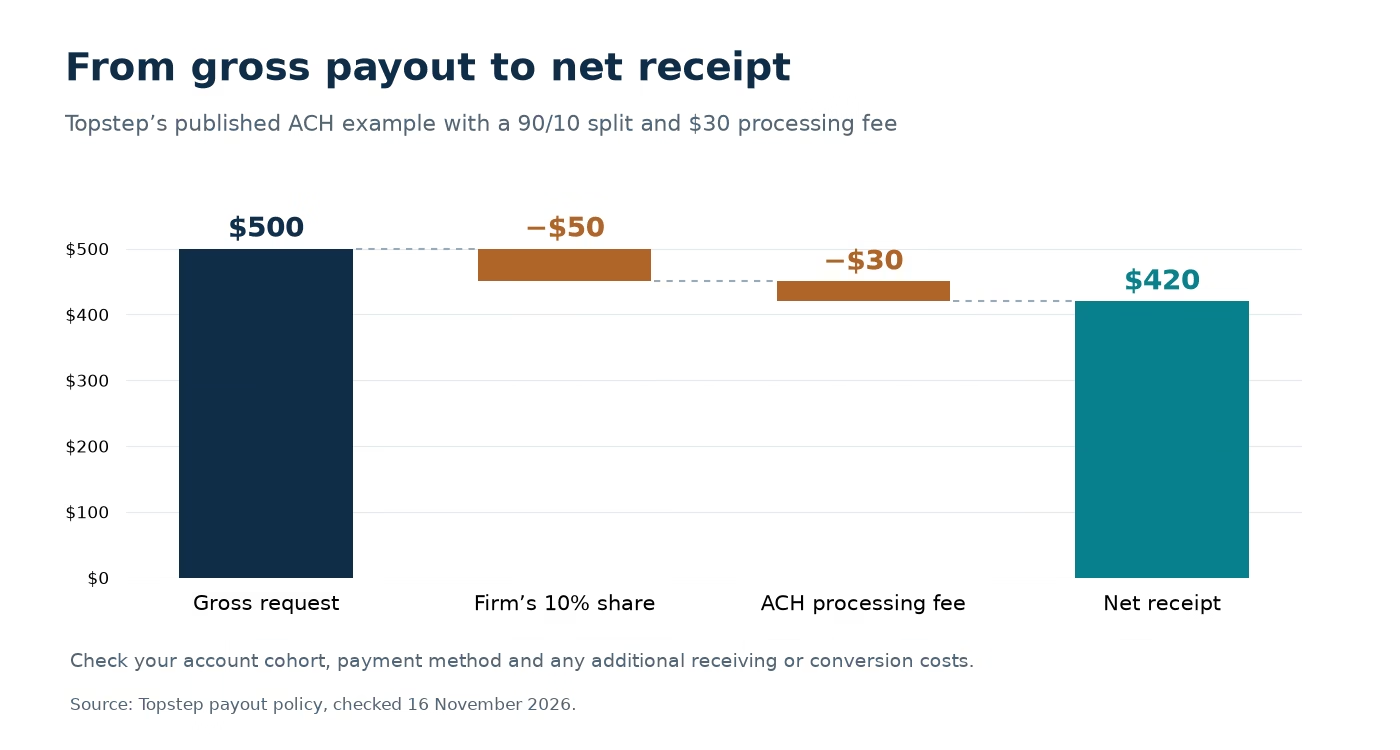
Topstep’s current payout policy describes a 90/10 split for the standard arrangement, a legacy exception for certain traders, and method-specific processing fees. Its published example of a $500 request with a 10% share deducted and a $30 processing fee results in a $420 receipt. Use the policy matching your account and chosen method rather than applying that example universally. Topstep payout policy.
Wise’s USD receiving guidance distinguishes ACH, domestic wire and Swift routes, with different receiving-fee treatment and possible correspondent-bank deductions. Availability and terms depend on the account and region. This is an example of why the transfer route matters, not a recommendation to choose Wise. Wise USD receiving guidance.
Ask for the actual payment method shown on the confirmation. “Bank transfer” may not be precise enough to identify the applicable receiving fee. Do not subtract a fee twice if the provider’s displayed net amount already includes it.
Keep currency conversion separate
First reconcile the payout in its original currency. Then record the conversion amount, exchange rate, conversion charge, and final local-currency credit. Mixing these steps makes a smaller bank deposit look like a larger profit split.
For a purely hypothetical example, suppose the post-fee payout is $900. A conversion quote offers 80 units of local currency for each dollar and a separate 100-unit charge. The resulting amount is:
$900 × 80 − 100 = 71,900 local-currency units.
These are invented numbers, not a current exchange-rate quote. The example shows the sequence only. Use the executed conversion details for reconciliation, because an indicative rate viewed before processing may differ from the completed transaction.
Where the provider quotes an all-in amount after its charge, record that amount directly and note that the charge is already included. An extra subtraction would understate what you should expect to receive.
Use a payout worksheet for each request
Create one row per request, even if several accounts pay out on the same day. Do not aggregate them until each individual request reconciles.
| Worksheet field | Value to record |
|---|---|
| Firm, program and account reference | Exact account and applicable terms |
| Request date and ID | Confirmation reference |
| Gross amount requested and approved | Record both if they differ |
| Applicable trader share | Percentage and any cohort condition |
| Firm deduction | Amount shown on confirmation |
| Transfer and receiving deductions | Amounts and charging party |
| Amount received in payout currency | Provider’s completed amount |
| Conversion details | Executed rate and included or separate charges |
| Final bank credit | Amount, currency and date |
If the numbers do not match, identify the first unexplained difference. For example, if the gross request and trader share reconcile but the provider receipt is lower, investigate the transfer deductions before concluding that the firm changed the split.
Keep the payout worksheet with your tax records. Keep official statements and use appropriate professional advice for tax treatment rather than treating the bank deposit alone as a complete reporting figure.
Resolve a mismatch before your next request
If the policy is unclear, ask: “For this account and payout number, is the displayed cap the gross request or my post-split share? Which deductions will the firm take, and which receiving charges are outside the firm?”
Include the program, account stage, purchase cohort if relevant, and selected payment method. Avoid sending full bank-account details in a public discussion. A cropped payout preview can show the arithmetic without exposing payment credentials.
Also calculate the drawdown buffer remaining after a payout before deciding how much to request. The amount you receive and the room left in the trading account answer different questions.
If the approved amount is correct but the payment has not arrived, follow the payout tracing checklist.
Save the answer with the confirmation. When terms change later, that record helps explain which policy applied to the particular request without assuming every past payout used today’s rules.
Frequently asked questions
Can I request more to cover the firm’s share?
Only if the higher gross amount remains eligible and within the applicable cap. A desired net receipt does not increase the permitted gross request.
Does a 90/10 split mean I receive 90% in my bank?
It establishes the split before any separately applicable deductions. Transfer costs and conversion can make the final credit different.
Why does the same gross request produce different deposits?
Compare the applicable split, payment route, receiving charges, currency conversion and account cohort. Reconcile each step before assuming an error.
Should I use the deposit as my gross payout record?
Keep both figures. The request, firm’s deduction, payment costs and bank credit answer different questions and should remain traceable separately.