
To calculate your drawdown buffer after a prop firm payout, subtract the post-payout loss threshold from the post-payout account value. A withdrawal reduces the account value. Depending on the account rules, it may also change the threshold. Calculate both before deciding how much to request.
Table of Contents
- How to calculate your drawdown buffer after a payout
- Check whether the first payout moves the threshold
- Separate the payout buffer from the failure threshold
- Use the account debit, not the bank receipt
- Build a before-and-after worksheet
- Use the remaining room in your next-session worksheet
- Frequently asked questions
- Does withdrawing less always preserve more drawdown room?
- Can I withdraw the entire displayed profit?
- Is the original account size my available drawdown?
- What should I save after the payout?
The amount reaching your bank is a separate figure. A profit split can make your cash receipt smaller than the amount removed from the trading account. Neither the advertised account size nor the withdrawal confirmation, by itself, tells you how much room remains for losses.
The examples below show how to reconcile those figures. All worked calculations are hypothetical. Named policy examples reflect official documentation checked on November 9, 2026; use the version that applies to your account and purchase date.
How to calculate your drawdown buffer after a payout
Write down the current account value, the amount the withdrawal will deduct, and the loss threshold that will apply afterward. Use the same accounting basis throughout: either full account balances or profit balances measured from a common starting point.
Remaining room = current account value − payout debit − post-payout loss threshold.
This simplified calculation assumes no intervening trades or other account adjustments. If there are open positions, identify which equity measure the firm’s risk system uses before treating a closed-trade balance as available room.
Here is a hypothetical account with a fixed threshold:
| Item | Before payout | After a $1,000 account debit |
|---|---|---|
| Account value | $53,000 | $52,000 |
| Loss threshold | $50,000 | $50,000 |
| Distance above threshold | $3,000 | $2,000 |
The account still displays more than $50,000, but the relevant distance is $2,000. Using the whole displayed balance would hide the actual constraint.
Now express the same example relative to a $50,000 starting balance. The account’s profit balance falls from $3,000 to $2,000, and the threshold is zero. The answer remains $2,000. Problems arise when someone subtracts a full-balance threshold from a profit-only balance, or assumes every platform uses the same display convention.
Check whether the first payout moves the threshold
Topstep’s Maximum Loss Limit documentation says its Express Funded Account starts with a zero balance; the account-size label describes buying power. It also states that the first payout sets the XFA’s Maximum Loss Limit to zero, even if it was previously below zero. That makes the first-payout calculation different from simply subtracting the requested amount from the existing buffer. Topstep: Maximum Loss Limit
Consider a hypothetical ledger using that threshold-reset mechanism. Assume all separate payout conditions have been satisfied:
| Ledger entry | Before | After |
|---|---|---|
| Profit balance | $1,200 | $700 |
| Payout debit | — | $500 |
| Loss threshold | −$800 | $0 |
| Remaining room | $2,000 | $700 |
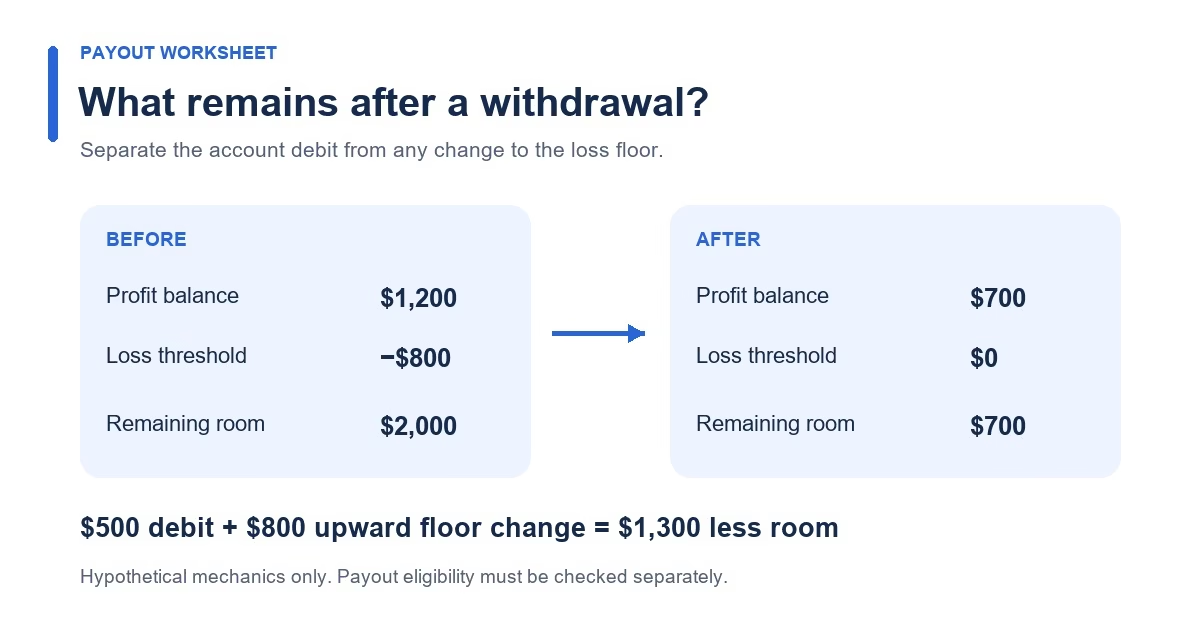
The reduction in room is $1,300: a $500 debit plus an $800 upward threshold movement. This example illustrates the mechanics, not a statement that every account at a $1,200 balance qualifies for a payout.
You can capture that relationship more generally:
Reduction in room = payout debit + upward movement in the threshold.
When the threshold does not move, only the debit reduces the room. When it moves upward, both changes matter.
Other plans can handle the event differently. Alpha Futures’ Zero Account overview specifically says a first withdrawal does not automatically move its Maximum Loss Limit to the starting-balance level; its example preserves the existing threshold through the payout. Apply the published Zero rule to a Zero account, rather than importing the Topstep XFA mechanism. Alpha Futures: Zero Account Overview
The useful question for support is precise: “What will my loss threshold be immediately after this request is deducted?” A statement that an account has a trailing drawdown does not answer that question on its own.
Separate the payout buffer from the failure threshold
A minimum balance required for withdrawals can sit above the level at which the account breaches its loss rule. Both matter, but they answer different questions.
For example, Tradeify’s Select Daily documentation lists a $2,100 payout buffer for the 50K account. Its Select account documentation describes a locked loss floor $100 above the starting balance. Those are different reference points: $52,100 for the stated payout buffer and $50,100 for the locked floor. Tradeify: Select Daily payout policy, Tradeify: Select account rules
Using those reference points, take a hypothetical $53,500 balance with its floor already locked. A hypothetical $500 account debit would leave $53,000:
- Distance above the $50,100 loss floor: $2,900.
- Distance above the $52,100 payout-buffer level: $900.
The $2,900 measures room above the loss floor. The $900 measures excess above the withdrawal buffer. Neither number establishes the next approved payout: minimum requests, caps, cycle-profit rules, and other eligibility conditions require their own checks.
This distinction helps when reading a dashboard with several green indicators. An account can have room to trade while lacking enough excess above a payout threshold for the amount you want. Record each threshold with its purpose instead of calling every figure “the buffer.”
Use the account debit, not the bank receipt
Alpha Futures’ payout policy states that the requested amount is removed from the trading account, while the trader receives 90% of that request. The remaining-account calculation therefore uses the full request under that policy. Alpha Futures: Payout Policy
For a hypothetical $1,000 request under that accounting treatment, the trading ledger loses $1,000 and the stated split produces a $900 receipt before any separate payment adjustments. Using $900 in the buffer formula would overstate the remaining room by $100.
Keep a small reconciliation with distinct entries for the requested amount, account deduction, profit split, payment fees if any, and net cash received. If the figures disagree, identify the exact line that differs. “My payout was smaller” can describe a payment issue; “my account fell by more than I expected” describes a ledger issue. The supporting records are different.
Build a before-and-after worksheet
Complete this before submitting a request, then update the actual values after processing. Keep one worksheet per account; combining several accounts makes it easy to apply the wrong floor or payout cycle.
| Field | What to record |
|---|---|
| Account identity | Plan, size, stage, purchase date, applicable add-ons |
| Current value | The balance or equity measure used by the risk rule |
| Current threshold | Exact dashboard value and whether it is still trailing |
| Proposed debit | Amount that will leave the trading ledger |
| Expected new threshold | Rule-based value after the payout event |
| Expected remaining room | Current value minus debit minus new threshold |
| Separate payout conditions | Minimum balance, cap, days, cycle profit, other restrictions |
| Actual posted values | Debit, resulting balance, threshold, timestamp |
Save the timestamp alongside the figures. A screenshot before a new trading session and a dashboard after that session are not a clean before-and-after pair if trades occurred between them. The worksheet should make those intervening changes visible.
If you cannot determine the expected threshold, send support the proposed debit and the displayed balance and floor. Ask for the post-payout values in the same units. An answer about the percentage you may withdraw is insufficient to resolve a question about the loss floor.
Use the remaining room in your next-session worksheet
The arithmetic tells you the distance to a boundary. It does not tell you what loss to accept on the next position.
For a hypothetical planning exercise, suppose the remaining room is $1,800. You choose to reserve $600 and use $1,200 for comparing possible sequences of losses. Three assumed losses of $400 would consume that planning amount. These invented values are a worksheet demonstration, not a recommended allocation or a guarantee that actual exits will match planned losses.
Run the exercise with your own documented loss assumptions, including any costs absent from them. If the answer depends on every stop filling at precisely the intended price, record that assumption explicitly rather than hiding it inside a round number.
Also distinguish when a threshold updates from when it is enforced. Topstep says its MLL updates at the end of the trading day but is monitored during the session using realized and unrealized P&L. A final closed-trade balance above the floor does not undo an earlier touch of that limit. Topstep: Maximum Loss Limit
Before the next session, reconcile the actual posted payout and threshold with the worksheet. If they differ from your expectation, resolve the difference before using the estimate to size another position.
Frequently asked questions
Does withdrawing less always preserve more drawdown room?
With an identical post-payout threshold, a smaller debit leaves more room by exactly the difference in the debits. But compare two complete scenarios. If making a first withdrawal also changes the threshold, taking a small payout can still produce a substantial reduction in room. Work out the “no payout” and “proposed payout” cases using their respective floors.
Can I withdraw the entire displayed profit?
The buffer calculation cannot establish permission to withdraw. Check the account’s payout cap, minimum balance, eligible profit, and other request conditions first. Then calculate the room left by an allowed debit. A displayed profit figure is an input to the worksheet; it is not, by itself, an approved withdrawal amount.
Is the original account size my available drawdown?
Use the difference between the applicable account value and current loss threshold. The account label alone does not supply that difference. Confirm how the platform displays balances before copying numbers into the formula; a nominal size, a profit balance, and a liquidation threshold are different fields.
What should I save after the payout?
Keep the posted account debit, resulting balance, updated threshold, payout reference, and timestamps together. Compare them with your expected values. This gives you a usable starting point for the next cycle and a specific record to send support if the accounting does not reconcile.
If the account debit has posted but the payment is missing, follow our companion guide on how to track a prop firm payout that has not arrived. The account ledger and the payment journey need separate records.