
Open
Futures prop firm payout rules determine when you can request money, how much you can request, and what remains in your account afterward. Comparing profit splits alone misses most of that decision. A larger percentage can apply to a smaller permitted withdrawal, while a short waiting period can sit behind a substantial profit requirement.
Table of Contents
- Watch the short, then check the rules behind it
- How did we rank payout flexibility?
- The six plans, ranked under our method
- Why these positions follow from the method
- What happens with the same 3,000-dollar profit?
- Why can a profitable account still be ineligible?
- Which account versions could change this result?
- How long can these simulated payout terms continue?
- How should you calculate a request?
- What does this comparison leave out?
- Frequently asked questions
- Which plan is first in this article?
- Does the fastest minimum schedule mean the fastest cash?
- Why did we rank a 95% share below 90% plans?
- Are these live brokerage accounts?
- Official policy sources
We compared six selected $50K simulated funded plans using their official policies, checked October 29, 2026. Our ranking favors fewer payout eligibility conditions, then useful withdrawal flexibility. It is an editorial assessment of published terms, not a rating of company safety, financial strength, payment reliability or expected trading returns.
Key takeaways
- Our first choice under this specific method is Tradeify Select Flex, using its newer purchase cohort.
- Topstep Standard and LucidFlex follow closely, with different minimum requests.
- A two-day eligibility rule does not mean payment arrives in two days.
- Calculate the permitted request, trader share and remaining balance separately.
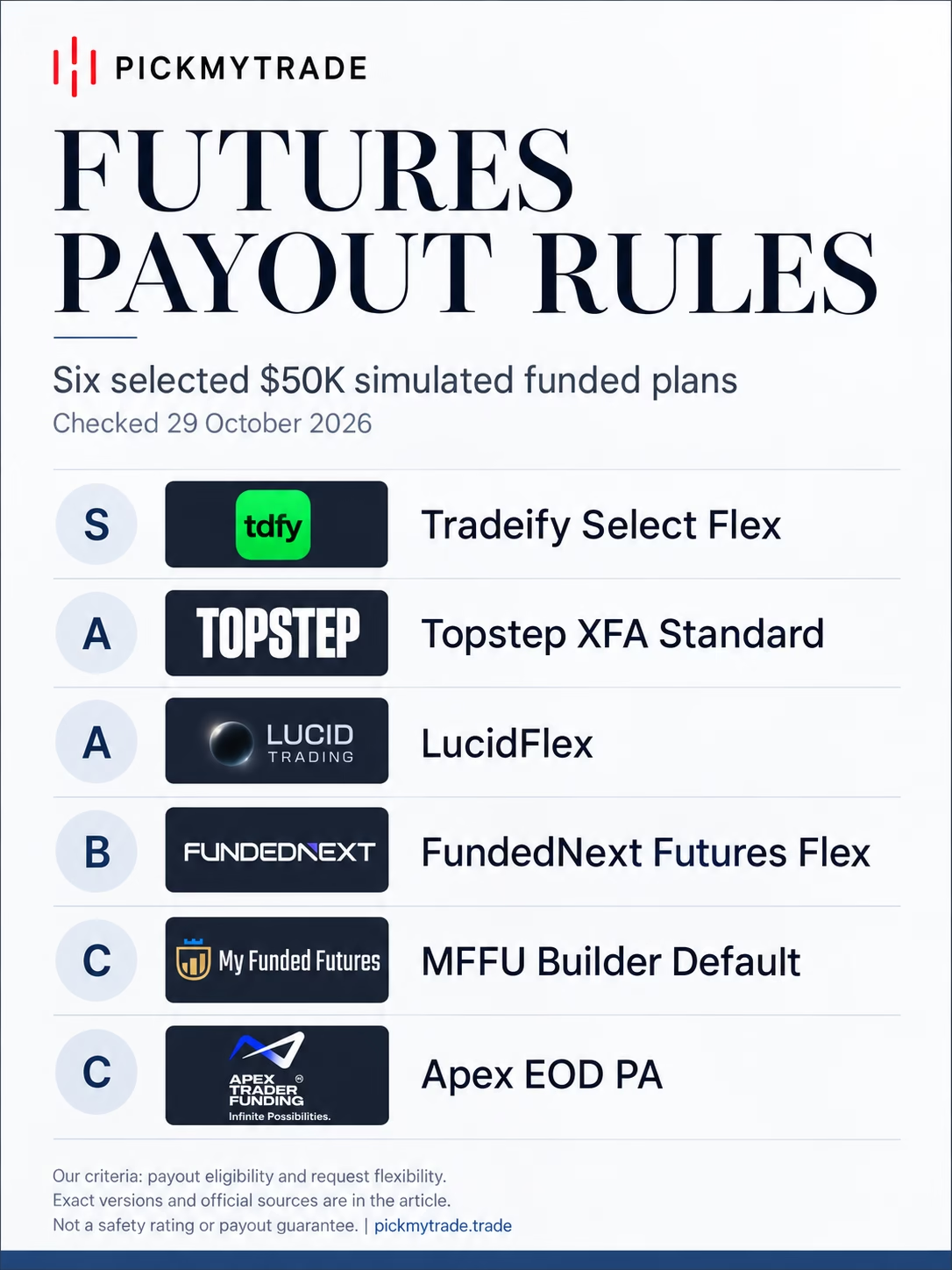
Editorial classification from the official rules linked below. Exact configurations apply.
Watch the short, then check the rules behind it
Watch “Best Futures Prop Firms 2026 Ranked — Best to Worst” by Tradelyze.
The Short introduces a quick comparison based on an October 8 rules snapshot. This article expands that topic with an independently defined method, current official policy checks and worked withdrawal examples. The video's historical tiers are not the evidence for the ranking below.
We identify the exact account version beside each firm. In particular, our Apex comparison selects its EOD Performance Account. A firm name alone is insufficient when several plans have different conditions. All figures are USD, and “$50K” is an account label, not an amount the trader can withdraw.
How did we rank payout flexibility?
We used an ordered set of preferences, rather than adding arbitrary points to produce a seemingly scientific score. The question is: which selected plan gives a trader fewer payout eligibility hurdles, followed by more flexibility in choosing a request?
Our priorities, in order, are:
- Avoid both a retained payout buffer and a funded-stage consistency requirement. These can prevent a request even after a trader has accumulated profitable days.
- Compare required trading days and daily profit thresholds. Fewer required days rank higher; where the day count is equal, a lower qualifying profit per day ranks higher.
- Compare the ordinary first-request cap. A larger cap breaks the remaining tie. Temporary offers and alternative paths are separated from the baseline.
- Compare the minimum request. A smaller minimum breaks a further tie because it permits smaller withdrawals.
These priorities deliberately favor access conditions before the profit split. That preference is debatable, so we also show an equal-profit example where a lower-ranked plan produces a larger trader share. Readers who prioritize maximum cash from one qualifying cycle should use that calculation rather than treating our order as universal.
The review excludes evaluation purchase prices, promotion codes, account-survival probability, country eligibility and live-account benefits from the ranking. Those matter when choosing a firm, but mixing them into a payout-access list would answer a different question. We have not tested real withdrawal requests with these firms.
The six plans, ranked under our method
For the visual tier list, we group the same assessment into four editorial bins: S has no buffer or funded consistency, the lower daily qualification threshold shared by the leading group, and that group's highest ordinary cap. A shares those access conditions with a lower cap. B has no buffer or funded consistency but a higher daily qualification threshold. C requires both a retained buffer and funded consistency. These are relative groups within this shortlist, not industry standards or safety grades.
| Our rank | Selected $50K simulated funded plan | Payout eligibility | Request formula, minimum and trader share |
|---|---|---|---|
| 1 · S | Tradeify Select Flex, purchases on/after September 1, 2026 | Five days at $150+; no funded consistency or payout buffer; later cycles net positive | 50% of total profit, capped at $2,500; $250 minimum; 90% share |
| 2 · A | Topstep XFA Standard, base cap, current 90/10 cohort | Five $150+ winning days; no Standard consistency target or separate retained payout buffer; later cycles net positive | 50% of balance, capped at $2,000; $125 minimum; 90% share |
| 3 · A | LucidFlex, DLL off | Five $150+ days and positive cycle profit; no funded consistency or payout buffer | 50% of profit, capped at $2,000; $500 minimum; 90% share |
| 4 · B | FundedNext Futures Flex | Five $200 benchmark days and $500 cycle profit; no funded consistency or payout buffer | 50% of accumulated cycle profit, capped at $1,500; $250 minimum; 95% share |
| 5 · C | My Funded Futures Builder Default, $2,000 MLL | Two days per cycle; initial 48-hour condition; $2,100 buffer; best day at most 50% of cycle profit; later requests also need $500 net profit since the last approved payout | First request needs $500 above buffer; $2,000 cap; $500 minimum; 80% share |
| 6 · C | Apex EOD Performance Account | Five $250+ days; $52,600 minimum request balance; $52,100 safety net; best day below 50% | First two request caps $1,500; $500 minimum; 100% approved-payout share |
Sources: Tradeify, Topstep payouts and Standard parameters, Lucid payouts and funded parameters, FundedNext Flex, MFFU Builder, Apex EOD.
Why these positions follow from the method
Tradeify leads because it shares the lower qualifying-day threshold of the next two plans and offers the larger ordinary cap. Topstep places above Lucid on the final tiebreaker: its smaller minimum request. That is a narrow distinction, not a claim that either firm is better overall.
FundedNext places fourth because its qualifying-day threshold is higher. Its larger share can still be attractive once the trader qualifies. Builder places above Apex because our method gives its shorter minimum trading period priority within the buffer-and-consistency group. A trader prioritizing the share received could reverse those last two.
This is our own ordering and classification from the disclosed rules. The resulting letter groups coincide with the earlier video's groups, but the policy evidence and explicit tiebreakers determine them here. A future policy change can move a plan without implying that the firm itself became better or worse in every respect.
What happens with the same 3,000-dollar profit?
Assume a hypothetical trader finishes five separate trading days with $600 net profit each. Total simulated profit is $3,000, and the largest day is 20% of that total. Assume the account is otherwise compliant, the request timing is eligible, and any required review approves the request.
This deliberately simple scenario isolates withdrawal arithmetic. It does not imply that every strategy could produce these results under each firm's trading rules.
| Selected plan | Maximum first request in this example | Trader share before other charges |
|---|---|---|
| Tradeify Select Flex | $3,000 × 50% = $1,500 | $1,350 |
| Topstep Standard | $3,000 × 50% = $1,500 | $1,350 |
| LucidFlex | $3,000 × 50% = $1,500 | $1,350 |
| FundedNext Flex | $3,000 × 50% = $1,500 | $1,425 |
| Builder Default | $3,000 − $2,100 buffer = $900 | $720 |
| Apex EOD | $53,000 − $52,100 safety net = $900 | $900 |
These calculations apply the official formulas linked above. They exclude evaluation costs, resets, bank charges, currency conversion, taxes and any other deductions.
FundedNext produces the largest trader share in this example, despite ranking fourth for our access priorities. Tradeify's larger cap is not used because the profit-based limit is smaller. Apex's full split exceeds Builder's share on an equal request, although Builder ranked higher on minimum trading days.
That is why a ranking needs a stated purpose. “Fewer payout hurdles,” “largest withdrawal from this balance,” and “best chance of keeping an account” are different comparisons. A single best-to-worst label conceals those trade-offs.
Why can a profitable account still be ineligible?
A qualifying day is not the same as a profitable cycle. Consider a hypothetical rule requiring five days above a stated threshold. A trader might complete those days, then give back the gains in one losing session. Counting green days alone would miss the net-profit condition.
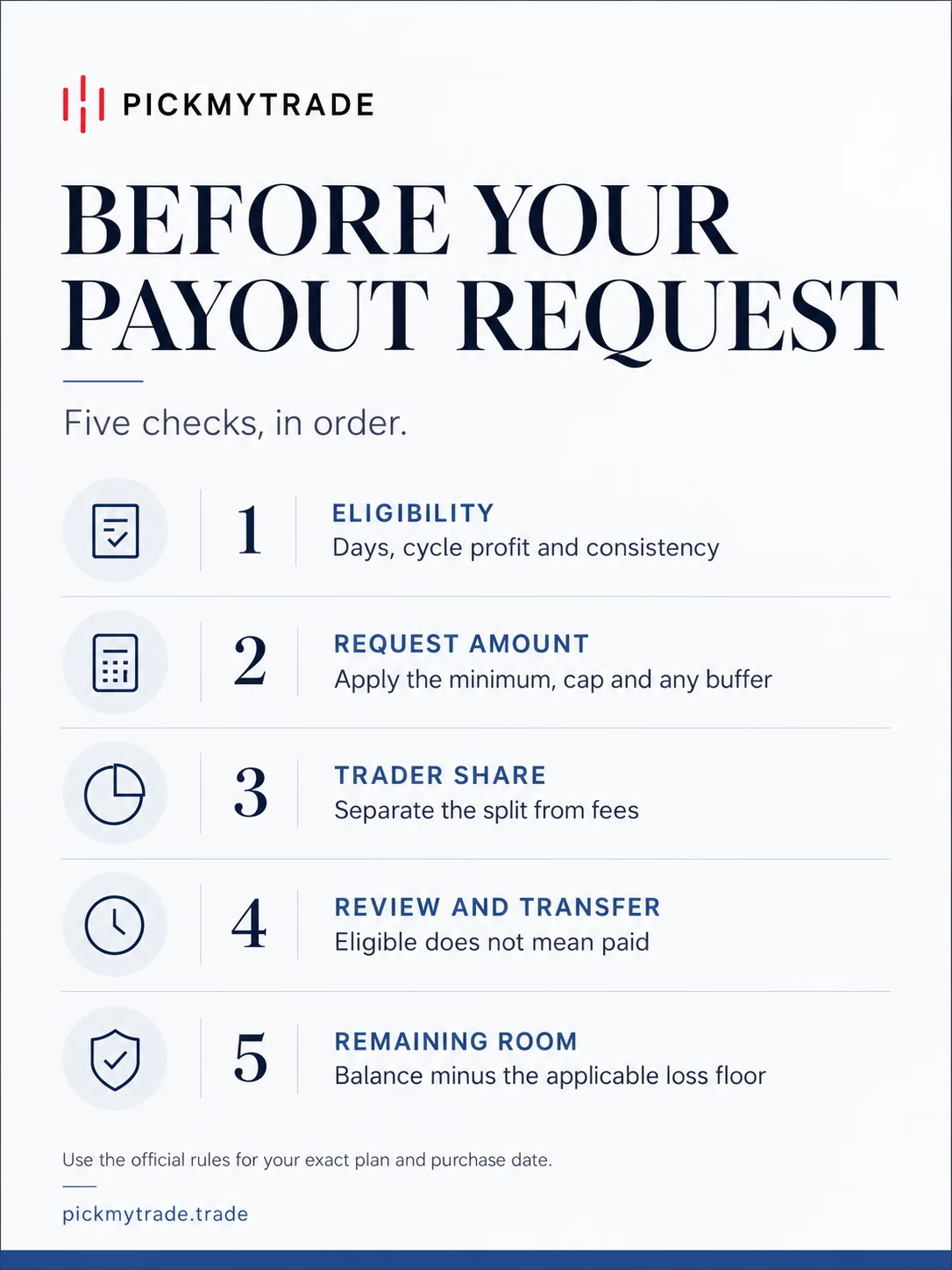
Treat each requirement as a separate check: trading days, cycle profit, consistency, retained balance and request size. Passing one does not waive another. A dashboard can therefore show positive lifetime profit while the current cycle is not eligible.
For a consistency example, suppose the best day is $1,200 and total cycle profit is $2,400. The ratio is exactly 50%. That satisfies a hypothetical “no more than 50%” boundary, but not a “strictly below 50%” boundary. The distinction matters here: Builder uses the former and Apex EOD the latter in their cited policies.
This arithmetic explains the condition; it is not a reason to manufacture trades or increase risk to reach a denominator. If a request is unavailable, identify the unsatisfied rule and verify the calculation. Do not assume an additional trade will fix it.
Which account versions could change this result?
Account options can alter the comparison. Topstep's eligible DLL-at-Combine-purchase offer raises the $50K Standard cap to $4,000, which would change our cap tiebreaker. Adding DLL when activating the XFA does not qualify. Its separate Consistency path is also outside this Standard comparison. See the current offer and cohort details.
LucidFlex with DLL on offers intraday request access under its customization rules; a request pauses trading until the session ends. DLL off uses the regular end-of-day schedule. Our baseline uses DLL off rather than combining the benefits of different configurations. The customization guide explains those purchase-time choices.
Tradeify Select Flex purchased before the stated September boundary has a different cap. Builder's lower-MLL add-on changes its retained buffer. Neither should silently replace the baseline row. Keep a copy of the terms attached to the actual purchase rather than combining attractive numbers from different plan versions.
Also separate policy availability from personal eligibility. A page advertising an account does not establish that a particular country, payment method, platform or trader is eligible to purchase it. Complete that check before comparing checkout totals.
How long can these simulated payout terms continue?
Do not multiply a per-request cap into indefinite future withdrawals. FundedNext Flex ends after its fifth reward. Apex EOD permits six payouts and then closes the PA; its $50K caps progress through $1,500, $1,500, $2,000, $2,500, $2,500 and $3,000. Another Apex PA requires another evaluation. FundedNext Flex, Apex EOD payouts.
Builder allows up to five sim payouts before eligibility for live promotion. Lucid's newer policy treats Payout 5 as Flex's maximum sim payout level, with live transitions at the risk team's discretion and potentially earlier. Eligibility or a maximum payout level is not a guaranteed transition date. Builder guide, Lucid live structure.
Tradeify's published thresholds for live consideration are three payouts on one account or ten across plans since the previous live transition. Meeting a threshold does not guarantee selection. These lifecycle rules are separate from our first-request access ranking. Tradeify payout policies.
How should you calculate a request?
Start with the latest account balance after commissions and the correct payout-cycle start. Then work through the following sequence:
- Confirm the eligible cycle. Record which days count and which profits belong to it.
- Apply the access conditions. Check the day threshold, cycle-profit rule and any consistency calculation.
- Apply the withdrawal formula. This may be a percentage of profit or the amount above a retained threshold.
- Apply the request cap and minimum. A cap limits what the formula permits; it does not create additional withdrawable profit.
- Apply the trader share and charges. Keep the request amount separate from what arrives at the payment destination.
- Calculate the account left behind. Record the balance and applicable loss floor after the request.
For example, a hypothetical account has $4,000 available in its profit balance, a $1,000 request and a post-request loss floor of $100. The remaining balance is $3,000, leaving $2,900 above that floor. This is a generic bookkeeping illustration, not the rule of every account in the table.
The selected plans also change or lock their loss floors around payouts. Topstep sets the XFA MLL to $0 after the first payout. Tradeify Select Flex locks at starting balance plus $100 at its EOD threshold or a payout request, whichever happens first. FundedNext Flex's first withdrawal sets its floor at starting balance plus $100. LucidFlex adjusts to its locked MLL at a payout request. A payout buffer and a liquidation floor are different things. Topstep, Tradeify, FundedNext, Lucid drawdown.
Payment does not remove the need to plan the next trading cycle. Decide how much to request using both the withdrawal allowance and the conditions that apply afterward. Maximizing a request and preserving room for subsequent losses are separate objectives.
What does this comparison leave out?
The policy table does not measure how frequently traders qualify, whether a particular withdrawal will be approved or how quickly a bank will credit it. Those outcomes require evidence beyond published rules. An advertised processing time starts at a defined stage; it should not be confused with the time needed to earn eligibility.
We have also kept automation and copying permission outside the ranking. A payout-friendly plan may still restrict the intended trading method. Identify the source of the trade, account owner, platform and account stage, then consult that firm's current policies. Software connectivity cannot establish payout entitlement. For a separate policy comparison, see which prop firms allow automated trading.
Before paying for an evaluation, save a short comparison sheet containing the exact plan, version, source links, required profit, qualifying days, request formula, minimum, cap and share. Add the costs and eligibility restrictions relevant to you. This provides a decision record you can revisit if a dashboard result differs from expectations.
Frequently asked questions
Which plan is first in this article?
Tradeify Select Flex for the specified newer $50K cohort ranks first under our access-first method. The ranking is conditional on that method and the baseline account options. It is not a claim about company solvency, payment reliability or the best outcome for every trader.
Does the fastest minimum schedule mean the fastest cash?
No. Minimum trading days, qualifying profit, request eligibility, approval and transfer are separate stages. A trader can satisfy the time requirement before satisfying the money requirement. Compare the entire sequence rather than converting “eligible after” into a promised payment date.
Why did we rank a 95% share below 90% plans?
Our method prioritizes eligibility conditions and qualifying-day thresholds before the split. The worked example makes the trade-off visible: once the assumed conditions are satisfied, the 95% plan pays a larger share of an equal approved request. Choose the comparison that matches your actual priority.
Are these live brokerage accounts?
This comparison covers the specified simulated funded stage. Do not carry the table into a live-account decision. A change of stage can change the agreement, available platform, trading limits and withdrawal rules. Rebuild the comparison from the live agreement when that transition becomes relevant.
Use the table to shortlist account terms, then verify your selected version directly with the firm. Recheck before purchase and before requesting a withdrawal.
Educational comparison. The examples are hypothetical calculations, not trading results or promised payouts. Trading and evaluation fees involve financial risk.
Official policy sources
- Tradeify Select Flex and Select Daily payout policies
- Topstep payout policy
- Topstep Express Funded Account parameters
- LucidFlex payouts
- LucidFlex funded account
- LucidFlex customization
- LucidFlex drawdown
- Lucid's current live structure
- FundedNext Futures Flex account rules
- My Funded Futures Builder $50K guide
- Apex EOD payout rules