

Table of Contents
- Our shortlist and ranking method
- The six evaluations at a glance
- S: FundedNext Rapid Pro, without the DLL add-on
- A: Tradeify Growth
- A: My Funded Futures Builder Default
- A: Topstep Trading Combine, without the purchased DLL
- B: LucidFlex, 40% consistency and DLL Off
- C: Apex EOD Evaluation, for an unrushed attempt
- Why “EOD drawdown” does not mean losses are checked only at night
- A big winning day can increase the work required
- Three sessions, the same profit, two different outcomes
- The checks that can override any tier
- Frequently asked questions
- Which futures challenge is easiest to pass?
- Does the evaluation size equal the loss allowance?
- Does a one-day evaluation make the funded account easier?
- Should everyone choose the S-tier account?
- Official sources
Evaluation rules rechecked November 6, 2026.
All six $50K futures challenges in this comparison ask you to make $3,000 with an initial $2,000 loss allowance. What separates them is what happens along the way. Can you earn most of the profit in one session? Does a rough morning end your trading day? Can you sit out a quiet month without buying another evaluation?
FundedNext Rapid Pro without the daily loss limit add-on ranks first for an intraday trader who wants time to wait for setups and whose profits vary from day to day. It allows a one-day pass, imposes no deadline and lets you earn the target across as many sessions as you need. Its short-hold trading policy can still prevent a trader from advancing. The table shows where a different trading style might favor one of the other five plans.
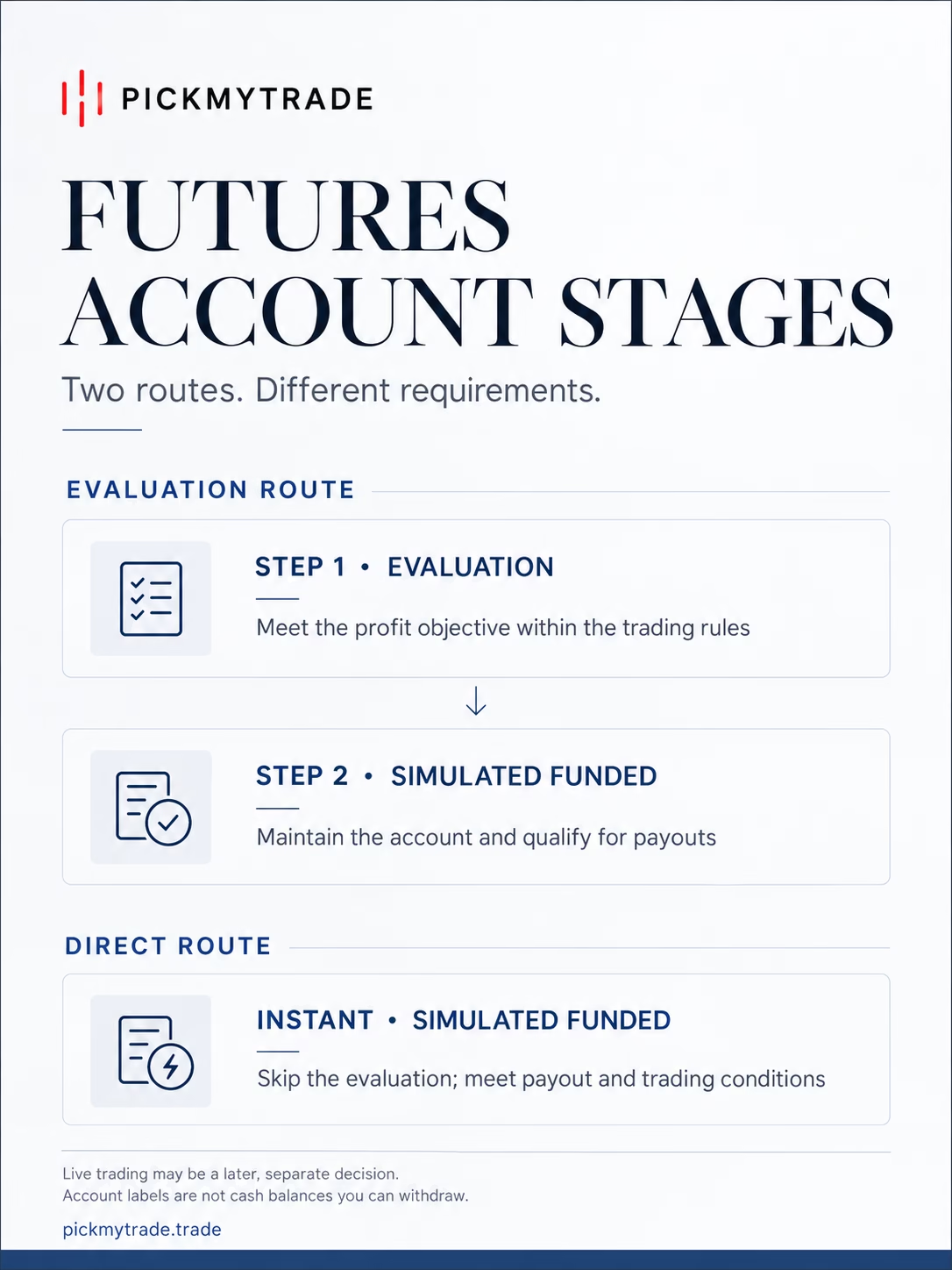
These tiers compare the rules of the paid evaluation. Passing usually opens a simulated funded account with its own limits. We haven’t seen comparable pass-rate data for these six configurations, so the ranking measures rule flexibility.
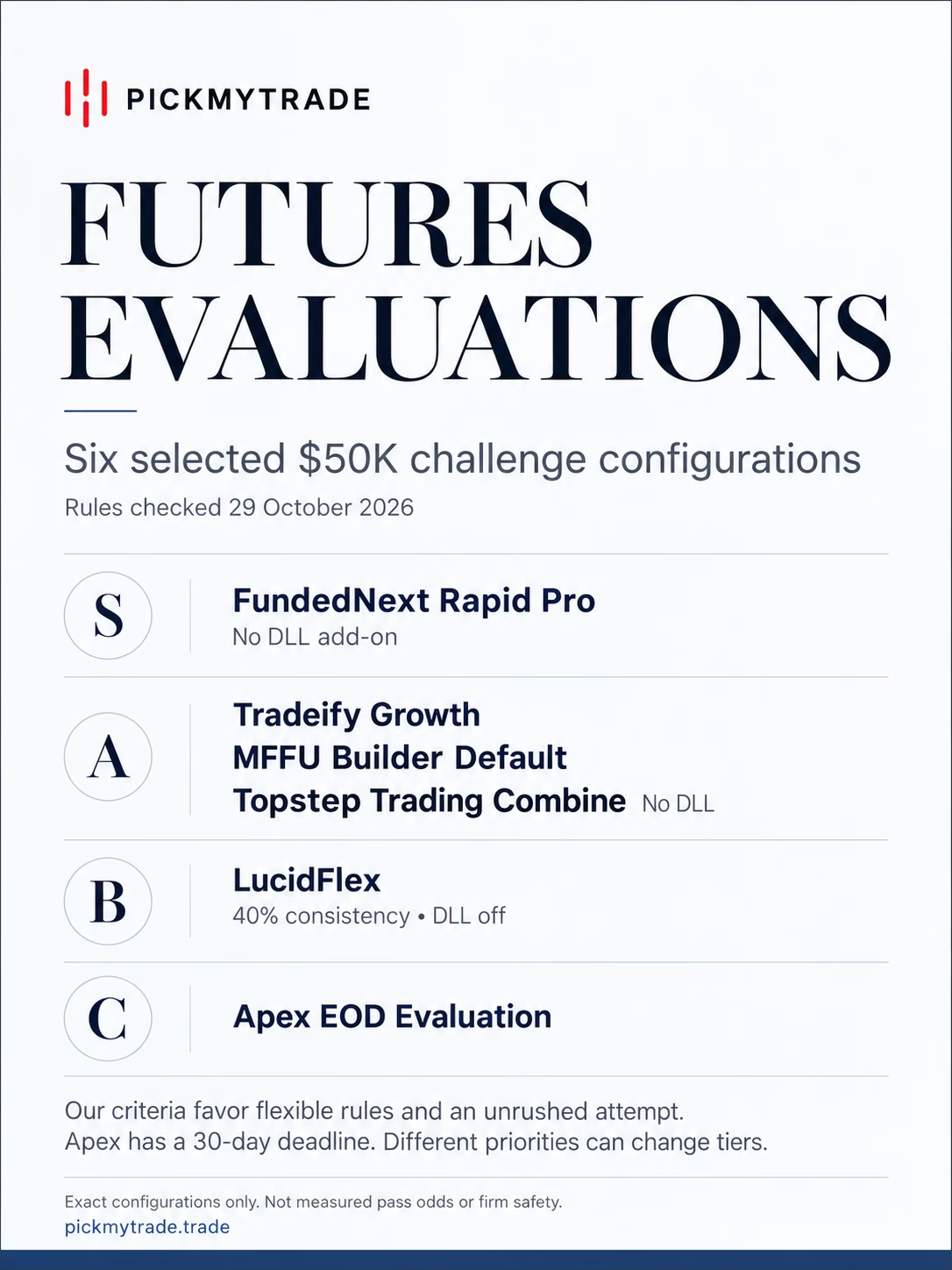
Editorial classification from the official rules linked below. Exact configurations apply.
Our shortlist and ranking method
We reviewed ten $50K evaluation configurations across six firms: FundedNext Rapid Pro, Rapid Daily and Flex; Tradeify Growth and Select; My Funded Futures Builder Default and Rapid EOD; Topstep Trading Combine; LucidFlex; and Apex EOD. We selected one configuration from each firm to make differences visible without filling the list with several versions of the same provider. This is a bounded shortlist, not a claim that we researched every futures prop firm or identified the six largest.
The baseline reader is a discretionary intraday trader whose strategy fits the firm's permitted products, session times and conduct rules. The trader prioritizes an unrushed attempt, does not rely on sub-ten-second profit concentration, and wants room to spread profits unevenly across sessions. Price, payout size and brand reputation do not determine these tiers.
All six selected configurations have a published $3,000 target and $2,000 EOD maximum drawdown: a 1.5 target-to-drawdown ratio. That ratio is arithmetic, not a forecast. The differences come from the additional gates.
| Tier | Our rule for this comparison |
|---|---|
| S | No profit-day consistency requirement, no compulsory daily loss limit, and no fixed completion deadline. |
| A | No fixed completion deadline, with either a soft daily loss limit and no profit-day consistency rule, or a consistency threshold of at least 50% with no compulsory daily loss limit. |
| B | No fixed completion deadline, but a stricter 40% profit-day consistency requirement in the selected configuration. |
| C | A fixed completion deadline combined with a compulsory daily loss limit, for this reader who prioritizes an unrushed attempt. |
These definitions apply to this shortlist, not to every possible product. Within a tier, the firms are tied. A mandatory daily pause receives a lower flexibility classification; that does not mean a personal daily risk limit is undesirable.
Sensitivity matters: if a 30-day deadline does not constrain your strategy, Apex's rules fit our A-tier description after removing that deadline factor. If you choose LucidFlex's 50% consistency add-on with DLL Off, it also fits A. FundedNext Rapid Pro with the DLL add-on fits A rather than S. The configuration matters more than the logo.
The six evaluations at a glance
Every row is $50K nominal size, $3,000 target and $2,000 EOD drawdown. “One day” means the earliest permitted completion, not a recommended target or typical result.
| Tier | Exact configuration | Profit-day consistency | Daily loss limit | Earliest completion | Completion window |
|---|---|---|---|---|---|
| S | FundedNext Futures Rapid Pro, without DLL add-on | None in challenge | None by default | One trading day possible | No time limit |
| A | Tradeify Growth | None in evaluation | $1,250 soft pause | One trading day | No time limit; inactivity rules remain |
| A | My Funded Futures Builder Default, $2,000 MLL | None in evaluation | $1,000 soft pause | One trading day | No time limit |
| A | Topstep Trading Combine on TopstepX, without purchased DLL | Best day at or below 55% of total profit | Optional | Two trading days | No pass deadline; monthly rebilling |
| B | LucidFlex 40% consistency, DLL Off | Best day at or below 40% of total profit | Off in this configuration | Three trading days | No time limit |
| C | Apex EOD Evaluation, current 30-day product | None in evaluation | $1,000 soft pause | One trading day possible | 30 calendar days from purchase |
The rule evidence is the firms' own Rapid Pro guide, Growth guide, Builder guide, Topstep consistency policy, LucidFlex evaluation guide, and Apex EOD evaluation guide. Topstep's DLL policy, subscription terms, Tradeify's FAQs, and MFFU's evaluation overview supply the optional-limit and timing details.
S: FundedNext Rapid Pro, without the DLL add-on
Rapid Pro has the fewest of our selected evaluation gates: no profit-day consistency rule, no default DLL, and no completion deadline. Its $50K contract ceiling is four minis or forty micros. The classification applies to Rapid Pro, not the older Rapid product, Rapid Daily, Flex, or the similarly named funded account.
There is still a material strategy filter. In the challenge, FundedNext monitors profit from trades closed within ten seconds. Its policy describes a warning at 30% and a hold on advancement at 40% or more until that percentage falls below 40%. A trader whose normal method repeatedly hits that hold should not treat this S tier as a recommendation. Official micro-scalping policy. After passing, Rapid Pro introduces a 40% funded-account consistency rule. Official funded-account rules.
Our judgment: strong flexibility for the defined baseline strategy, with a substantial change of obligations after passing. A simple evaluation is not evidence of simple withdrawals.
A: Tradeify Growth
Growth exchanges unrestricted daily profit concentration for a $1,250 soft daily pause. It has no evaluation consistency rule, permits completion in one trading day, and allows four minis or forty micros on the selected $50K configuration. The purchase is one-time, with no recurring subscription or activation fee. Official Growth rules.
Tradeify says evaluations have no completion deadline, but the weekly inactivity rule still applies: at least one trade per week, Monday through Friday, with closure possible after an email warning. “No deadline” therefore does not mean the account can be left unused indefinitely. Official Tradeify FAQs.
Our judgment: a useful configuration for uneven profit days when the daily pause is compatible with the trader's own risk plan. Growth's funded payout path is fixed. Someone wanting to choose Select Flex or Select Daily after passing needs the Select evaluation, which has different rules.
A: My Funded Futures Builder Default
Builder Default combines no evaluation consistency requirement with a $1,000 soft DLL and four-mini/forty-micro limit. The cheaper Builder add-on is a different risk configuration: its drawdown is $1,500, so the same $3,000 target becomes a 2.0 ratio, rather than 1.5. Our tier does not transfer to it automatically. Official Builder $50K guide.
MFFU describes the evaluation purchase as one-time, with no renewal, activation fee or completion deadline. Official evaluation overview.
Our judgment: comparable to Growth on the main gates, with a tighter daily pause. Before selecting it, read the next stage: Builder restricts the number of active sim-funded Builder accounts and introduces payout consistency. Passing the evaluation does not remove those later requirements.
A: Topstep Trading Combine, without the purchased DLL
Topstep's current consistency policy uses 55%, not the older 50% figure still repeated in many summaries. A $50K Combine requires $3,000 profit; no best day may exceed 55% of total profit at qualification. The policy says there is no rounding buffer. Two-day completion is possible. Official Topstep consistency policy.
The selected configuration has no purchased DLL. Adding one at checkout changes the configuration and carries that limit into the Express Funded Account. The evaluation position ceiling is five minis or fifty micros. Official DLL policy, Combine parameters.
Our judgment: more room for a large best day than a 40% configuration, but less profit-distribution freedom than the no-consistency plans. The subscription renews every 30 days until passing or cancellation; a failed account does not automatically cancel billing. That cost pressure is separate from a hard completion deadline. Official subscription terms.
B: LucidFlex, 40% consistency and DLL Off
The current default LucidFlex evaluation consistency setting is 40%, with a 50% add-on available. The selected configuration allows four minis or forty micros and has no compulsory DLL. The firm states a minimum three-day path at 40%, or two days with the 50% add-on. The evaluation is a one-time purchase without monthly rebilling or a funded activation fee. Official LucidFlex evaluation guide.
B reflects the stricter distribution requirement, not an inferior firm or funded account. A trader already generating evenly sized daily results may find that difference immaterial. A trader whose profits arrive in a few large sessions should calculate how often the 40% gate would require extra profit.
The optional 50% setting has its own cushion mechanics. Do not import that cushion into the 40% default or assume it is a fixed dollar allowance for every result. Official LucidFlex consistency explanation.
C: Apex EOD Evaluation, for an unrushed attempt
Apex EOD has no evaluation consistency rule, permits a one-day pass and lists a six-contract maximum for $50K. Its $1,000 DLL is a temporary pause; touching the EOD drawdown floor fails the evaluation. Official Apex EOD rules.
The decisive difference is the 30-calendar-day access period. Weekends and holidays count. The account cannot be extended or reset; an expired or failed attempt requires a new evaluation purchase, and its balance does not carry over. After the account is officially marked passed, there is a seven-calendar-day PA activation window. Official Apex fees and access policy.
Our judgment: the least flexible fit here for someone who wants to wait indefinitely for suitable setups within one attempt. For a trader comfortable with that deadline, its lack of consistency makes it much more competitive. Do not apply the older Apex Legacy subscription and minimum-day rules to this current EOD product.
Why “EOD drawdown” does not mean losses are checked only at night
Separate when the floor moves from when a breach is enforced. In an EOD model, the floor can update after the close while still being enforced against the account during the next session. A temporary open loss can therefore end the account before a hoped-for recovery. This is explicit in Tradeify's Growth rules and Apex's drawdown explanation.
Consider a simplified $50K account with a $2,000 EOD drawdown. It starts with a $48,000 floor. A $50,700 closing balance can raise the next session's floor to $48,700. If the next session ends at $50,200, the old higher floor does not move downward: remaining room is $1,500. This is an illustration of the mechanism, before plan-specific lock levels and fees.
Lock points also differ. Topstep's Combine MLL stops at the starting balance, while LucidFlex's $50K guide specifies $50,100. Apex evaluation trailing behavior differs by platform. Check the exact account rather than assuming all EOD products are identical. Topstep MLL, LucidFlex drawdown, Apex EOD drawdown.
A big winning day can increase the work required
Use the applicable formula: required total profit = largest profit day ÷ consistency limit, subject to the original target and the firm's exact calculation.
For a hypothetical $1,800 best day:
| Consistency setting | Total profit needed for that best day |
|---|---|
| Topstep 55% | At least about $3,272.73 |
| LucidFlex 40% | At least $4,500 |
These are our arithmetic examples using the official Topstep and LucidFlex formulas. A larger required total is not an instruction to increase risk. Losing money does not erase the best day; it can make the ratio worse.
Three sessions, the same profit, two different outcomes
Suppose a trader closes three sessions up $1,500, $900 and $600 after fees. The best day accounts for 50% of the $3,000 total. That record clears Topstep’s 55% test. On the default LucidFlex evaluation, the same trader would need $3,750 in total profit for the $1,500 day to represent 40%. That leaves $750 to earn, assuming the best day stays at $1,500. Both examples assume all other trading rules were met.
To run the same check on your own log, use each session’s net result, including losing sessions. Divide your largest winning session by the plan’s percentage, then compare the result with the original profit target. The higher number is the amount you would need under that consistency rule.
The checks that can override any tier
Before purchasing, compare your own trading log with the actual rule set. Record the largest day, intraday loss, closing drawdown, typical holding time, and session. A tier is useful only after the strategy is eligible.
Check the close-out time in the firm's timezone and the specific product's hours. Topstep requires positions closed by 3:10 p.m. CT; Apex requires closure before 4:59 p.m. ET, with earlier-closing products and holidays handled separately. Never convert those into a fixed local-time schedule without accounting for daylight saving. Topstep trading hours, Apex trading times.
Read the conduct and platform rules for automation, copying, news events, hedging and rapid scalping. A technical connection or copied order is not proof of firm permission. Apex's agreement, for example, requires personal order entry and confirmation under its automation restrictions; this comparison is not an automation compatibility list. Official Apex user agreement.
Budget the full route: initial fee, repeat attempts, resets where offered, renewals, activation, optional data and commissions. We exclude promotional prices from the tiers because they are changeable. FundedNext's general price table and Rapid Pro guide also show different $50K offers. Confirm the selected configuration and final checkout price before paying; a cheaper add-on can change the risk rules.
Finally, read the funded-stage agreement before buying the evaluation. A one-day pass only satisfies the first gate. It says nothing about the days, buffer, consistency or review required before a payout.
Frequently asked questions
Which futures challenge is easiest to pass?
No ranking here establishes that. FundedNext Rapid Pro without its DLL add-on has the lightest combination of the selected evaluation gates for our baseline scenario. Actual passing depends on strategy results, costs, execution and compliance. We do not have comparable cohort data to turn these tiers into pass probabilities.
Does the evaluation size equal the loss allowance?
No. These selected configurations start with a $2,000 maximum drawdown allowance. The nominal size and actual room before breach are different numbers; trailing behavior can change the room remaining.
Does a one-day evaluation make the funded account easier?
It does not establish that. Evaluation qualification and funded payout eligibility are separate. See how contract limits, drawdown and payout eligibility change in our comparison of six funded futures accounts after passing.
Should everyone choose the S-tier account?
No. Someone who needs an external daily stop, trades very short holding periods, wants a different funded payout policy, or cannot use a supported platform may prefer another configuration. The ranking is a filter for a stated use case, not a universal purchase recommendation.
Official sources
The source review began October 29, 2026. We checked the six plans’ main ranking criteria again on November 6, 2026. The linked firm pages supply the rules; PickMyTrade's classification and numerical examples are our own analysis.
- FundedNext Futures: Rapid Pro Challenge, loss-limit mechanics, micro-scalping, Rapid Pro funded account, Rapid Daily Challenge, Flex Challenge, price table.
- Tradeify: Growth evaluation, Select evaluation, common FAQs.
- My Funded Futures: Builder $50K, evaluation overview, Rapid EOD $50K.
- Topstep: Combine parameters, consistency, DLL, MLL, subscriptions, trading hours.
- Lucid Trading: LucidFlex evaluation, consistency, drawdown.
- Apex: EOD evaluation, fees and access, EOD drawdown, trading times, user agreement.