

Table of Contents
- What our S, A, B and C tiers measure
- The six selected K simulated funded accounts
- 1. Topstep XFA Standard — S
- 2. Tradeify Select Flex — A
- 3. LucidFlex with DLL off — A
- 4. Alpha Futures Advanced Qualified — B
- 5. FundedNext Futures Flex — B
- 6. My Funded Futures Builder Default — C
- Why Apex EOD PA missed this particular six
- EOD drawdown still leaves an intraday breach risk
- Your first payout changes the remaining risk budget
- Rules that can override the table
- Before the first funded trade
Passing a futures evaluation does not tell you how much room the next account gives you. The simulated funded stage can introduce smaller contract limits, payout consistency tests, a daily trading pause or a new loss floor after your first withdrawal.
For a manual day trader prioritizing fewer operational restrictions, our selected $50K shortlist starts with Topstep XFA Standard, followed by Tradeify Select Flex and LucidFlex with the daily loss limit switched off. Alpha Futures Advanced, FundedNext Futures Flex and My Funded Futures Builder Default complete the six. This is PickMyTrade’s editorial assessment of published account rules, checked October 29, 2026. It is not a measured survival rate or a ranking of firm financial strength.
Here, “step 2” means the account after passing the evaluation. These are simulated funded accounts; this article does not rank a second evaluation phase or live brokerage accounts.
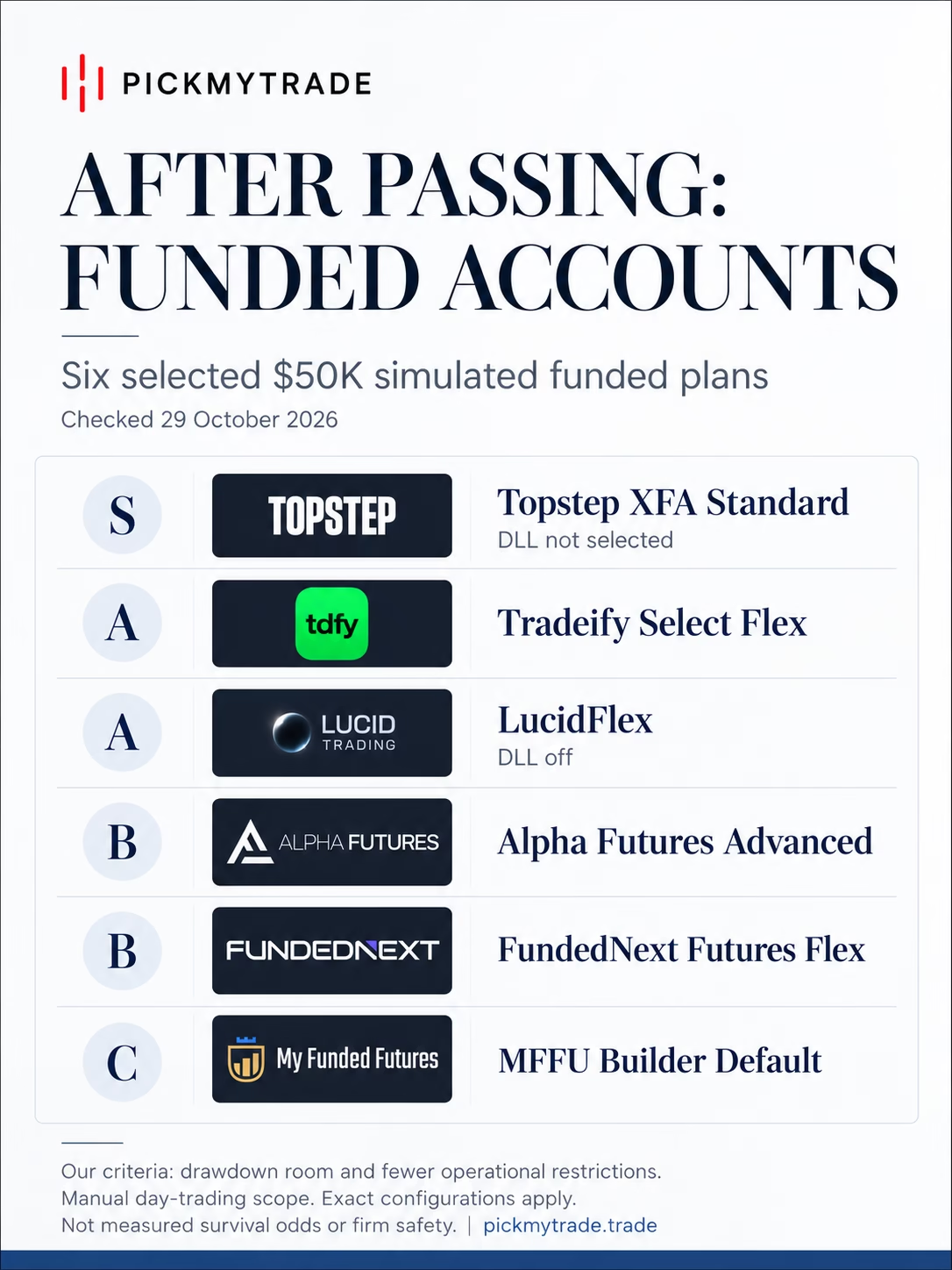
Editorial classification from the official rules linked below. Exact configurations apply.
What our S, A, B and C tiers measure
We screened seven named $50K plans, including Apex EOD PA, before selecting six. The comparison assumes a manual day trader whose strategy fits each firm’s conduct rules. An account that prohibits your strategy is unsuitable regardless of its letter.
Our priority order is explicit:
- Prefer end-of-day trailing drawdown with neither a compulsory daily loss pause nor a funded payout-consistency test.
- Within that group, prefer a larger initial loss allowance, then a lower locked floor relative to the starting balance.
- Where those match, prefer fewer moving contract-limit rules. Retained scaling tiers rank ahead of tiers that can fall after losses or withdrawals.
- Review session deadlines, automation, prohibited trading and unresolved policy wording as practical qualifications. These can override the order for a particular strategy.
S identifies the leading combination in this shortlist: $2,000 EOD room, no compulsory DLL or funded consistency, and a floor that locks at the starting P&L. A keeps the same initial room and core freedoms, but locks $100 above the starting balance. B keeps those core freedoms with less than $2,000 initial room. C adds both a compulsory daily pause and funded payout consistency.
These are relative editorial bins, not industry ratings. We give operational freedom priority over built-in intervention. A trader who benefits from a compulsory daily stop may reasonably prefer a C-tier configuration. Larger permitted contract size receives no automatic reward: it increases capacity, not the account’s loss allowance.
The six selected $50K simulated funded accounts
| Rank / tier | Exact funded configuration | Initial EOD loss allowance | Compulsory DLL | Funded payout consistency | Main qualification |
|---|---|---|---|---|---|
| 1 / S | Topstep XFA Standard; DLL not selected | $2,000 | None | None | Scaling applies; floor locks at $0 P&L |
| 2 / A | Tradeify Select Flex; newer September 2026 purchase cohort | $2,000 | None | None | Floor locks at starting balance + $100 |
| 3 / A | LucidFlex; DLL off | $2,000 | None | None | Contract tier can fall after a payout |
| 4 / B | Alpha Futures Advanced Qualified | $1,750 | None | None | Fixed capacity; automated trading prohibited |
| 5 / B | FundedNext Futures Flex | $1,500 | None | None | Fixed capacity; narrower loss allowance |
| 6 / C | MFFU Builder Default; $2,000 MLL option | $2,000 | $1,000 soft pause | Best day no more than 50% | Additional funded-stage conditions |
The official account sources and the reasons for each position follow. “None” applies to the identified configuration, not every product sold by that firm.
1. Topstep XFA Standard — S
The $50K XFA starts at $0 P&L, with its loss floor at −$2,000. Its threshold rises with end-of-day results and eventually locks at $0. The first payout also sets that floor to $0 if it has not reached it already. That starting-balance floor is the tie-breaker over the next two plans. Topstep maximum loss limit.
Standard has no funded consistency target, while the alternative Consistency path does. The DLL is optional in the XFA; this ranking assumes it was not selected. These choices matter more than the generic Topstep name. XFA parameters.
Contract scaling still needs attention. Additional capacity is released for the next session, not immediately when intraday profit crosses a threshold. Product exceptions also exist: Topstep’s standard micro-to-mini conversion does not apply identically to every instrument. Check the current limit displayed in TopstepX rather than carrying evaluation sizing into the XFA. Scaling plan.
2. Tradeify Select Flex — A
Select Flex combines $2,000 EOD drawdown with no compulsory DLL or funded consistency. Its floor locks at $50,100 when the relevant EOD balance reaches $52,100, or immediately on a payout request if that happens first. Select Flex policy.
The $50K account starts at two minis or 20 micros, rises to three at $1,500 profit and four at $2,000, assessed at EOD. The policy says earned scaling tiers are retained despite later balance fluctuations. That reduces one moving rule compared with LucidFlex, earning Tradeify the tie-break. Retained permission does not mean the remaining balance can support the same trading risk.
The important strategy qualification is its funded microscalping rule: more than half of both trades and profits must come from trades held longer than ten seconds to request a payout. No funded consistency percentage does not mean no trading-pattern conditions. Essential rules.
3. LucidFlex with DLL off — A
LucidFlex’s $50K EOD allowance is also $2,000, with a $50,100 locked floor. A payout request triggers the locked floor even if the account has not completed its normal trailing progression. LucidFlex drawdown.
The specific configuration matters. DLL off removes the daily cap in the funded stage. DLL on imposes a soft pause and changes payout scheduling. The evaluation’s 40% or 50% consistency selection does not become funded consistency. Customization.
LucidFlex starts at two minis/20 micros, permits three at $1,000 profit and four at $2,000. Unlike Tradeify’s stated retained tiers, Lucid recalculates capacity up or down; a payout can reduce your next session’s allowance. A trader using three contracts before withdrawing should not assume three remain available afterward. Scaling plan.
4. Alpha Futures Advanced Qualified — B
Advanced has no compulsory Daily Loss Guard, no funded consistency rule and no contract scaling. Its $50K allowance is $1,750, below the first three plans, with capacity of five minis/50 micros. Advanced overview.
Alpha’s EOD threshold locks at the starting balance. However, touching the active floor with floating equity can close the qualified account during a session. The lower locked floor is useful, but our method gives the larger initial allowance priority. Maximum loss limit.
This placement is specifically for manual trading. Alpha prohibits bots and fully automated execution; an indicator may provide signals only with the trader manually placing, monitoring and managing trades. Its prohibition on exploitative tick/micro scalping is also relevant to very short-duration strategies. Prohibited practices.
5. FundedNext Futures Flex — B
Flex removes compulsory DLL and funded consistency, but $50K comes with $1,500 EOD loss room. Its loss floor locks at $50,100. The smaller starting allowance puts it below Alpha under our stated method. Loss-limit policy.
Capacity stays fixed at three e-minis/30 micro e-minis; it does not grow with profits. Exceeding it can remove profits attributable to the excess contracts while retaining their losses. Fixed capacity is simpler to track, but still requires combined-position control. Contract-limit policy.
The first withdrawal resets the floor to $50,100, and the selected Flex account concludes after five Performance Rewards. Those are lifecycle conditions, not evidence that a trader breached. Flex funded rules.
6. My Funded Futures Builder Default — C
Builder Default retains $2,000 EOD room, with a compulsory $1,000 soft daily pause, a funded 50% payout-consistency test and four-mini/40-micro capacity. It starts at $0 P&L. The smaller $1,500 MLL add-on is a different configuration. Builder 50K guide.
Its lower tier reflects more conditions to track, not a claim that intervention is harmful. Builder also lists seven calendar days for funded inactivity—relevant if you regularly take a week away.
Why Apex EOD PA missed this particular six
We screened Apex’s current $50K EOD PA, not its Intraday or Legacy products. It offers $2,000 EOD drawdown, but combines a compulsory DLL with moving position tiers. At the initial tier, the limit is two contracts and a $1,000 DLL. Both can change with later EOD balances. EOD PA rules, PA scaling.
Apex also requires the largest profitable day to remain below 50% of cycle profit for a payout, and prohibits automated algorithmic execution. Builder’s displayed contract capacity is simpler under our manual-trader method, so it takes sixth place. This is a narrow selection decision, not a verdict on Apex’s overall quality. EOD payouts, prohibited activities.
EOD drawdown still leaves an intraday breach risk
Two clocks operate at once: when the floor rises and when the floor is enforced. EOD refers to the first clock. A threshold that updates only after the session can still be breached by an open position midday. Topstep and FundedNext explicitly make that distinction in their loss-limit policies linked above.
Consider a hypothetical $50,000 account with a $2,000 EOD allowance and initial floor of $48,000. These are illustration numbers, net of trading costs:
| Event | Balance/equity | Active floor | Distance to floor |
|---|---|---|---|
| Account begins | $50,000 | $48,000 | $2,000 |
| First session reaches an unrealized high | $51,500 | $48,000 | $3,500 |
| First session closes | $50,700 | $48,700 after update | $2,000 |
| Next session loses $900 | $49,800 | $48,700 | $1,100 |
The $51,500 intraday high did not ratchet this EOD floor upward. The profitable close did. A later loss does not lower the threshold again. Another $1,100 decline would touch it; that distance is not a recommended stop or a promise of an exit fill at the boundary.
Your first payout changes the remaining risk budget
Calculate remaining balance minus active loss floor, not “account size minus withdrawals.” The $50K label is not $50,000 of permissible losses.
For a hypothetical eligible first withdrawal under Tradeify or LucidFlex’s stated floor rule, $2,000 profit followed by a $1,000 account deduction leaves $1,000 profit. With the locked floor $100 above the original starting balance, only $900 remains above it. At Topstep, the same P&L and deduction leave $1,000 above its $0 XFA floor. This is floor arithmetic, not a payout eligibility calculation; all separate request conditions must already be met.
The distinction can change position sizing immediately. A configuration that initially provided $2,000 of room may provide much less after a withdrawal. Lucid’s contract tier can also fall, so the balance and permitted quantity need separate checks.
Rules that can override the table
Session timing: Topstep requires weekday positions closed by 3:10 p.m. CT, with earlier deadlines for some products. Alpha publishes a 4:20 p.m. “EST” deadline, while Lucid publishes 4:45 p.m. “EST.” Confirm the platform clock and holiday schedule rather than assuming every firm means the same session or converting those labels mechanically around daylight-saving changes. Topstep hours, Alpha hours, Lucid hours.
Trading behavior: Topstep prohibits intentionally trading maximum position size directly into major scheduled news. Alpha Advanced has no scheduled-news restriction but still prohibits gambling and simulator exploitation. Lucid flags accounts when more than half of profits come from trades lasting five seconds or less, then reviews the behavior; that is not the same as automatically banning every short trade. Topstep prohibited strategies, Alpha news policy, Lucid microscalping policy.
Documentation conflicts: FundedNext’s Flex summary says the balance reaches the lock point, while its dedicated loss-limit page says the MLL itself reaches that level. We use the dedicated explanation: before withdrawals, a $1,500 trail reaches a $50,100 floor at a $51,600 EOD high. Builder’s guide describes breach assessment at EOD and allows news, while its general fair-play policy restricts Tier 1 news. Treat the enforcement timing and news scope as points requiring written plan-specific clarification; this article grants no permission to cross a floor intraday or trade a disputed event. Builder guide, MFFU fair-play policy.
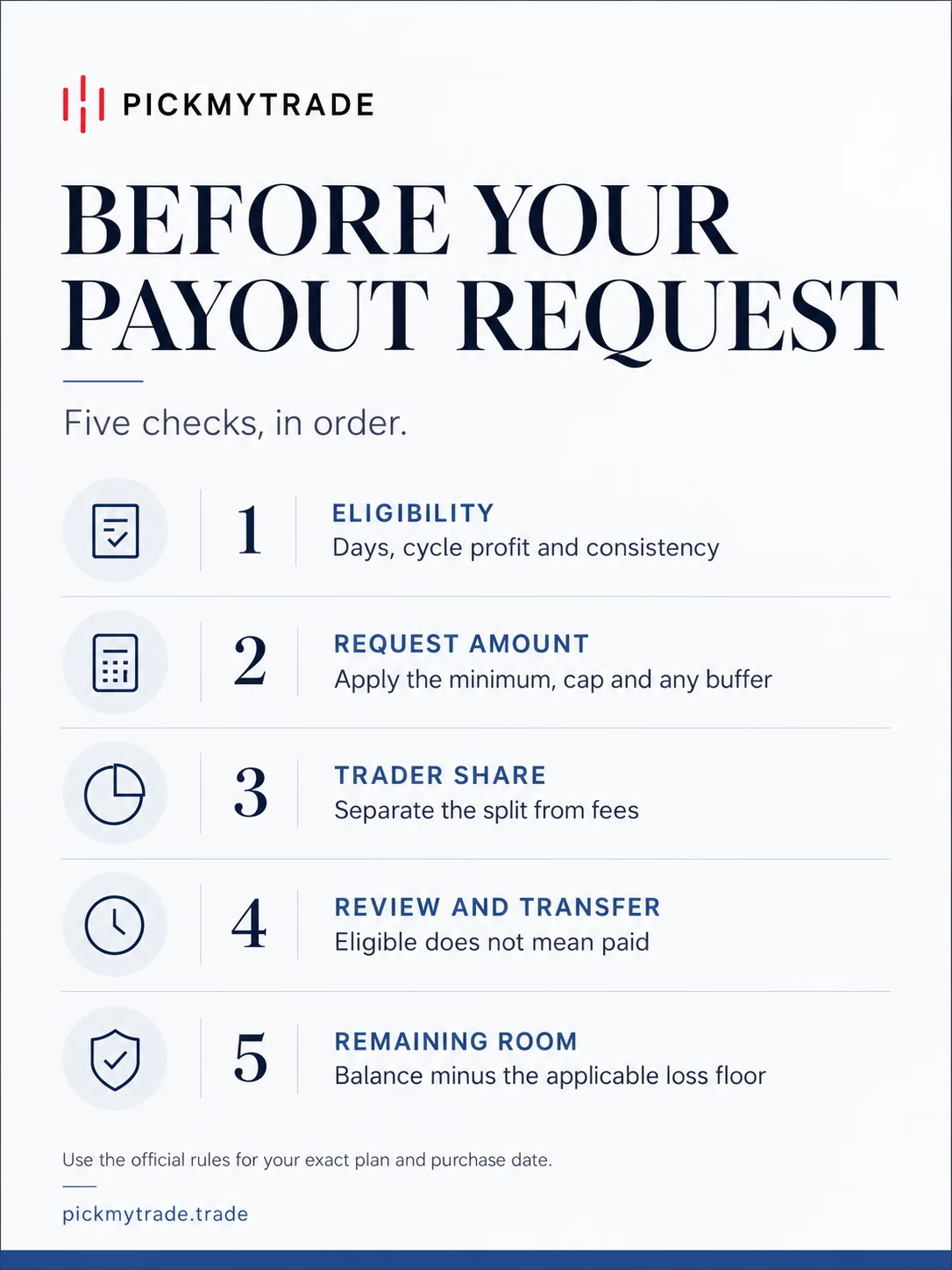
Before the first funded trade
Record the exact plan, selected add-ons, current floor, daily pause if any, permitted contracts and session deadline. After a profitable close or withdrawal, refresh those values. Keep payout qualification separate from account failure: a consistency problem can postpone a request without meaning that the account has already breached.
Use the ranking to narrow the policy pages you need to read. For a strategy that relies on automated execution, ultra-short holds, news entries or holding through the close, the relevant conduct clause is a selection gate. A high tier cannot make an incompatible strategy permissible.