
Introduction
Trading psychology and automation are now central to modern investing, especially as markets become faster and more volatile. Emotional pitfalls such as FOMO, loss aversion, and revenge trading continue to derail traders, but automated systems provide a structural solution by enforcing discipline and consistency. This article explores how automation mitigates psychological biases, strengthens risk management, and improves long-term trading performance.
Table of Contents
How Automation Tackles These Issues
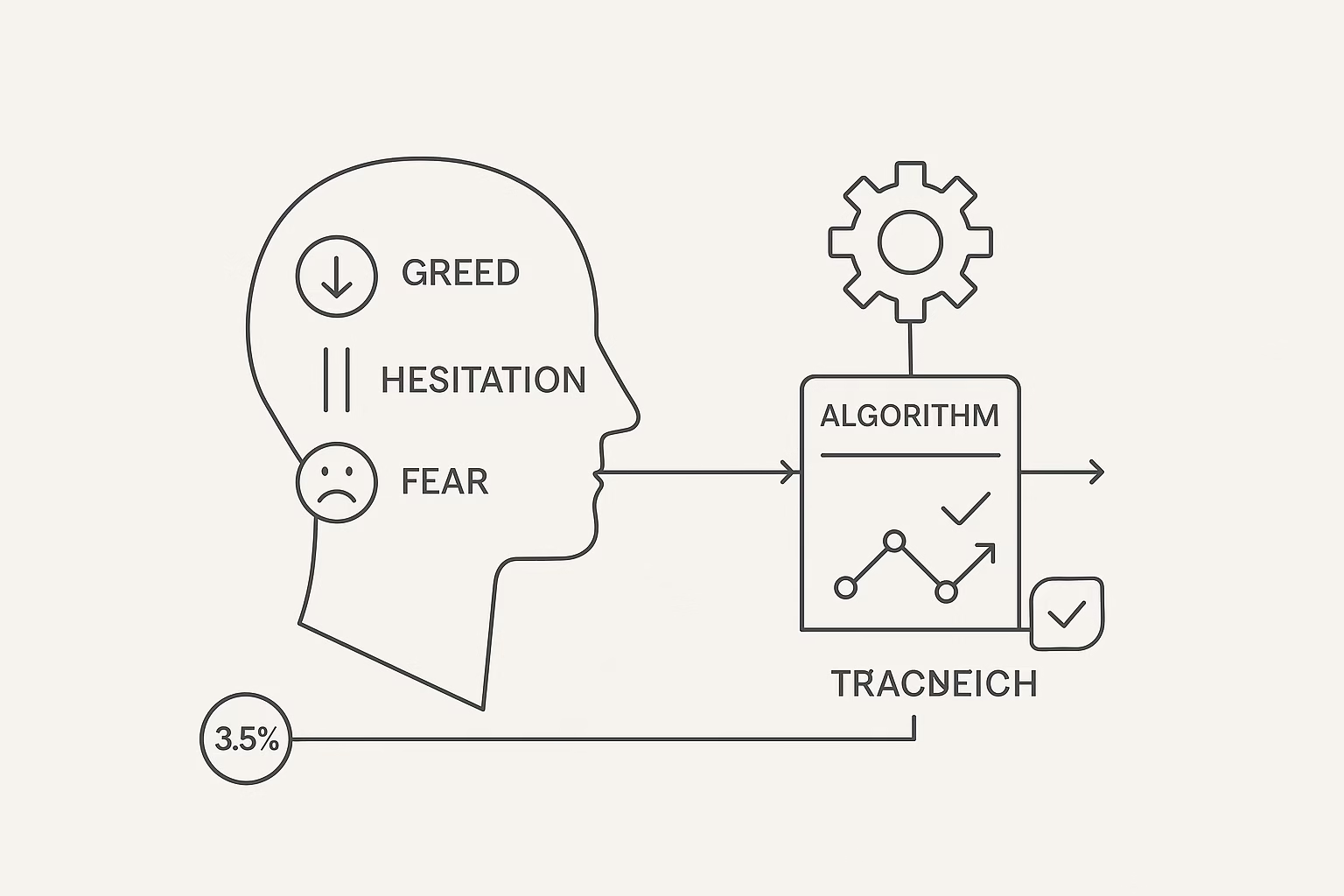
Automation uses algorithms to execute trades based on predefined criteria such as price levels or technical indicators, taking emotion out of the moment of execution. A stop-loss or take-profit order fires automatically once it’s triggered, so there’s no window for fear or hope to override the plan. This is the same principle behind disciplined, rules-based investing generally: a strategy that gets followed consistently tends to hold up better over time than one that gets abandoned under stress.
Core Benefits of Automated Trading
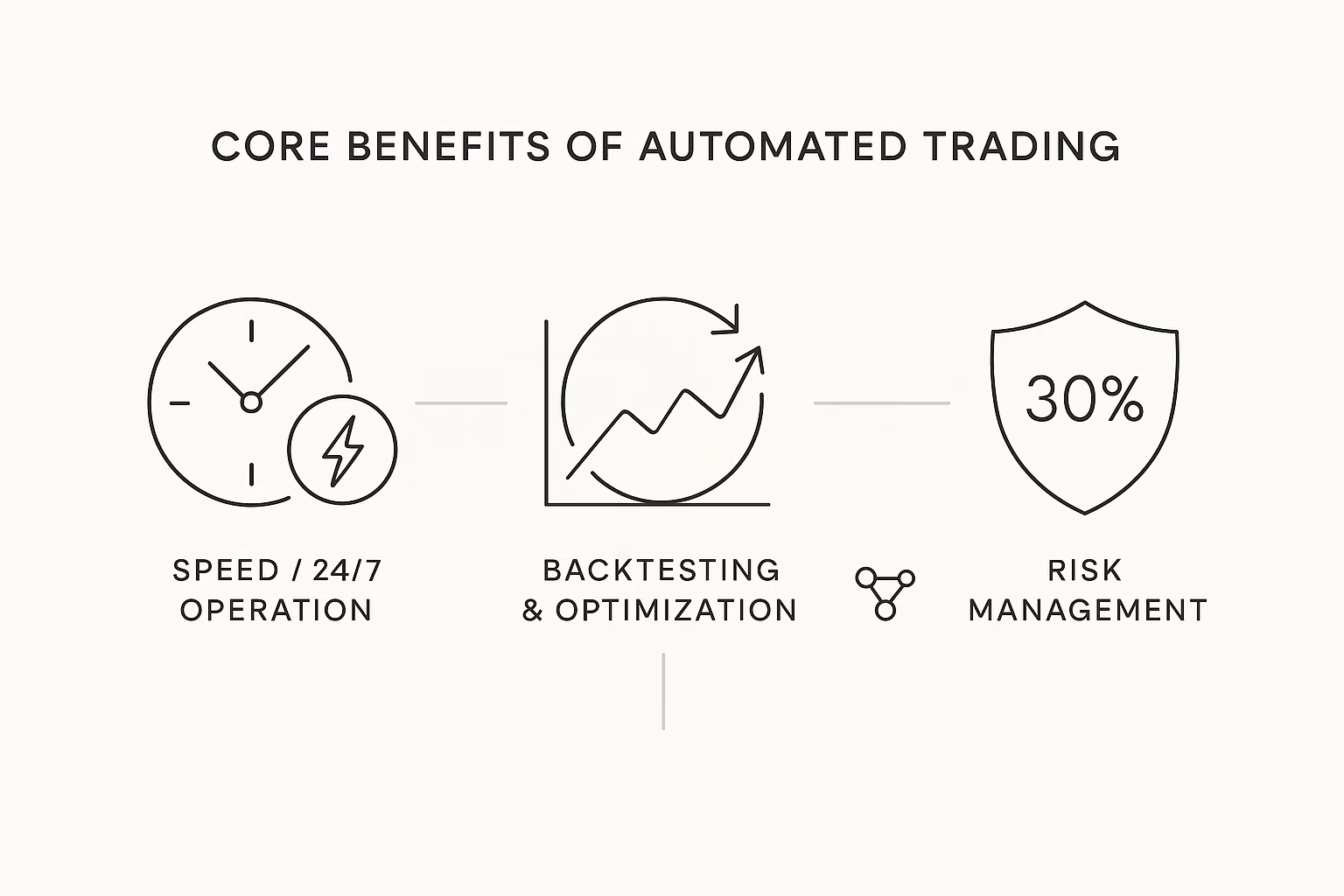
- Speed and 24/7 Operation: Executes trades instantly across markets, without fatigue or hesitation.
- Backtesting and Optimization: Historical simulations build confidence, reducing overconfidence bias.
- Risk Management: Built-in limits such as a maximum drawdown cap help enforce an exit before a losing streak turns into a blown account. Automation isn’t foolproof — over-optimized strategies or technical outages can still cause problems, so newer traders are usually better off keeping some human oversight alongside the system.
The Transformative Role of Trading Automation in Overcoming Psychological Barriers: A Comprehensive Exploration
In financial markets, where conditions can shift in seconds, psychology is often the biggest obstacle to consistent results. Traders deal with fear, greed, overconfidence, and regret, and each of these can distort judgment and erode returns. Automated trading offers a practical way to reduce that influence: once a strategy is coded and running, the system doesn’t get scared out of a good trade or greedy after a winning streak. This section looks at where trading psychology breaks down, how automation addresses it, what the tradeoffs are, and how to bring automation into a trading plan without losing the judgment that still matters.
The Anatomy of Trading Psychology: Identifying the Emotional Roadblocks
Trading psychology covers the mental and emotional responses that shape decisions under uncertainty. Technical analysis and market knowledge matter, but it’s often the mind that undoes an otherwise sound strategy. A large and long-running body of research on retail trading finds that most individual traders underperform simple market benchmarks, and psychological factors are one of the most commonly cited reasons why.
Key psychological challenges include:
| Psychological Bias | Description | Impact on Trading | Example |
|---|---|---|---|
| Fear of Missing Out (FOMO) | Urge to enter trades during hype, ignoring risk signals. | Leads to buying after a big move up, often right before a pullback. | Buying a stock right after it gaps up on a headline, then holding through the reversal that follows. |
| Loss Aversion | Preference to avoid losses over equivalent gains, holding losers too long. | Traders tend to hold losing positions too long hoping for a recovery, while closing winners early to lock in a smaller, safer gain. | Holding a declining position well after the original thesis has broken, hoping it recovers. |
| Greed and Overconfidence | Post-win euphoria prompting larger bets or overtrading. | Leads to oversized positions or trading more often than the plan calls for, raising the odds of a large loss. | Increasing position size after a winning streak, then giving back the gains on the next losing trade. |
| Confirmation Bias | Seeking data that supports preconceptions while ignoring contradictions. | Causes traders to miss valid exit signals because the signals don’t fit the story they want to believe. | Dismissing bearish signals during a strong uptrend because the recent trend has been so profitable. |
| Revenge Trading | Impulsive trades to recoup losses, fueled by frustration. | Leads to larger, impulsive trades aimed at recouping a loss quickly, which usually compounds the damage instead. | Taking an oversized, high-leverage trade right after a stop-out to try to “win it back.” |
| Analysis Paralysis | Overwhelm from data overload, delaying decisions. | Too many indicators or data points delay a decision until the opportunity has already passed. | Watching dozens of charts during a busy news period and freezing instead of acting. |
These patterns are well documented in behavioral finance. Research firms such as DALBAR have tracked the gap between the returns investment funds report and the returns individual investors actually earn for decades, and consistently point to poorly timed buying and selling — driven by emotion — as a major cause of that gap. The CFA Institute and other industry researchers cover similar ground in their ongoing work on investor behavior.
Automation as the Antidote: Mechanisms for Emotional Neutrality
Automated trading — whether through algorithmic systems, bots, or rule-based platforms — works by turning a strategy into code. Entries, exits, position sizing, and risk controls are defined in advance and triggered by market data, not by how the trader is feeling that day. That shift from discretionary to systematic execution is what changes the psychological picture.
Consider the core mechanisms:
- Rule-Based Execution: Algorithms follow predefined conditions — a moving average crossover, an RSI level, a specific price trigger — without discretion. There’s no chasing a headline or a social media trend mid-trade, which removes a common source of FOMO-driven entries and fear-driven exits.
- Consistent, Fast Processing: A person deciding whether to act on a signal can hesitate for minutes; a system acts as soon as its conditions are met. That consistency matters most exactly when emotions are running highest.
- Built-In Risk Safeguards: Stop-losses, position size limits, and maximum drawdown rules can be written directly into a strategy, so the risk plan isn’t something the trader has to remember to apply under pressure.
- Backtesting and Forward Testing: Testing a strategy against historical data, then running it on a small scale before committing real size, builds confidence in the approach itself — which reduces the temptation to override it later out of doubt.
The overall effect is that trading shifts from a series of individually stressful decisions to a process that runs on a predefined set of rules. That doesn’t remove judgment from trading altogether — someone still has to design, test, and monitor the strategy — but it does remove the moment-to-moment emotional interference that causes many of the mistakes described above.
Empirical Evidence: Quantifying the Benefits
It’s hard to put one precise number on how much automation improves results, since outcomes vary widely by strategy, market, and how strictly the underlying rules are actually followed. What research and industry experience point to consistently is a pattern, not a fixed percentage:
| Factor | Manual (Emotional) Trading | Rule-Based / Automated Trading |
|---|---|---|
| Consistency of execution | Varies with mood, news, and recent results. | Same rules applied every time, regardless of mood. |
| Gap vs. the strategy’s own backtested return | Often significant — the timing of entries and exits erodes returns. | Typically smaller — trades are placed as the rules specify, not as emotions dictate. |
| Drawdown management | Can spiral if a trader freezes or hopes a loss back to breakeven. | Capped by predefined stop-loss and exposure rules, if set correctly. |
| Trade cadence | Inconsistent — bursts of overtrading followed by inaction. | Steady, matching the strategy’s actual signal frequency. |
| Reaction speed | Can be delayed by seconds or minutes while deciding. | Executes as soon as the defined condition is met. |
None of this means automation guarantees profits — a badly designed or poorly risk-managed algorithm will lose money just as reliably as a bad discretionary strategy, just faster and more consistently. The real advantage is in closing the gap between a strategy’s theoretical performance and what a trader actually captures by following it exactly. Beyond the numbers, many traders who move from manual to automated execution also report a meaningful drop in day-to-day stress, simply because they’re no longer watching every tick and second-guessing themselves in real time.
Real-World Applications and Case Studies
Automation shows up across asset classes. In futures and forex, traders use rule-based systems to manage overnight risk and stick to a plan through volatile sessions, rather than closing out of fear mid-move. On the execution side, platforms that connect TradingView alerts directly to a broker — PickMyTrade is one example — let a trader who builds and backtests a strategy on a chart have it executed automatically, instead of manually placing the same trade under pressure every time the alert fires. That kind of automation doesn’t change the strategy itself, but it removes a common point where revenge trading and hesitation creep in: the gap between seeing a signal and acting on it.
Automation isn’t limited to fully hands-off systems, either. Many traders use a hybrid approach — automating execution and risk controls while keeping strategy decisions and periodic reviews in human hands. This keeps the benefits of consistent execution without removing the trader’s ability to adapt when market conditions genuinely change.
The main challenge traders run into is the temptation to override the system anyway — pausing it during a losing streak, or manually closing a trade the rules would have let run. Overriding a tested system without a logged, pre-defined reason tends to erode exactly the discipline automation is meant to provide. Most experienced automated traders set a hard rule for themselves: no manual overrides without writing down the reason in advance.
Strategies for Integrating Automation Effectively
To maximize benefits:
- Assess Your Biases: Journal your emotional triggers before automating anything, so you know which mistakes you’re actually trying to remove.
- Choose the Right Tools: Pick an automation approach that matches your broker and asset class. For traders working from TradingView alerts, a service like PickMyTrade can handle the connection to the broker so a signal executes the same way every time, instead of being retyped manually under pressure.
- Scale Gradually: Start with a modest share of your total capital and increase size only after the system has a track record you trust.
- Continuous Learning: Review performance regularly and adjust through proper forward-testing, not by tweaking the strategy mid-drawdown out of frustration.
- Hybrid Approach: Let automation handle execution and risk limits while keeping strategy design and periodic review as a human responsibility.
Looking Ahead: The Future of Emotion-Free Trading
Automated and algorithmic execution already account for a substantial share of trading volume in major markets, particularly among institutional participants, and that share has been growing for years as the tools become more accessible to individual traders too. The exact pace of that shift is hard to predict, but the direction is clear: more of the mechanical, repeatable parts of trading are handled by rules and code, freeing traders to focus on strategy and risk management rather than moment-to-moment execution.
In summary, trading automation doesn’t eliminate psychology from trading — it eliminates psychology from execution. The trader still has to build a sound strategy, manage risk, and recognize when the market has genuinely changed enough to warrant a rule change. What automation takes off the table is the daily temptation to override a plan in the heat of the moment, which for a lot of traders is where the real damage gets done.
You may also like:
Your AI Trading Copilot: How MCP Servers Transform Stock Market Analysis in 2025
AI-Powered Trading Decisions: How MCP Servers Turn Claude into Your Market Intelligence Engine
Key Citations
- DALBAR — investor behavior research (QAIB)
- CFA Institute — Enterprising Investor (behavioral finance coverage)