
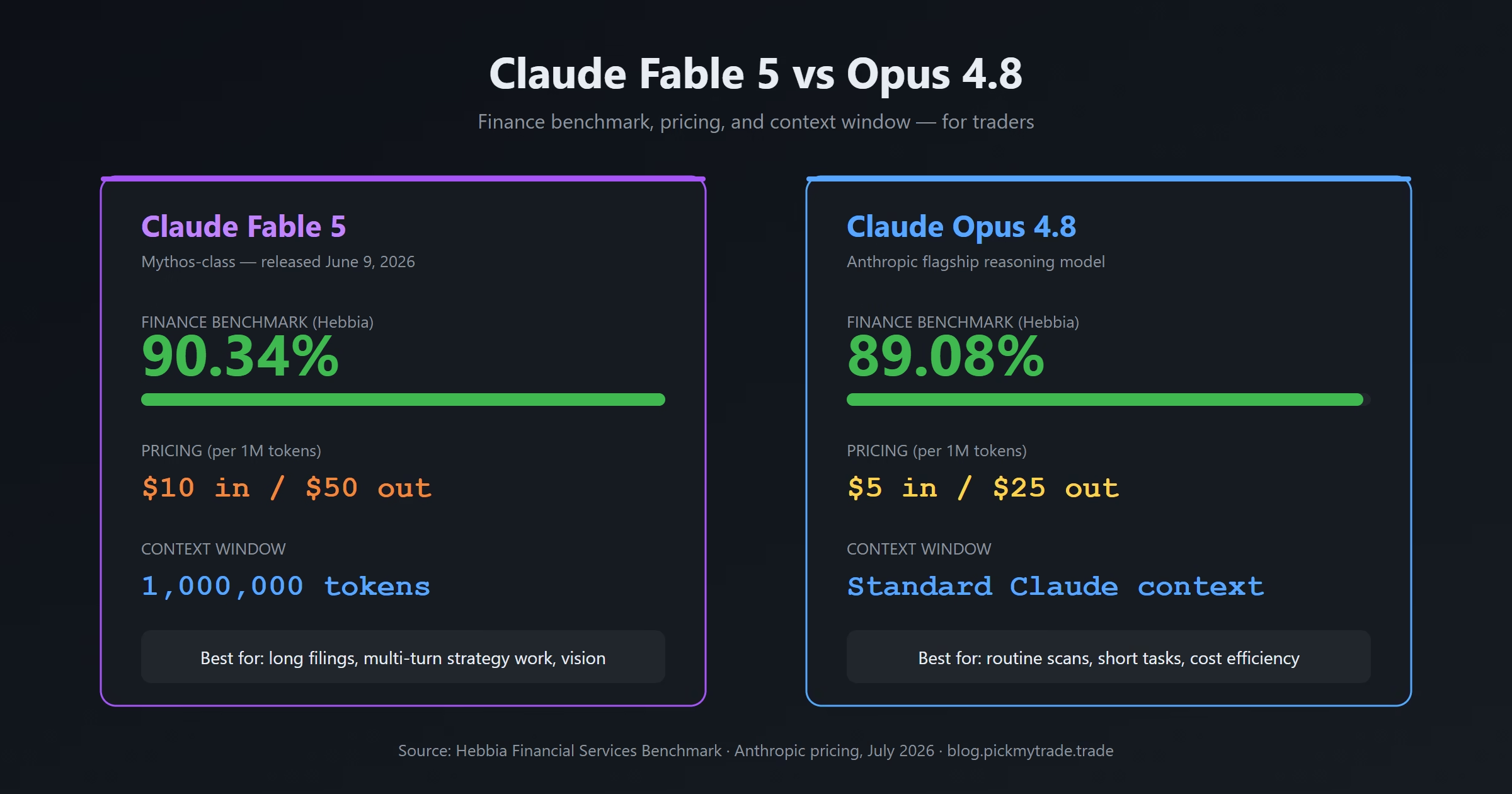
Quick answer: Claude Fable 5 is Anthropic’s strongest model for finance work, scoring 90.34% on Hebbia’s senior-level finance benchmark against Opus 4.8’s 89.08% — a real but modest gap. The bigger number is the price: Fable 5 runs $10/$50 per million input/output tokens versus $5/$25 for Opus 4.8, a flat 2x premium. For most trading research, Opus 4.8 is the better buy. Fable 5 earns its cost specifically on the long, multi-step jobs — reading a full 10-K cover to cover, holding a multi-file Pine Script strategy in memory across a long debugging session, or running an unattended agent for hours. Pick by task, not by “which model is smarter.”
Table of Contents
- What Actually Changed Between Opus 4.8 and Fable 5?
- How Much Better Is Fable 5 on Financial Reasoning, Actually?
- What Does the Extra Cost Actually Buy You?
- Which One Should You Use for Scanning, Strategy-Building, and Chart Reading?
- Where Both Models Still Fall Short
- Real-World Validation: What IMC’s Trading Desk Found
- So Which Should You Actually Pick?
- Neither Model Can Execute Your Trades
- Frequently Asked Questions
- You May Also Like
Written by the PickMyTrade team. PickMyTrade is our own trade-automation product; we’ve flagged that wherever it’s relevant.
Key Takeaways
- Claude Fable 5 leads Hebbia’s independent finance-reasoning benchmark at 90.34% accuracy — the first model ever to cross 90% — with Claude Opus 4.8 close behind at 89.08%.
- Fable 5 costs $10 input / $50 output per million tokens; Opus 4.8 costs $5 input / $25 output — exactly double.
- The trading firm IMC evaluated Fable 5 and found it aced trading-analysis evaluations nearly across the board, specifically because of its long-horizon task completion — it finishes extended, multi-step research chains without abandoning them partway through.
- Fable 5’s 1-million-token context window lets it hold an entire 10-K filing, or a multi-file trading strategy plus its backtest history, in memory at once — Opus 4.8’s practical working context is smaller in agentic sessions.
- Neither model can place a trade. Both stop at analysis and code generation; turning either one’s output into a filled order still requires an execution layer.
What Actually Changed Between Opus 4.8 and Fable 5?
Claude Opus 4.8 has been Anthropic’s flagship reasoning model since its release, and it’s the model behind most of the “Claude for trading” content published so far, including our own Claude 4.1 trading guide. Fable 5 is a different tier entirely — Anthropic’s first “Mythos-class” model made publicly available, released June 9, 2026, with capabilities the company said exceed anything it had previously shipped generally.
The rollout wasn’t smooth. On June 10, Anthropic was accused of quietly limiting some of Fable 5’s capabilities and had to walk the restriction back publicly. Two days later, on June 12, the US government placed Fable 5 under export controls barring access for foreign nationals, so Anthropic pulled the model globally — for everyone — to comply. That suspension lasted 18 days. The Commerce Department lifted the controls on June 30, and Anthropic restored worldwide access on July 1, 2026, with a tightened set of safety classifiers, particularly around cybersecurity-adjacent tasks.
None of that drama changes the two facts that actually matter for a trader deciding which model to pay for: Fable 5 is measurably stronger at finance reasoning, and it costs twice as much to run.
How Much Better Is Fable 5 on Financial Reasoning, Actually?
Anthropic doesn’t just claim Fable 5 is good at finance — it’s independently verifiable. Hebbia’s Financial Services Benchmark runs models against more than 600 real analyst questions pulled from actual finance workflows, split into three categories: extraction (pulling an exact number or quote from a document), summarization (condensing management commentary or filing language), and reasoning (multi-step judgment calls that require connecting several facts).
Fable 5 scored 90.34% — the first model to cross 90% on this benchmark. Opus 4.8 scored 89.08%, a gap of about a point and a quarter. That’s a real, measured difference, but it’s not the gulf the marketing copy implies. Where the gap widens is specifically in the reasoning category — the multi-step analysis work that takes a human analyst the longest and is where older, shorter-context models tend to lose the thread partway through a document.
Independent validation backs this up outside of a benchmark leaderboard. The proprietary trading firm IMC put Fable 5 through its own internal trading-analysis evaluations and reported it aced them nearly across the board. The specific reason IMC gave matters more than the headline: Fable 5’s advantage is long-horizon task completion — it finishes an extended, multi-step research chain in a single pass, with fewer abandoned attempts, than prior Claude generations managed on the same kind of work.
That’s the practical signature of the upgrade. It’s not that Fable 5 is a better analyst in a single-question sense — it’s that it doesn’t lose momentum on the fifteenth step of a long analysis the way earlier models sometimes did.
What Does the Extra Cost Actually Buy You?
| Model | Input (per 1M tokens) | Output (per 1M tokens) | Context window | Finance benchmark |
|---|---|---|---|---|
| Claude Fable 5 | $10.00 | $50.00 | 1,000,000 tokens | 90.34% |
| Claude Opus 4.8 | $5.00 | $25.00 | Standard Claude context | 89.08% |
Fable 5 is flatly 2x the price of Opus 4.8 on both input and output tokens, for a benchmark improvement of roughly one and a quarter percentage points. On a pure accuracy-per-dollar basis, that’s a bad trade for most work — Opus 4.8 currently has the best accuracy-per-dollar ratio of any model scoring above 88% on the finance benchmark.
Where the price gap stops mattering is the context window. Fable 5’s 1-million-token window is large enough to hold an entire 10-K filing — often 100-plus pages including footnotes — or several quarters of filings side by side, in a single conversation. It also supports genuinely long agentic sessions: developers have reported multi-hour autonomous coding runs where Fable 5 plans across stages, checks its own work, and picks back up exactly where it left off without you re-explaining the task. Opus 4.8 is still a capable model in a long conversation, but its practical working memory for holding an entire strategy codebase, its backtest report, and your edit notes all at once is smaller — which means more re-pasting, more context loss, and more chances for it to contradict a decision you made ten messages ago.
Anthropic’s own published guidance is blunt about this trade-off: route by task. Use Fable 5 for the hard, high-stakes, long-context jobs where a missed detail is costly. Use Opus 4.8 as the default for shorter, well-scoped work, where the two models perform much closer to each other and Opus 4.8’s lower cost wins outright.
Which One Should You Use for Scanning, Strategy-Building, and Chart Reading?
Breaking this down by the three jobs traders actually use these models for:
Scanning and screening. This is usually a repeated, well-scoped task — apply a fixed set of filters across a watchlist, rank the output. Opus 4.8 handles this comfortably and at half the cost; you don’t need a million-token context window to screen 200 tickers against a technical filter. Save Fable 5’s premium pricing for the rare scan that also requires reading long, unstructured context (news, filings) alongside the numeric screen.
Strategy-building and Pine Script. This is where Fable 5’s context advantage starts to pay for itself. Iterating on a multi-file strategy — the entry logic, the risk module, several rounds of backtest results, and your notes on what to fix — is exactly the kind of long, cumulative session where Opus 4.8 tends to lose earlier decisions and Fable 5 doesn’t. We cover the mechanics of this workflow in Write and Backtest a Pine Script v6 Strategy with Claude AI — the mechanics are the same regardless of which model generation you’re running; Fable 5 just holds more of the session without slipping.
Chart and document reading. Both models have vision capability, but Fable 5’s is measurably stronger — it set a new state-of-the-art on extracting precise data from charts, tables, and figures in Anthropic’s own vision benchmarks, and the Hebbia gains specifically included chart and table interpretation. If your workflow involves reading annotated charts, dense multi-page reports, or scanned filings, Fable 5’s vision edge is real and worth the premium.
For general research, connecting either model to live market data via MCP, or running a multi-model workflow where several AI “analysts” check each other, see our guides on connecting Claude to TradingView, TradingView MCP setup, and multi-agent AI trading.
Where Both Models Still Fall Short
Reading and reasoning about disclosed facts is a different skill than predicting what happens next, and neither model closes that gap. Independent crypto-price testing found Fable 5 was good at identifying the right risk metrics and reading the general direction of risk, but its specific price calls and timing missed too often to trust for position sizing. There’s no evidence Opus 4.8 does meaningfully better on the same kind of forecasting task — if anything, Fable 5’s longer context and stronger reasoning should make it the more reliable of the two for exactly this reason, and it’s still not reliable enough to trade on.
Treat both models the same way: excellent at telling you what a document says and what changed, useful for building and refining the logic of a strategy, and not a source of price predictions you should size a position around.
Real-World Validation: What IMC’s Trading Desk Found
IMC’s internal evaluation is worth returning to because it’s one of the few assessments of Fable 5 that comes from an actual trading operation rather than a benchmark leaderboard or a vendor blog post. The firm’s finding — that Fable 5 aced its trading-analysis evaluations largely because it completes long research chains without abandoning them — is the single most useful data point in this whole comparison, because it tells you exactly what kind of task justifies the 2x price: the long ones, not the short ones.
So Which Should You Actually Pick?
| Your situation | Pick | Why |
|---|---|---|
| Routine scanning, quick chart checks, short Q&A | Opus 4.8 | Same-tier accuracy on short tasks, half the cost |
| Reading a full 10-K, multi-quarter filing comparison | Fable 5 | 1M-token context holds the whole document set at once |
| Iterating on a multi-file trading strategy over many turns | Fable 5 | Long-horizon reasoning without losing earlier decisions |
| Cost-sensitive, high-volume automated research pipeline | Opus 4.8 | Best accuracy-per-dollar above 88% on the finance benchmark |
| Reading annotated charts, dense visual reports | Fable 5 | Measurably stronger vision on charts, tables, figures |
| You’re not sure yet | Start with Opus 4.8 | Upgrade to Fable 5 only for the specific tasks where it stalls |
Neither Model Can Execute Your Trades
This is the part that doesn’t change no matter which model wins the benchmark: Fable 5 and Opus 4.8 can both scan, research, write strategy code, and read a chart — but neither one has a connection to your broker. They stop at analysis.
That’s the layer PickMyTrade fills. Once either model helps you build a thesis or a strategy with a defined trigger, you set that as a TradingView alert with a webhook, and PickMyTrade executes it automatically on your account — Tradovate, Rithmic, Interactive Brokers, TradeStation, TradeLocker, and more, with bracket orders and risk controls, so the trade happens the moment your condition is met instead of waiting on you to be at the screen. For the technical setup connecting either model’s output directly to your broker via MCP, see our Interactive Brokers MCP + Claude Integration guide.
Frequently Asked Questions
Is Claude Fable 5 better than Opus 4.8 for trading?
On Hebbia’s independent finance benchmark, Fable 5 scores 90.34% versus Opus 4.8’s 89.08% — a real but modest edge. Fable 5’s bigger advantage is on long, multi-step tasks like reading full filings or iterating on a complex strategy, where its 1-million-token context window and stronger long-horizon reasoning matter more than the raw benchmark gap.
How much more expensive is Claude Fable 5 than Opus 4.8?
Exactly double: Fable 5 costs $10 per million input tokens and $50 per million output tokens, versus $5 and $25 for Opus 4.8.
Should I use Fable 5 or Opus 4.8 for Pine Script strategy development?
Opus 4.8 handles most Pine Script work fine at half the cost. Fable 5 pays for itself specifically on long, iterative sessions — a multi-file strategy with several rounds of backtest results and revisions — where its larger context window prevents it from losing track of earlier decisions.
Can either model place trades automatically?
No. Both Fable 5 and Opus 4.8 are analysis and code-generation tools with no built-in broker connection. To execute what either model produces, you need an automation layer like PickMyTrade connected via a TradingView webhook.
Is Claude Fable 5 available right now?
Yes. After launching June 9, 2026 and being pulled globally under a temporary US export-control order from June 12, Fable 5 was restored worldwide on July 1, 2026, across Claude.ai, the API, and major cloud platforms.
You May Also Like
- Claude 4.1 AI for Trading: 2025 Guide to Building an Algo-Trading Copilot — the earlier Claude generation’s full trading workflow guide
- Claude AI Pine Script: Write V6 Strategies That Actually Compile — the exact strategy-building workflow this post references
- Interactive Brokers MCP + Claude Integration — connect either model’s output straight to your broker
- Multi-Agent AI Trading: 20 Analysts, One System — stack several AI models against the same thesis
Ready to turn either model’s research into an actual trade? Start your PickMyTrade free trial and connect your first TradingView alert to your broker in minutes.
Sources: Anthropic — Claude Fable 5 and Claude Mythos 5, Anthropic — Redeploying Claude Fable 5, Hebbia — Financial Services Benchmark, CNBC — export controls lifted, TrueFoundry — Fable 5 vs Opus 4.8 benchmarks and pricing, Finout — Fable 5 and Mythos 5 pricing/benchmark comparison, Espressio — How Trading Desks Use Claude Fable 5: What IMC’s Evaluation Found, Yahoo Finance — crypto testing. Model pricing and benchmark results change fast — verify current figures before making a purchasing decision. Educational content, not financial advice.







Pingback: Claude AI for Trading: The Complete Resource Hub (2026)