
In the dynamic world of trading, where edges can make or break success, many experienced traders guard their strategies closely. Why traders hesitate to share trading strategies often boils down to protecting hard-won advantages in competitive markets. This hesitation persists even as online communities like TradingView—now boasting over 100 million users globally—encourage idea exchange and collaboration. While sharing can accelerate learning, core concerns keep full strategies private.
Understanding the Reluctance: Key Reasons Traders Hold Back
Traders invest countless hours refining systems through backtesting, forward testing, and real-market adjustments. Revealing details risks undermining that effort.
Fear of Diluting a Competitive Edge
A primary reason traders hesitate to share trading strategies is the potential for market impact. In less liquid markets, like certain futures contracts or niche stocks, widespread adoption could alter price action. More participants entering similar positions might reduce profitability or cause signals to fail as the market adapts. This “strategy dilution” concern remains valid in 2025, especially with growing retail participation.
The Role of Personal Ownership and Ego
Developing a profitable approach creates deep emotional investment. Traders often view their methods as unique achievements, tied to personal pride. Sharing opens the door to criticism or improvements by others, which can feel diminishing. Ego plays a part too—some prefer the status of being “the one who figured it out” rather than risking others outperforming with the same foundation.
Avoiding Ongoing Support Burdens
When traders do share, recipients frequently follow up with questions about tweaks, performance metrics, or adaptations to new conditions. This turns casual sharing into unintended mentorship, draining time and energy. Many prefer focusing on their own trading rather than managing others’ expectations.
Why Traders Hesitate to Share Trading Strategies: Benefits vs. Limitations of Opening Up
Sharing fragments—like risk management techniques or indicator setups—offers advantages without full exposure.
Benefits:
- Builds community knowledge and feedback loops.
- Accelerates collective learning in platforms like TradingView or Reddit’s r/Daytrading.
- Fosters collaborations on non-core elements, such as handling consolidations or optimizing stops.
Limitations:
- Full disclosure risks edge erosion.
- Invites endless support requests.
- Exposes traders to copycat competition without reciprocal value.
Real-World Use Cases: Where Selective Sharing Shines
Experienced traders often contribute by discussing solutions to common problems rather than complete systems:
- Improving stop-loss placement during volatile sessions.
- Adjusting position sizing for better risk control.
- Handling false breakouts in trending markets.
- Integrating volume profile analysis for confluence.
- Backtesting modifications for changing volatility regimes.
These contributions help others while preserving proprietary edges.
Click Here To Start Futures Trading Automation For Free
Automating Your Private Strategies with PickMyTrade
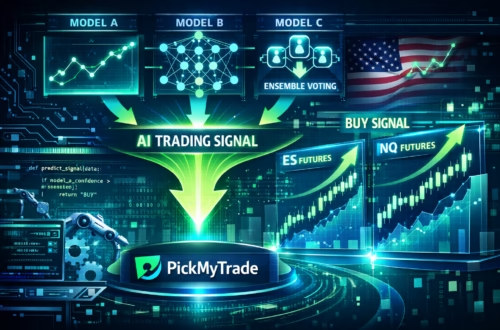
Instead of sharing, many traders automate personal strategies for hands-free execution. PickMyTrade bridges TradingView alerts to brokers like Tradovate, Rithmic, and Interactive Brokers with millisecond precision—no coding required.
This keeps your edge private while eliminating manual intervention.
Setup Checklist for Automating Strategies Using PickMyTrade
Follow these steps to connect TradingView alerts to PickMyTrade:
- Sign up for a PickMyTrade account (5-day free trial available, no card needed).
- Connect your broker (Tradovate, Rithmic, Interactive Brokers, etc.) via one-click integration.
- In PickMyTrade dashboard, generate a unique webhook URL and sample JSON payload.
- On TradingView, create an alert on your strategy/indicator.
- Paste the PickMyTrade webhook URL into the alert’s Webhook field.
- Insert the JSON payload into the alert message (customize fields like action, symbol, quantity).
- Test with a demo account to verify execution.
5 Practical Trading Examples or Scenarios Where This Automation Helps
- Futures Scalping on ES/NQ: EMA crossover signals buy/sell; automation enters micro-contracts instantly during high-volatility opens, capturing quick moves without screen watching.
- Breakout Trading: Price breaches a drawn trendline; webhook triggers market entry with bracket orders (TP/SL), ideal for news events on Tradovate.
- Mean Reversion Plays: RSI divergence alerts reversal; automate entries on Rithmic for low-latency futures execution.
- Multi-Account Prop Firm Trading: Same alert routes to multiple Tradovate prop accounts simultaneously for scaled risk.
- Overnight Position Management: Indicator signals exit on close; trailing stops adjust automatically via Interactive Brokers integration.
Benefits & Risks
Benefits:
- Executes trades 24/7 with precision, reducing emotional errors.
- Keeps strategies fully private—no sharing required.
- Supports unlimited strategies and multi-broker routing.
- Millisecond execution on supported brokers.
- Easy testing in demo mode.
Risks:
- Technical glitches (e.g., webhook delays) could miss signals.
- Over-reliance on automation without monitoring market changes.
- Broker-specific issues like contract rollovers needing configuration.
- Potential for amplified losses if risk parameters are mis-set (always use demo first).
Common Setup Pitfalls
- Using incorrect symbol mapping (e.g., TradingView MNQ1! vs. broker MNQZ25)—enable auto-mapping in PickMyTrade.
- Forgetting open-ended alert expiration, causing alerts to stop.
- Mismatched quantity/risk settings leading to oversized positions.
Advanced Tips
- Use partial exits with advanced TP/SL groups for scaled profit-taking.
- Add passphrase security to webhooks for extra protection.
- Combine with TradingView’s Pine Script plots for dynamic TP/SL levels.
Most-Asked FAQs
Why do profitable traders rarely share full strategies?
They fear losing their edge through market adaptation or saturation, plus avoiding constant support requests.
Is strategy dilution a real concern in 2025?
Yes, especially in futures and niche markets where increased volume from copycats can impact pricing.
Can I benefit from communities without sharing my strategy?
Absolutely—focus on discussing general techniques like risk management or indicator tweaks.
How does PickMyTrade differ from direct broker integrations?
It requires no API coding, supports multiple brokers, and handles complex orders via simple webhooks.
Do I need a paid TradingView plan for webhooks?
Yes, webhook alerts require at least the Essential plan.
Can automation handle partial exits or trailing stops?
Yes, PickMyTrade supports advanced TP/SL and trailing features via payload configurations.
Disclaimer:
This content is for informational purposes only and does not constitute financial, investment, or trading advice. Trading and investing in financial markets involve risk, and it is possible to lose some or all of your capital. Always perform your own research and consult with a licensed financial advisor before making any trading decisions. The mention of any proprietary trading firms, brokers, does not constitute an endorsement or partnership. Ensure you understand all terms, conditions, and compliance requirements of the firms and platforms you use.
Also Checkout: Automate TradingView Indicators with Tradovate Using PickMyTrade








The concern about strategy dilution is a major one—especially in niche markets where small changes can have a big impact. It’s hard to strike the right balance between sharing for learning and protecting what makes a strategy successful.