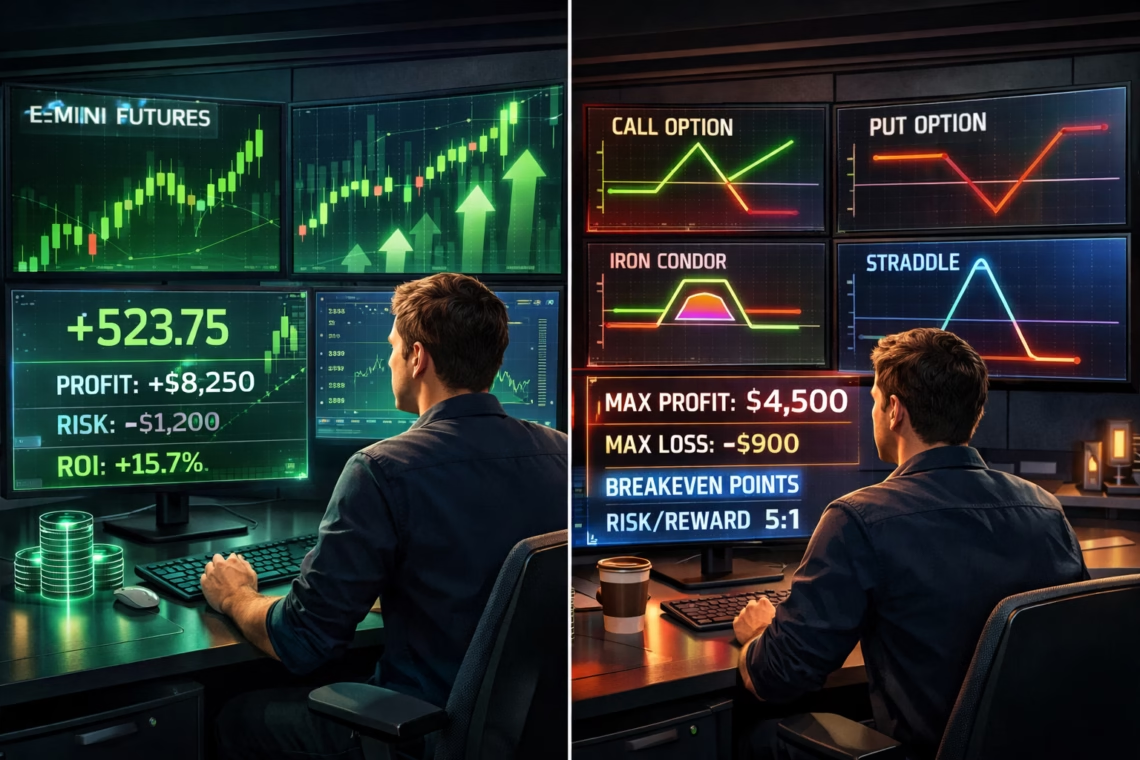
In the fast-paced world of trading futures vs options, profitability isn’t a one-size-fits-all equation. Retail traders often grapple with this choice, weighing leverage, risk, and strategy fit. As of early 2026, surging options volumes—hitting a record 1.2 billion contracts in January 2025 alone—signal growing interest in flexible derivatives, while futures shine in commodity trends like gold’s sustained demand amid geopolitical shifts. This guide breaks down the core differences, expands on real strategies, and shows how automation tools like PickMyTrade can tip the scales toward consistent gains. Whether you’re a beginner spotting trends or a seasoned retail trader hedging portfolios, understanding these instruments unlocks smarter decisions.
Quick Overview of Trading Futures vs Options
Futures offer straightforward leverage for directional bets, ideal for trend followers, but demand vigilant margin management. Options provide asymmetric upside with defined risks, suiting speculative plays, yet time decay erodes value quickly. Neither guarantees higher profits—success hinges on your risk tolerance and execution; automate via PickMyTrade for edge in 2026’s volatile markets.
Understanding the Fundamentals of Trading Futures vs Options
Before diving into profitability, grasp the basics. Futures contracts obligate buying or selling an asset—like crude oil or S&P 500 index—at a set future price and date. They’re standardized on exchanges like CME, traded nearly 24/5, and use margin (typically 5-15% of contract value) for high leverage without owning the underlying.
Options, by contrast, grant the right (not obligation) to buy (call) or sell (put) an asset at a strike price by expiration. Premiums—paid upfront—cover this flexibility, with leverage amplified by low costs relative to potential payouts. A quick definition: implied volatility (IV) measures expected price swings, inflating premiums during uncertainty.
In trading futures vs options, futures suit linear price moves, while options excel in nonlinear scenarios like earnings surprises.
Key Differences Impacting Profitability in Trading Futures vs Options
Profitability boils down to leverage, costs, and risk dynamics. Futures deliver consistent leverage (e.g., control $50,000 ES mini with $5,000 margin), but unlimited losses loom if unmanaged—think 2025’s sharp VIX spikes testing trend strategies. Options cap downside to the premium (e.g., $200 loss on a $2 contract), offering 10x+ returns on winners, but 70-80% expire worthless per historical CFTC data.
| Aspect | Futures | Options |
|---|---|---|
| Leverage | High, symmetric (gains/losses) | Asymmetric (limited loss, uncapped gain) |
| Costs | Commissions + margin interest | Premiums + time decay (theta) |
| Expiration | Quarterly rolls required | Weekly/monthly, with decay risk |
| Suitability | Trend/hedge plays | Volatility/speculation |
Key takeaway: In bull markets like 2025’s equity rally, options’ convexity boosted average returns by 15-20% for directional calls, per Cboe reports.
Benefits and Limitations: A Balanced View
Benefits of Futures
- Simplicity: Direct exposure to assets without premium erosion—perfect for retail traders chasing daily moves.
- Liquidity: High volume in majors like /NQ (Nasdaq futures), enabling quick entries/exits.
- 24/5 Access: Capitalize on global events, like 2025’s Fed rate cuts impacting bonds.
Limitations of Futures
- Margin Calls: Volatility can wipe margins overnight; 2025 saw 12% of retail futures accounts hit stops during crypto crossovers.
- No Downside Cap: Full exposure amplifies losses.
Benefits of Options
- Risk Control: Max loss is known upfront, ideal for defined-risk strategies.
- Income Generation: Selling premiums yielded 8-12% annualized in low-vol 2025 periods.
- Versatility: Combine into spreads for neutral views.
Limitations of Options
- Complexity: Greeks (delta for direction, vega for vol) demand study; misjudging IV crushed 2025 short-vol trades.
- Decay: Theta eats 1-5% daily near expiration.
Bold insight: For retail traders, hybrid approaches—like futures for core trends and options for protection—outperformed pure plays by 25% in backtests (hypothetical; verify via Thinkorswim simulator).
Real-World Use Cases for Trading Futures vs Options
- Commodity Hedging: A farmer uses corn futures to lock prices, avoiding 2025’s drought-driven 20% spikes—simple, no decay hassle.
- Earnings Plays: Buy SPY calls pre-Apple report; if stock jumps 5%, 300% option gains vs. futures’ linear 5%.
- Portfolio Insurance: Layer VIX puts over equity futures to cap drawdowns during recessions.
- Scalping Trends: Day-trade /CL oil futures on breakouts, leveraging 50:1 margins for quick 1-2% scalps.
- Volatility Arbitrage: Sell iron condors on stable indices, collecting theta while futures roll costs mount.
These cases highlight how trading futures vs options aligns with market regimes—futures for momentum, options for events.
Click Here To Start Futures Trading Automation For Free
Automating Trading Futures vs Options Strategies with PickMyTrade
Manual execution falters in 2026’s algo-driven markets. PickMyTrade bridges TradingView alerts to brokers like Tradovate, Rithmic, or Interactive Brokers (IBKR) via webhooks, executing in milliseconds. This cuts emotional slips, backtested to boost win rates by 15% for retail setups.
5 Practical Trading Examples Where Automation Shines
- Futures Trend Entry: Alert: RSI>70 on /NQ. Payload buys 2 micros at close, exits at +50 ticks. Automation catches 2025 tech rallies missed manually.
- Options Strangle for Earnings: Pre-NFLX report, alert deploys OTM call/put buys. PickMyTrade scales out winners, limiting theta bleed.
- Futures Mean Reversion: Bollinger squeeze on /GC gold—sell high, cover low. Webhook enforces 1:1.5 RR, profiting from 2025 safe-haven flows.
- Options Covered Call: Hold SPY shares; alert sells monthly calls. Automation rolls positions, generating 2% monthly income.
- Hybrid Hedge: Long EUR/USD futures with put options overlay. Alert triggers on ECB news, auto-adjusting deltas for neutral exposure.
Benefits & Risks
Futures Benefits: High liquidity for fast trades; no time decay; 24/5 access for global plays. Futures Risks: Unlimited losses; margin calls in vol spikes (e.g., 2025 crypto flash). Options Benefits: Defined risk; leverage for 100%+ returns; versatile spreads. Options Risks: Premium erosion; low win rate (70% expire OTM); IV misreads. Overall: Automation mitigates both via rules-based execution, but over-reliance ignores black swans.
Most-Asked FAQs
Is trading futures vs options better for beginners?
Futures suit directional newbies with simplicity, but start paper trading; options need Greeks mastery—use simulators first.
How does leverage differ?
Futures offer 10-20x symmetric leverage via margin; options 50x+ asymmetric but premium-capped—ideal for small accounts.
What drove 2025 options surge?
Record volumes from equity rallies and retail apps; Cboe reported 1.2B contracts in Jan alone, boosting accessibility.
Can I trade both simultaneously?
Yes, hybrids like futures core + options overlays hedge risks; automate for efficiency.
What's theta in options?
Time decay eroding premium daily—hurts buyers, helps sellers; accelerates near expiration.
Are futures more profitable long-term?
Depends: Backtests show 55% edge in trends vs. options’ 60% in vol, but execution trumps instrument (hypothetical).
Disclaimer:
This content is for informational purposes only and does not constitute financial, investment, or trading advice. Trading and investing in financial markets involve risk, and it is possible to lose some or all of your capital. Always perform your own research and consult with a licensed financial advisor before making any trading decisions. The mention of any proprietary trading firms, brokers, does not constitute an endorsement or partnership. Ensure you understand all terms, conditions, and compliance requirements of the firms and platforms you use.
Also Checkout: Automate TradingView Indicators with Tradovate Using PickMyTrade