Markets don’t move in straight lines — they shift between distinct “regimes” of behavior. One day volatility is low and trends persist; the next, chaos erupts with sharp reversals. Regime detection is the quantitative edge that identifies these transitions in real time, letting traders adapt strategies, size positions, and protect capital before the crowd reacts.
In 2026, with structural uncertainty baked into policy, geopolitics, and AI-driven flows, mastering regime detection has never been more critical. This guide walks you through proven and cutting-edge methods, recent breakthroughs, and a practical way to automate regime-aware trades on US futures markets.
What Is Regime Detection?
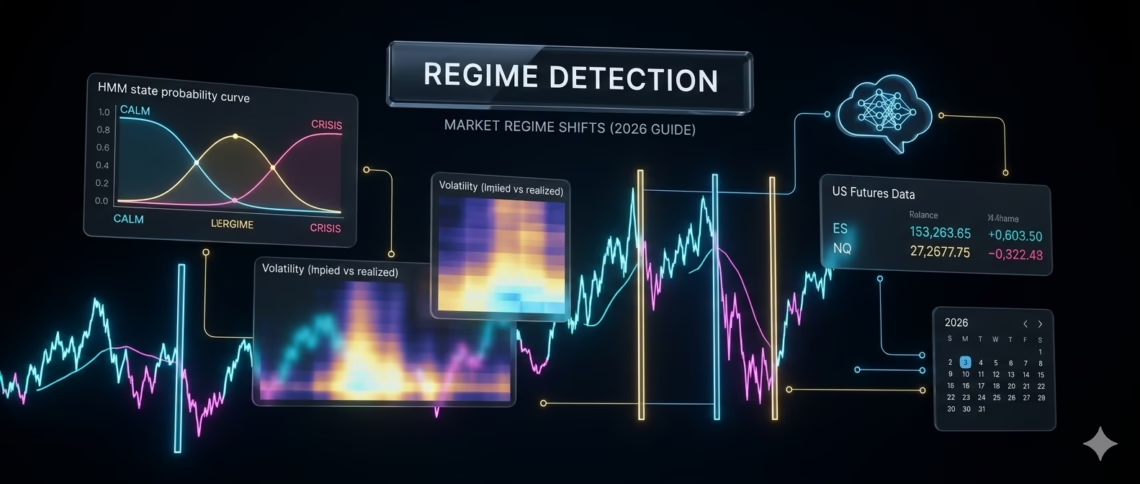
Regime detection is the process of statistically or algorithmically identifying when financial markets transition between latent states — such as expansion (bullish, low-vol), contraction (bearish, high-vol), or neutral (sideways). These states are “hidden” because we observe only price, volume, and indicators, not the underlying regime itself.
Think of it as a market mood detector: calm vs. turbulent, trending vs. range-bound. Once detected, you can switch models, adjust leverage, or pause trading entirely. Without regime detection, even the best strategy fails when the environment changes.
Why Regime Detection Matters for Traders in 2026
Markets in 2025–2026 demonstrated rapid regime flips — from policy-driven euphoria to liquidation cascades. The global Market Regime Detection AI market itself exploded from $1.49 billion in 2024 to $1.84 billion in 2025 (CAGR 23.8%), projected to hit $4.28 billion by 2029.
Traders who ignore regime detection suffer larger drawdowns and missed opportunities. Those who embrace it achieve higher Sharpe ratios, lower volatility, and consistent outperformance across bull, bear, and neutral phases.
Core Techniques for Effective Regime Detection
Hidden Markov Models (HMM) — The Gold Standard
HMMs remain the most widely used tool for regime detection. They model two layers:
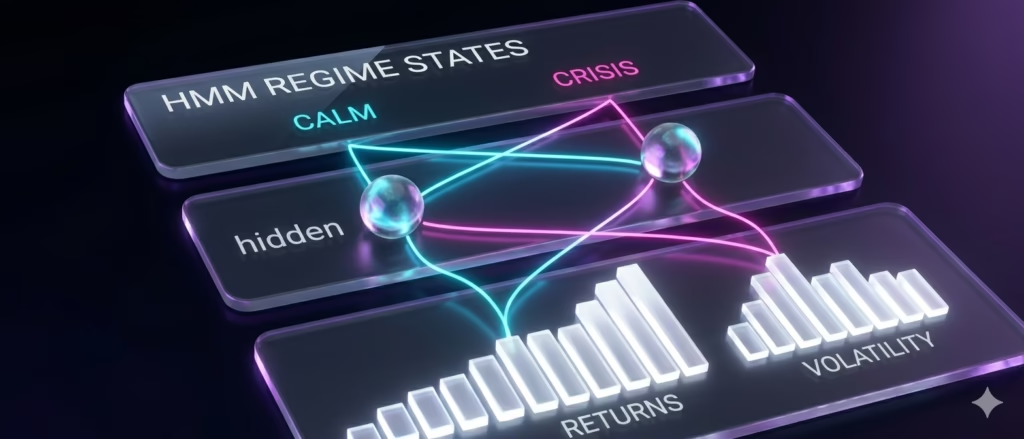
- Hidden states (e.g., “calm” vs. “crisis”)
- Observable emissions (returns, volatility, technical indicators)
The model learns transition probabilities and emission distributions, then infers the most likely current regime. Recent implementations on S&P 500 futures and Bitcoin data (2024–2026) show strong accuracy in spotting volatility spikes before they widen.
Gaussian Mixture Models (GMM) and Clustering
Unsupervised alternatives like GMM and k-means group data points into clusters that naturally form regimes. LSEG’s 2023 AI framework (still influential) combines HMMs, GMMs, and k-means for robust multi-regime classification.
Advanced 2025–2026 Innovations
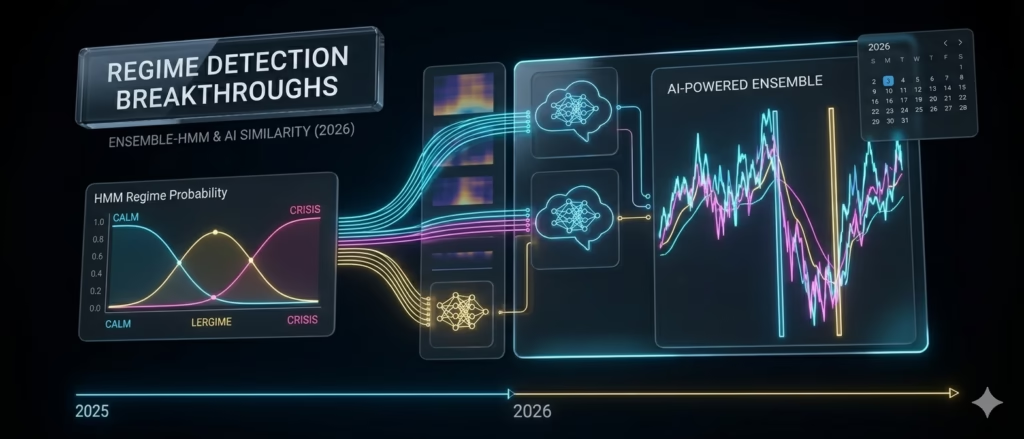
- Ensemble-HMM Voting Frameworks: Combine XGBoost/Bagging with HMM via hybrid voting. On Russell 3000 and S&P 500 ETFs, these deliver Sharpe ratios up to 1.68, lower drawdowns, and fewer false signals than standalone models.
- Similarity-Based Regime Detection (Mulliner et al., March 2025): No predefined states — simply measure how closely current economic variables match historical periods. Long factors when history favors them, short when “anti-regimes” dominate. Produced statistically significant alpha and positive skewness.
- Wasserstein Clustering and Geometric “Market Folding”: Use optimal transport distances or eigenvalue entropy for high-dimensional regime mapping — more robust to noise than traditional HMMs.
Recent Advances Keeping Regime Detection Cutting-Edge
2025 delivered six distinct crypto regimes driven by policy, hacks, regulation, and macro shocks — each with unique open-interest, funding, and liquidation signatures. Regime 5’s $15.3B liquidation cascade permanently altered market depth, underscoring why real-time regime detection is essential.
Into 2026, the shift is structural: elevated term premia, multipolar geopolitics, and AI analytics dominate. New geometric and representation-learning approaches are emerging alongside cloud-based AI platforms that deliver regime signals in milliseconds.
Practical Implementation: Building Your Own Regime Detection System
- Gather features: daily returns, VIX, MACD, Bollinger Bands, yield spreads, oil prices.
- Train an HMM or ensemble model (walk-forward to avoid lookahead bias).
- Generate regime probabilities daily.
- Define rules: long equities in “bull” regime, rotate to treasuries/gold in “neutral,” hedge or reduce size in “bear.”
Platforms like TradingView let you script simple HMM-style indicators or use LuxAlgo-style regime tools.
Automate Your Edge with PickMyTrade on US Futures Markets
Detecting the regime is only half the battle — executing flawlessly 24/7 is the other. Enter PickMyTrade, the leading no-code automation platform built specifically for US futures traders.
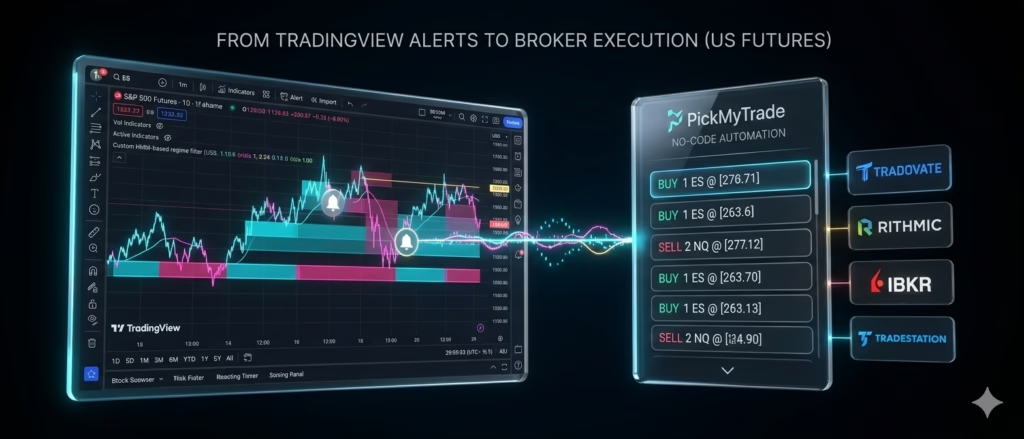
PickMyTrade connects TradingView alerts directly to brokers including Tradovate, Rithmic, Interactive Brokers, and TradeStation. You build your regime detection indicator or strategy on TradingView, set alerts, and PickMyTrade executes instantly on live, demo, or prop-firm accounts — no coding, no open charts required.
Key advantages:
- Millisecond execution, unlimited strategies/accounts/tickers
- Native futures logic (mini/micro scaling, risk automation)
- 24/7 operation with priority support
- Perfect for regime-adaptive systems: pause in high-vol regimes, scale aggressively in low-vol expansion phases
- $50/month or $500/year; 5-day free trial
Prop traders at Apex, TopStep, and Blue Guardian love it for consistent execution across funded accounts. Turn your regime detection signals into automated futures trades on ES, NQ, CL, and more — emotion-free and scalable.
Click Here To Automate Futures Trading
Real-World Performance and Risk Management
Backtests of ensemble-HMM strategies on S&P 500 ETFs show superior risk-adjusted returns versus buy-and-hold, with drawdowns cut by more than half in turbulent regimes. The new similarity-based method adds statistically significant alpha while maintaining positive skewness.
Always pair regime detection with robust risk rules: dynamic position sizing, stop-losses, and circuit-breaker logic. Remember, no model is perfect — slippage, latency, and black-swan events remain.
Conclusion: Make Regime Detection Your 2026 Superpower
Markets will keep shifting. The traders who thrive will be those who measure and adapt to those shifts in real time. Regime detection — powered by HMMs, ensembles, AI similarity metrics, and seamless automation — is no longer optional; it’s table stakes.
Start small: add a simple HMM filter to your existing system, test on US futures, then automate with PickMyTrade. The edge compounds.
The future belongs to regime-aware traders. Are you ready?
Most Asked FAQs
What exactly is regime detection in trading?
Regime detection identifies hidden market states (bull, bear, high-vol, low-vol) using statistical models so traders can adapt strategies dynamically.
How do Hidden Markov Models work for regime detection?
HMMs treat regimes as hidden states and price data as observations. They calculate transition probabilities and infer the current regime probability in real time.
Are there new regime detection methods in 2026?
Yes — ensemble-HMM voting, similarity-based economic matching, Wasserstein clustering, and geometric “Market Folding” approaches now outperform classic HMM alone.
Can regime detection improve automated trading?
Absolutely. Feed regime signals into TradingView alerts and let PickMyTrade execute automatically on Tradovate or Rithmic futures accounts — 24/7, no coding.
Does PickMyTrade support US futures regime strategies?
Yes. It’s purpose-built for futures, supports unlimited accounts, prop firms, and instant webhook execution — ideal for switching or pausing strategies by detected regime.
Disclaimer:
This content is for informational purposes only and does not constitute financial, investment, or trading advice. Trading and investing in financial markets involve risk, and it is possible to lose some or all of your capital. Always perform your own research and consult with a licensed financial advisor before making any trading decisions. The mention of any proprietary trading firms, brokers, does not constitute an endorsement or partnership. Ensure you understand all terms, conditions, and compliance requirements of the firms and platforms you use.
Also Checkout: Automate TradingView Indicators with Tradovate Using PickMyTrade