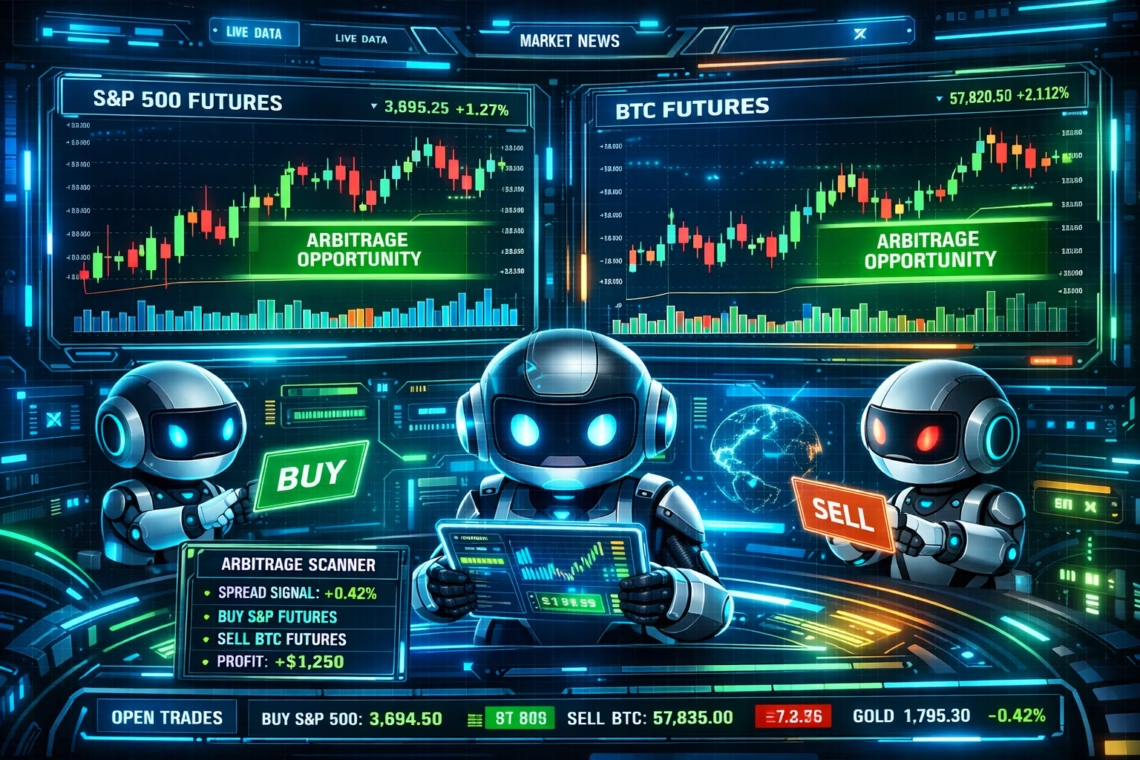
In the fast-evolving world of derivatives trading, futures arbitrage bots have become essential tools for traders seeking low-risk, consistent returns. These automated systems exploit price inefficiencies across futures contracts, exchanges, or between spot and futures markets—often through strategies like spread trading. As markets grow more efficient in 2026, with AI-driven execution and high-frequency tactics dominating platforms like Polymarket and crypto exchanges, manual trading struggles to compete. Futures arbitrage bots enable 24/7 monitoring, millisecond-speed trades, and reduced emotional bias, making them ideal for both retail and professional traders.
What Are Futures Arbitrage Bots and How Do They Work?
Futures arbitrage bots are software programs that automatically identify and execute trades on price discrepancies in futures markets. Common types include:
- Cross-exchange arbitrage: Buying low on one platform and selling high on another.
- Spot-futures arbitrage: Going long on spot assets while shorting perpetual futures to capture funding rates (delta-neutral strategies).
- Inter-contract spread trading: Exploiting differences between related futures contracts, such as calendar spreads or commodity vs. index futures.
These bots use real-time data feeds, APIs, and algorithms to scan markets, calculate potential profits (after fees and slippage), and execute trades instantly. In 2026, advancements in AI and machine learning allow bots to retrain models dynamically, adapting to volatility and predicting mispricings more accurately than ever.
Recent developments highlight their dominance: On prediction markets like Polymarket, arbitrage bots have generated millions in profits through high-frequency tactics and temporal arbitrage, far outpacing human traders. Crypto exchanges report refined spot-futures bots yielding 15-50% APR in funding rate plays, while regulatory shifts (e.g., EU’s DAC8 reporting) emphasize compliant, reliable automation.
The Power of Spread Trading in Futures Markets
Spread trading remains a cornerstone of futures arbitrage, focusing on the price difference (spread) between two related instruments rather than outright directional bets. This reduces directional risk and capitalizes on mean reversion.
In futures, common spread trading setups include:
- Calendar spreads (e.g., near-month vs. far-month contracts).
- Inter-commodity spreads (e.g., crude oil vs. natural gas).
- Basis trades in Treasuries or crypto perpetuals.
Futures arbitrage bots excel here by automating grid-based or statistical arbitrage within spreads, placing orders at predefined intervals to profit from fluctuations. Platforms like KuCoin and Phemex offer built-in futures grid bots for neutral, long, or short positions with leverage, while open-source tools enable custom spread trading logic.
In volatile 2026 markets—driven by geopolitical events and tokenized assets—spread trading via bots provides steadier returns than pure directional plays.
Recent Updates in Futures Arbitrage Automation (2026 Insights)
As of early 2026, key trends include:
- AI integration: Bots on Polymarket use ensemble modeling for real-time mispricing detection, with reports of $40M+ in arbitrage profits from 2024-2025 strategies continuing into now.
- Funding rate dominance: Exchange bots (e.g., Binance, OKX) automate delta-neutral spot-perps trades, capturing fees in perpetual futures.
- High reliability focus: Development prioritizes low-latency VPS, compliance, and risk controls amid tighter regulations.
- Cross-market expansion: Bots exploit inefficiencies between prediction markets, sportsbooks, and traditional futures.
Automation now handles over 70% of retail futures volume in some segments, with bots like those for crypto futures targeting 15-50% APR in arbitrage setups.
PickMyTrade: Streamline Your Futures Arbitrage Automation
For traders using platforms like Tradovate (popular for futures and prop firms), PickMyTrade stands out as a powerful automation solution. It connects TradingView strategies directly to brokers with millisecond execution, supporting automated futures trading without coding.
While not exclusively an arbitrage bot, PickMyTrade excels in automating spread trading signals, custom strategies, and risk-managed entries/exits—ideal for futures arbitrage setups. Features include:
- Seamless webhook integration for alerts.
- 24/7 auto-execution across futures markets.
- Prop firm compatibility (e.g., Apex, Topstep).
- Advanced risk tools like SL/TP and position sizing.
With over 3 million trades executed and a free trial, PickMyTrade empowers users to deploy futures arbitrage bots via TradingView indicators (e.g., UT Bot for signals) and focus on strategy refinement rather than manual monitoring.
Click Here To Start Trading Automation
Benefits and Risks of Using Futures Arbitrage Bots
Benefits:
- Speed and efficiency: Execute in milliseconds, capturing fleeting opportunities.
- Reduced risk: Spread trading and delta-neutral approaches minimize exposure.
- Scalability: Run multiple strategies 24/7.
- Consistency: Eliminate emotional decisions.
Risks:
- Slippage and fees can erode thin margins.
- Technical failures or latency issues.
- Market changes (e.g., reduced inefficiencies) or regulatory impacts.
- Over-leveraging in futures.
Always backtest, start small, and use robust risk management.
FAQs on Futures Arbitrage Bots
What is the best futures arbitrage bot in 2026?
Built-in exchange bots like Binance or OKX for funding rate arbitrage lead for simplicity, while customizable platforms like PickMyTrade suit advanced futures setups on Tradovate.
Are futures arbitrage bots profitable?
Yes, especially in funding rate or spread trading, with reported APRs of 15-50% in delta-neutral strategies—though results vary and involve risks.
How do futures arbitrage bots differ from spread trading bots?
Futures arbitrage bots target any price discrepancy; spread trading focuses specifically on related contract differences for lower-risk plays.
Is coding required for futures arbitrage bots?
No—many like PickMyTrade, Phemex, or exchange bots use no-code setups, though advanced users customize via APIs.
What markets work best for futures arbitrage bots?
Crypto perpetuals (funding rates), commodities, indices, and prediction markets like Polymarket show strong opportunities in 2026.
Disclaimer:
This content is for informational purposes only and does not constitute financial, investment, or trading advice. Trading and investing in financial markets involve risk, and it is possible to lose some or all of your capital. Always perform your own research and consult with a licensed financial advisor before making any trading decisions. The mention of any proprietary trading firms, brokers, does not constitute an endorsement or partnership. Ensure you understand all terms, conditions, and compliance requirements of the firms and platforms you use.
Also Checkout: Automate TradingView Indicators with Tradovate Using PickMyTrade









Futures arbitrage bots are becoming incredibly powerful with the integration of AI and machine learning. The ability to adapt to market volatility in real time could really give smaller traders an edge, allowing them to compete more effectively with the bigger players.