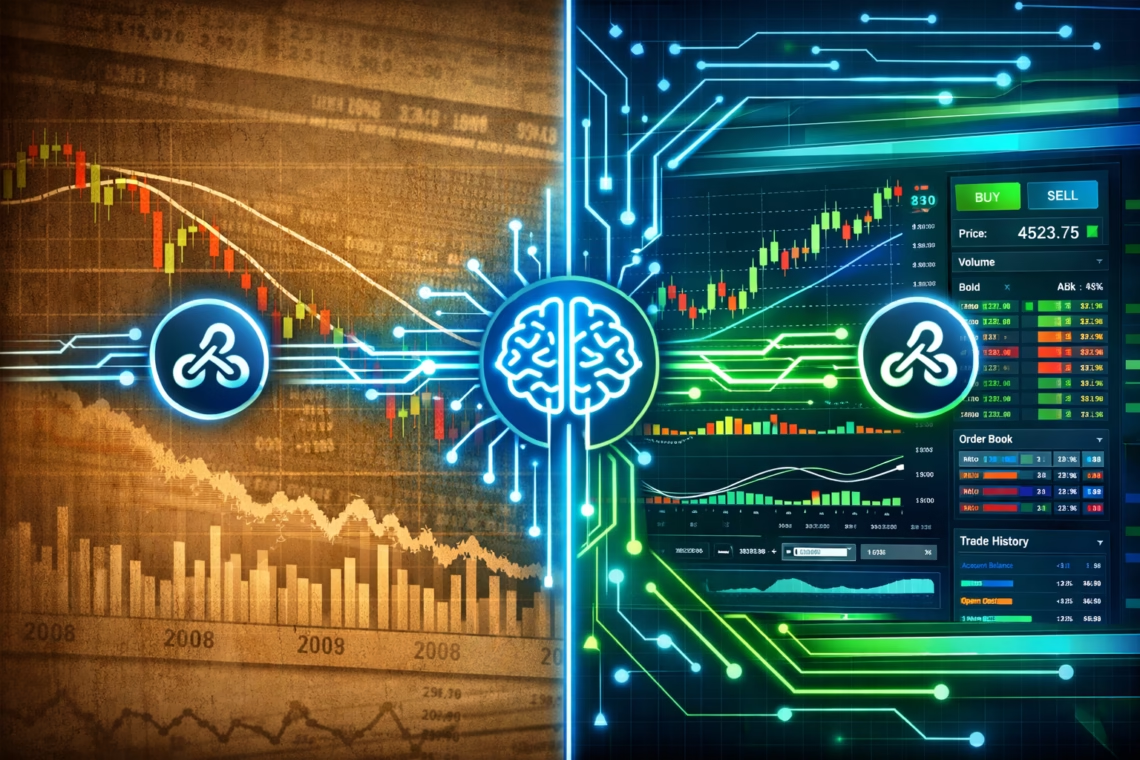
In the fast-paced world of trading, forward testing vs backtesting stands as a cornerstone debate for retail and algo traders alike. Backtesting lets you rewind the clock on historical data to spot patterns, while forward testing thrusts your strategy into live market chaos for real validation. This guide dives deep, blending timeless principles with 2025 updates like AI-driven walk-forward analysis to help you avoid costly pitfalls and automate smarter.
Whether you’re a retail trader tweaking indicators or an algo developer scaling bots, mastering forward testing vs backtesting ensures your edge survives real-world volatility. We’ll explore definitions, integrations, and PickMyTrade automation to bridge theory and execution.
What Is Backtesting? Simulate Past Performance for Future Wins
Backtesting applies your trading rules to historical market data, replaying “what if” scenarios to gauge potential outcomes. Think of it as a time machine for strategies—test a moving average crossover on S&P 500 data from 2010-2020 without risking a dime.
Why Backtesting Speeds Up Strategy Refinement
Traders love backtesting for its efficiency: crunch decades of data in minutes using tools like Python’s Backtrader or TradingView’s replay feature. In 2025, AI enhancements now auto-optimize parameters, spotting overfitting early.
Key takeaway: It reveals win rates, drawdowns, and Sharpe ratios—vital stats for statistical confidence across bull, bear, and sideways markets.
Backtesting Pitfalls: Don’t Let History Fool You
Common traps include look-ahead bias (peeking at future data) and survivorship bias (ignoring delisted stocks). A 2025 study highlights how shorter 6-12 month tests outperform 20-year backtests by capturing recent algo dominance. Always validate with out-of-sample data to keep results grounded.
What Is Forward Testing? Validate in Live Fire
Forward testing, often called paper trading or live simulation, deploys your strategy on unseen, real-time data. Unlike backtesting’s rearview mirror, this forward march tests execution slippage, news shocks, and your own discipline.
Paper Trading: Risk-Free Real-Time Trials
Start here: Mimic trades on a demo account to feel market pulses. For instance, forward test a RSI divergence strategy during earnings season—did latency eat your fills?
Walk-Forward Analysis: The 2025 Evolution
This technique rolls optimized parameters forward through time, mimicking adaptive trading. Recent Interactive Brokers updates in March 2025 emphasize its role in robust evaluations, especially for futures where volatility spikes unpredictably.
Key takeaway: Forward testing uncovers psychological biases, like hesitation on losing streaks, that backtests miss entirely.
Forward Testing vs Backtesting: Head-to-Head Comparison
| Aspect | Backtesting | Forward Testing |
|---|---|---|
| Data Type | Historical (past prices) | Real-time (current/unseen data) |
| Speed | Instant (years in minutes) | Ongoing (days to weeks) |
| Cost | Zero risk | Low (demo) to moderate (small lots) |
| Strength | Pattern discovery, optimization | Execution reality, adaptability |
| Weakness | Biases, no live dynamics | Time-intensive, emotional factors |
Integrate both: Backtest for ideation, forward test for confirmation. This hybrid slashed false positives by 30% in a 2024 quant survey (source: QuantConnect forums—verify at quantconnect.com).
Real-World Use Cases: Where Forward Testing vs Backtesting Shines
- Scalping ES Futures: Backtest tick data for entry precision; forward test during NFP releases to handle slippage.
- Swing Trading Stocks: Optimize Bollinger Bands historically, then paper trade through 2025’s AI earnings hype.
- Crypto Mean Reversion: Backtest BTC pairs for cycles; forward validate amid ETF inflows (post-Jan 2025 approvals).
These scenarios highlight how forward testing vs backtesting turns theory into consistent edges.
Benefits vs Limitations of Forward Testing vs Backtesting
Benefits
- Rapid Iteration: Backtesting tests hundreds of tweaks fast; forward confirms viability.
- Holistic Validation: Combines stats with psychology for resilient strategies.
- Cost Savings: Spot flaws pre-capital deployment, boosting long-term ROI.
Limitations
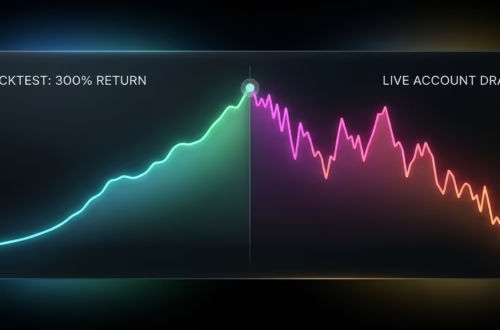
- Overfitting Risk: Backtests shine in-sample but flop live.
- Time Lag: Forward testing delays full deployment.
- Market Shifts: 2025’s SEBI F&O tweaks demand frequent revalidation.
Automating with PickMyTrade: From Alerts to Execution
Replace manual drudgery: PickMyTrade connects TradingView alerts to brokers like Tradovate, Rithmic, or Interactive Brokers via webhooks. This automation supercharges forward testing vs backtesting by enabling seamless live trials.
Common Setup Pitfalls
- Mismatched symbols—ensure TradingView ticker matches broker format (e.g., “ES1!” vs “ESZ24”).
- Ignoring rate limits—TradingView caps alerts; batch wisely.
- Unsecured webhooks—always use HTTPS to dodge interception.
Advanced Tips
- Layer risk params in JSON for dynamic sizing based on volatility.
- Use PickMyTrade’s multi-session feature for 24/7 forward testing across time zones.
- Integrate walk-forward via API hooks for auto-reoptimization.
Common Mistakes and Fixes in Forward Testing vs Backtesting
- Ignoring Slippage.Fix: Model realistic fills in backtests; forward test with micro-lots.
- Emotional Overrides.Fix: Stick to rules via PickMyTrade automation.
- Static Parameters.Fix: Employ 2025 walk-forward tools for adaptability.
Ready to automate? Get a 5-day free trial with PickMyTrade.
Most-Asked FAQs
What's the main difference in forward testing vs backtesting?
Backtesting uses past data for simulations; forward testing applies strategies live for real validation, catching execution nuances.
Can I backtest on TradingView?
Yes, use the Strategy Tester for historical replays—pair with PickMyTrade for automated forward leaps.
How long should I forward test a strategy?
Aim for 1-3 months or 100 trades to cover cycles; 2025 best practices suggest walk-forward for ongoing tweaks.
Does automation like PickMyTrade work for beginners?
Absolutely—step-by-step webhooks simplify it, but start with paper mode to learn.
What if my backtest shows 80% wins but live fails?
Likely overfitting; fix with out-of-sample forward testing and realistic slippage models.
Disclaimer:
This content is for informational purposes only and does not constitute financial, investment, or trading advice. Trading and investing in financial markets involve risk, and it is possible to lose some or all of your capital. Always perform your own research and consult with a licensed financial advisor before making any trading decisions. The mention of any proprietary trading firms, brokers, does not constitute an endorsement or partnership. Ensure you understand all terms, conditions, and compliance requirements of the firms and platforms you use.
Also Checkout: Automate TradingView Indicators with Tradovate Using PickMyTrade