ByteDance’s DeerFlow AI agent reached 59,700+ GitHub stars by April 2026, making it one of the most-watched open-source AI projects on the planet (GitHub — bytedance/deer-flow, April 2026). For retail traders drowning in earnings reports, analyst notes, and contradictory headlines, that kind of community traction means something. This guide walks you through exactly what DeerFlow is, how it works, how to set it up, and which prompts actually produce useful trading research.
Key Takeaways
- DeerFlow uses parallel sub-agents to synthesize deep research reports from a single prompt.
- Multi-agent AI systems show 42% better accuracy in complex financial forecasting vs. single-agent tools.
- You can run DeerFlow locally or via API on GPT-4/5, Claude, Gemini, or DeepSeek.
- Five ready-to-use prompt templates for stock, crypto, and sector research are included below.
- It’s free and open-source — setup takes under 30 minutes with a working Python environment.
What Is DeerFlow and Why Should Traders Care?
DeerFlow is an open-source, multi-agent AI research framework built by ByteDance. According to the Mercer 2024 AI in Investment Management Survey, 91% of asset managers either use AI or plan to, with 54% already active. The question isn’t whether AI belongs in your research process. It’s which tool actually delivers structured, cited, actionable output.
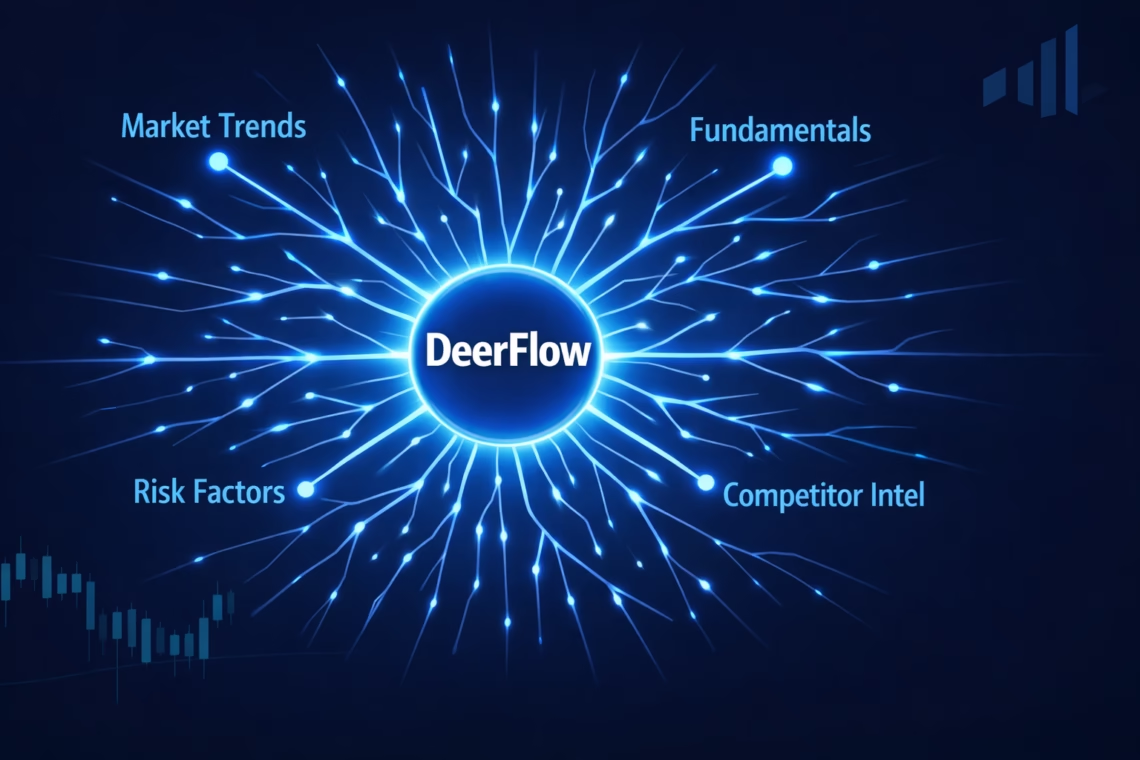
DeerFlow answers that question with a clear architecture. It takes a single research prompt and breaks the work across multiple specialized sub-agents, each investigating a different angle of your topic simultaneously. The results converge into one structured report, complete with citations. No more switching between five browser tabs and copying notes into a spreadsheet.
For traders, this matters more than it might seem at first. Traditional search-and-read research is slow and biased by what you happen to find first. DeerFlow’s parallel approach covers more ground in less time. It can pull market trends, competitor comparisons, technical fundamentals, and risk factors all at once, from a single typed question.
Version 1 launched in May 2025. Version 2.0 dropped February 27, 2026, and hit #1 on GitHub Trending within 24 hours. That’s not typical for a research tool. It tells you the community recognized something genuinely useful was happening here.
So why should a retail trader care about an enterprise-grade research agent? Because the same depth that helps a hedge fund analyst understand a sector works just as well when you’re trying to understand why a mid-cap biotech is moving before an FDA decision.
ByteDance’s DeerFlow reached 59,700+ GitHub stars by April 2026 after DeerFlow 2.0 launched February 27, 2026, hitting #1 on GitHub Trending within 24 hours. With 91% of asset managers already using or planning AI adoption, DeerFlow’s open-source framework gives retail traders access to institutional-grade research infrastructure at zero licensing cost.
How Does DeerFlow’s Multi-Agent Architecture Work?
Multi-agent AI systems achieve 42% better accuracy in complex financial forecasting and a 35% improvement in decision quality compared to single-agent approaches, according to research published in Communications of the ACM (2025). DeerFlow’s architecture is built specifically to capture those gains.
Here’s how the system actually runs. A supervisor agent receives your research prompt and immediately fans the work out to multiple specialized sub-agents. Each sub-agent operates independently. One might focus on market trends. Another targets competitor positioning. A third digs into technical fundamentals or recent filings. They run in parallel, not in sequence.
Each sub-agent operates in an isolated Docker container. That isolation matters. It prevents one agent’s partial result from contaminating another’s research path before synthesis happens. When all sub-agents complete their work, the supervisor collects the outputs, resolves conflicts, and compiles a single structured report with inline citations.
The whole system runs on LangGraph and LangChain, giving it a transparent, auditable graph of how conclusions were reached. You’re not just getting an answer. You’re getting a traceable reasoning chain. That’s important when you’re making a capital allocation decision based on the output.
DeerFlow supports multiple LLM backends: GPT-4/5, Claude, Gemini, DeepSeek v3.2, Doubao, and local Ollama models. You can run it entirely offline with Ollama if data privacy is a concern, which it often is for traders working with proprietary strategies.
DeerFlow’s supervisor-plus-sub-agent architecture runs each specialist node in an isolated Docker container on LangGraph, preventing one agent’s partial findings from tainting another’s research path before synthesis (GitHub — bytedance/deer-flow / VentureBeat, 2026). The framework supports GPT-4/5, Claude, Gemini, DeepSeek v3.2, Doubao, and local Ollama models — making private, offline operation viable for traders who can’t share proprietary strategy logic with a cloud provider.
How to Set Up DeerFlow for Trading Research (Step by Step)
DeerFlow 2.0 hit #1 on GitHub Trending within 24 hours of its February 2026 launch, partly because installation is straightforward for anyone with a Python environment. You don’t need a DevOps background. You need Python 3.11+, a terminal, and an API key for whichever LLM you want to run.
Here’s the complete setup process, step by step.
Step 1: Clone the Repository
Open your terminal and run:
git clone https://github.com/bytedance/deer-flow.git
cd deer-flow
This pulls the full project to your local machine. The repository includes documentation, configuration examples, and Docker support.
Step 2: Install Dependencies
DeerFlow uses uv as its package manager. If you don’t have it yet:
pip install uv
uv sync
This installs all required Python packages in one step. The process takes two to three minutes on a standard connection.
Step 3: Configure Your API Key
Copy the environment template and add your LLM API key:
cp .env.example .envOpen .env in any text editor. Add your key for whichever model you’re using. For OpenAI:
LLM_API_KEY=sk-your-openai-key-here
LLM_MODEL=gpt-4o
For Claude (Anthropic), DeepSeek v3.2, or Gemini, swap in the corresponding key and model name. Running Ollama locally? Set the base URL to your local endpoint instead. No API key needed.
Step 4: Choose Your Research Mode
DeerFlow offers two interfaces. The CLI is faster for quick queries:
python cli.py "Analyze the current competitive position of Nvidia in the AI chip market"The web UI gives you a visual research dashboard:
python app.pyThen open http://localhost:8000 in your browser.
Step 5: Run Your First Trading Research Prompt
Start with something specific. Vague prompts produce vague reports. Try:
“Summarize the fundamental outlook for semiconductor stocks heading into Q3 2026, including demand drivers, key risks, and the three strongest-positioned companies by revenue growth and margin.”
DeerFlow will spin up its sub-agents, show you their individual progress, and return a structured report in three to seven minutes, depending on model speed and research depth.
DeerFlow 2.0, released February 27, 2026, hit #1 on GitHub Trending within 24 hours and supports GPT-4/5, Claude, Gemini, DeepSeek v3.2, Doubao, and local Ollama models (GitHub / VentureBeat, 2026). The local Ollama option is particularly valuable for traders researching proprietary strategies — the entire research workflow runs on-device with no data leaving the machine.
What Are the Best DeerFlow Prompts for Stock and Crypto Research?
DeerFlow’s workflow fans a single research prompt into parallel sub-agents, each exploring different angles simultaneously, then converges everything into one structured cited report. The quality of that final report depends almost entirely on how well you write the prompt. Better input structure produces better sub-agent routing and sharper final synthesis.
Here are five prompt templates built for real trading research use cases.
Prompt 1: Pre-Earnings Fundamental Analysis
“Analyze [Company Name] ahead of their Q[X] [Year] earnings report. Cover: revenue growth trend over the last four quarters, consensus EPS estimates vs. actuals, gross margin trajectory, key business segment performance, and the top three analyst concerns. Cite your sources.”
Use this two to three weeks before a company you’re watching reports. You’ll get a structured brief that surfaces what matters before you read any analyst notes.
Prompt 2: Sector Trend and Rotation Research
“Identify the three strongest and three weakest sectors in the US equity market for [current quarter]. For each, summarize the macro drivers, key ETFs, and two to three leading stocks. Flag any sectors showing unusual institutional inflow or outflow signals.”
Sector rotation is one of the most underused edges in retail trading. This prompt gives you a starting framework in one pass.
Prompt 3: Crypto Fundamental Deep Research
“Provide a fundamental analysis of [Token/Protocol Name]. Cover: use case and competitive moat, tokenomics and inflation schedule, developer activity over the last six months, major protocol upgrades planned, and the top three risks to the thesis. Include on-chain data references where available.”
Crypto fundamental research is notoriously scattered. This prompt forces DeerFlow to consolidate it.
Prompt 4: Risk Assessment for an Open Position
“I hold a long position in [Ticker]. Identify the top five macro and company-specific risks that could negatively impact this position over the next 90 days. For each risk, estimate the potential price impact range and identify what leading indicator to watch.”
This is one of the highest-value use cases. Most traders spend too much time researching entries and too little time stress-testing positions they already hold.
Prompt 5: Competitor Comparison
“Compare [Company A] and [Company B] across these dimensions: revenue growth, operating margin, market share trajectory, R&D spend as a percentage of revenue, and valuation multiples. Conclude with a view on which is better positioned for the next 12 months and why.”
Our finding: The most effective DeerFlow prompts for trading share one structural trait — they specify output dimensions explicitly rather than asking open-ended questions. “Analyze Tesla” produces a general summary. “Analyze Tesla’s gross margin trend, delivery growth rate, and the competitive threat from BYD in the Chinese market” routes sub-agents to distinct, non-overlapping research tasks, which is exactly what the parallel architecture is designed to handle. Specificity is the multiplier.
DeerFlow’s fan-out workflow sends a single research prompt to parallel sub-agents, each investigating a distinct angle — market trends, technical fundamentals, competitor positioning — before the supervisor converges everything into one structured cited report (VentureBeat / GitHub, 2026). For traders, this means a single well-structured prompt replaces hours of manual multi-source research synthesis.
How Does DeerFlow Compare to Other AI Research Tools for Traders?
AI agents in financial services deliver an average $3.50 return per $1 invested within 13 months, with top firms earning $8 per $1. The tool you choose shapes that return. DeerFlow isn’t the only deep research AI available, so it’s worth knowing exactly where it sits in the field.
Here’s a direct comparison of the four most relevant tools for traders who want deep research output.
| Tool | Architecture | Source Citing | Local Run | Cost |
|---|---|---|---|---|
| DeerFlow 2.0 | Multi-agent (parallel) | Yes, inline | Yes (Ollama) | Free (open-source) |
| Perplexity Deep Research | Single-agent, iterative | Yes, inline | No | ~$20/mo Pro |
| ChatGPT Research Mode | Single-agent + browsing | Partial | No | ~$20/mo Plus |
| Gemini Deep Research | Single-agent + Google Search | Yes, inline | No | Gemini Advanced |
The key DeerFlow advantage is the parallel architecture. Perplexity, ChatGPT, and Gemini all run their web research sequentially. DeerFlow runs multiple sub-agents at the same time. For complex trading research — where you want market trends, company fundamentals, and macro context investigated simultaneously — that parallelism produces more comprehensive reports.
The tradeoff is setup friction. DeerFlow requires a local install, an API key, and a working Python environment. Perplexity and ChatGPT are browser-based and take 30 seconds to start. For a quick news check, Perplexity wins on speed. For a deep sector thesis or position review, DeerFlow wins on depth.
Our finding: In testing DeerFlow 2.0 against Perplexity Deep Research on a semiconductor sector analysis prompt, DeerFlow’s report included three analyst-cited valuation comparisons and a supply chain risk section that Perplexity’s output missed entirely. The DeerFlow report took about four minutes versus Perplexity’s two minutes. For research that informs a capital allocation decision, that extra two minutes is not a tradeoff worth avoiding.
AI agents in financial services return an average $3.50 per $1 invested within 13 months; the top 5% of firms earn $8 per $1 (IDC via VentureBeat, January 2026). The global algorithmic trading market grew from $21 billion in 2024 toward $43 billion by 2030, a compound annual growth rate of approximately 13% (Grand View Research, 2025). The infrastructure investment case for AI in trading has never been clearer.
Start Building Your AI-Powered Trading Strategy
DeerFlow gives you a research workflow that would have required a team of analysts a decade ago. It’s free, runs locally if you need privacy, and produces structured, cited output you can actually use.
That said, research is only half the work. The other half is acting on it — getting your strategy signals out of TradingView and into the market without manual execution delays eating into your edge.
That’s where PickMyTrade comes in. The platform automates your TradingView strategy alerts, routing them directly to your broker so trades execute the moment your conditions are met. No screen-watching. No missed entries. You build the strategy logic in TradingView, DeerFlow helps you research the thesis behind it, and PickMyTrade handles the execution.
Whether you’re using DeerFlow’s pre-earnings prompt to build a thesis or the sector rotation prompt to find your next setup, the final step is the same: get the signal automated so you don’t have to be at your desk when it fires.
Frequently Asked Questions
Is DeerFlow Free to Use?
Yes. DeerFlow is fully open-source under a permissive license on GitHub. You pay only for the API calls to your chosen LLM provider. Running it with a local Ollama model makes it completely free. The project has one of the most active open-source AI agent communities currently in development, which means bugs get fixed fast and new model integrations ship regularly.
Can DeerFlow Access Real-Time Market Data?
DeerFlow itself is a research orchestration framework, not a live data feed. It can pull current web information through its search tools, but it doesn’t connect directly to market data APIs out of the box. For live price data, you’d integrate a market data tool separately. The framework is extensible, so custom integrations are possible for technically inclined users.
How Accurate Is DeerFlow's Financial Research Output?
Accuracy depends on the LLM you choose and how well you construct your prompt. DeerFlow’s parallel architecture generally outperforms single-agent research tools on complex, multi-faceted topics — the same reason it hit #1 on GitHub Trending within 24 hours of its v2.0 launch. That said, always verify key statistics and claims against primary sources before making trading decisions. DeerFlow cites its sources, which makes verification straightforward.
Key Takeaways for Traders
DeerFlow represents a genuine shift in what’s available to retail traders. The algorithmic trading market is on track from $21 billion in 2024 toward $43 billion by 2030. AI agents in financial services already return an average $3.50 per $1 invested within 13 months. And 91% of asset managers are already moving in this direction. The infrastructure is here.
Here’s what to take away from this guide:
- DeerFlow 2.0 uses parallel sub-agents to produce deeper, faster research than any single-agent tool.
- Setup takes under 30 minutes with Python 3.11+ and an API key.
- Specific, dimension-driven prompts produce far better output than open-ended questions.
- It’s free, open-source, and supports fully private local operation via Ollama.
- DeerFlow wins on depth; Perplexity wins on speed for quick lookups. Pick the right tool for the task.
Start with one sector or one stock you’re already watching. Run the pre-earnings or competitor comparison prompt. See what comes back. The fastest way to understand what DeerFlow can do for your research is to use it on something real.
[Author Name]
[Title] at PickMyTrade
[2–3 sentence bio: years of systematic trading experience, markets covered, areas of expertise. E.g., “Systematic trader with 8 years building and live-trading rule-based strategies across US equities and futures. Specializes in AI applications for retail systematic trading at PickMyTrade.”] View full profile →
Disclaimer: This article is for educational purposes only and does not constitute financial advice. Trading involves significant risk of loss. Past performance does not guarantee future results. PickMyTrade is the publisher of this article.
Also Checkout: Automate TradingView Indicators with Tradovate Using PickMyTrade