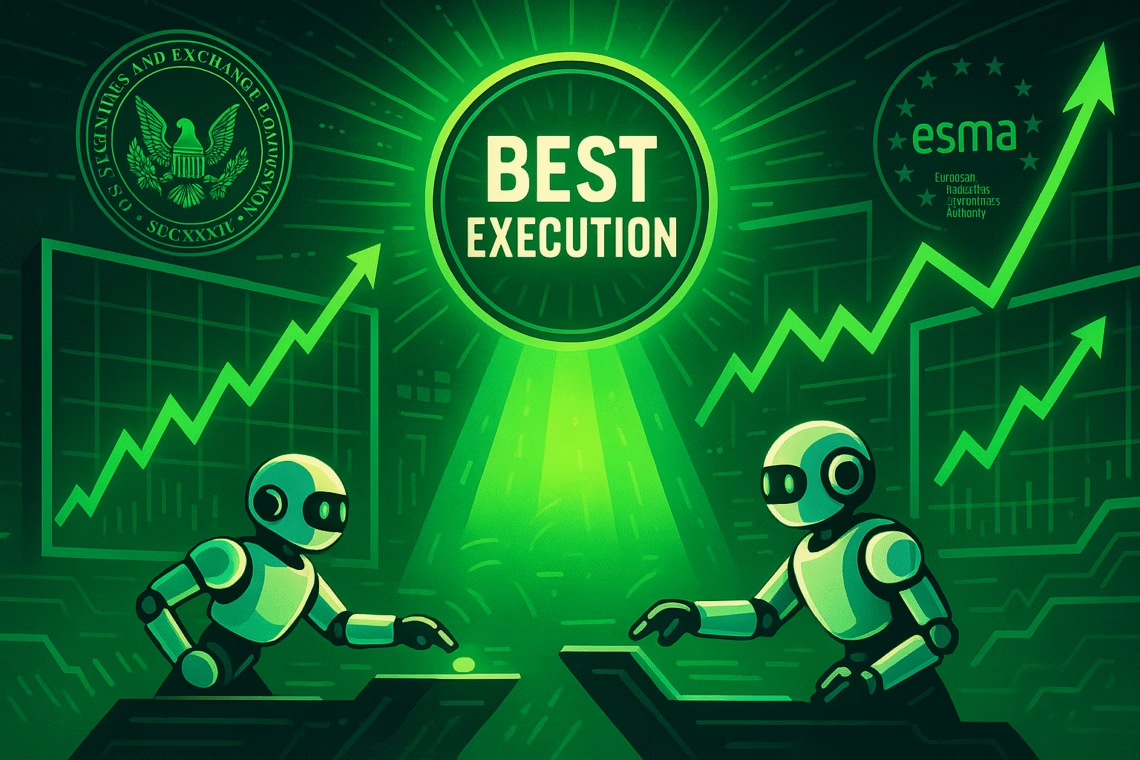
In the fast-paced world of financial markets, best execution in trading stands as a cornerstone principle, ensuring traders secure the most favorable outcomes for every transaction. As of November 2025, regulatory landscapes continue to evolve with stringent updates from bodies like the SEC and ESMA, emphasizing transparency, automation, and data-driven decisions. Whether you’re navigating equities, futures, or FX, mastering order execution, execution quality, broker compliance, and trade optimization isn’t just a best practice—it’s a competitive edge. This guide dives into the latest strategies, compliance mandates, and tools like PickMyTrade automation trading to help you achieve superior results.
What Is Best Execution in Trading?
Best execution in trading refers to the legal and ethical obligation of brokers and investment firms to execute client orders in a manner that delivers the optimal outcome. This isn’t solely about snagging the lowest price; it encompasses a holistic evaluation of factors like speed, cost, likelihood of fill, and market impact. Under U.S. FINRA Rule 5310 and EU MiFID II guidelines, firms must demonstrate “reasonable diligence” to prioritize client interests over internal incentives, such as payment for order flow (PFOF).
Recent 2024-2025 updates underscore this: The SEC’s Rule 605 amendments expanded reporting to include fractional shares, odd-lots, and after-hours trades, mandating metrics like realized spreads and size improvement for enhanced execution quality. Meanwhile, ESMA’s July 2024 consultation on MiFID II Review introduced stricter criteria for order execution policies, requiring firms to justify venue selection and monitor slippage quarterly. These changes aim to curb conflicts and boost transparency, with non-compliance fines reaching millions—as seen in 2024 cases against major brokers.
Key Factors Influencing Order Execution
Effective order execution hinges on balancing multiple elements to achieve best execution in trading. Brokers must assess:
- Price and Costs: Opportunity for price improvement beyond the National Best Bid and Offer (NBBO), plus fees, rebates, and spreads.
- Speed and Likelihood: Execution latency (milliseconds matter in volatile markets) and fill rates, especially for limit orders.
- Market Impact and Size: Minimizing information leakage for large trades, as highlighted in 2025 Tradeweb reports on automated time-release tools.
- Other Considerations: Settlement timelines, liquidity depth, and venue reliability.
In 2025, with ADV surpassing 13 billion shares daily, off-exchange trading hit 50% on peak days, amplifying the need for diversified routing to avoid “toxic” liquidity. Tools like algorithmic EMS platforms, such as Trading Technologies’ award-winning system, now integrate these factors for real-time optimization.
Measuring Execution Quality: Essential Metrics
Execution quality is quantifiable, guiding trade optimization and broker compliance. Top metrics for 2025 include:
| Metric | Description | Why It Matters in 2025 |
|---|---|---|
| Effective Spread | Difference between execution price and mid-point; EFQ (Effective/Quoted) measures improvement percentage. | SEC Rule 605 now requires it for fractional orders; Fidelity reported $1.94B in savings via EFQ in 2024. |
| Slippage | Gap between expected and actual fill price. | ESMA’s MiFID II updates mandate quarterly slippage monitoring. |
| Fill Rate | Percentage of orders fully executed. | Critical for high-volume futures; TradeZella’s 2024 backtesting tools emphasize it. |
| Latency | Time from order submission to fill. | Sub-millisecond execution via automation like PickMyTrade. |
| VWAP/TWAP Deviation | Alignment with volume/time-weighted benchmarks. | ICE’s Best Execution Score uses it for percentile ranking. |
These metrics, updated in SEC’s September 2024 Reg NMS amendments, now apply to tick sizes under $1.00 with 0.1% access fee caps, reducing distortions. Platforms like Cappitech benchmark against them for automated compliance.
Click Here To Start Futures Trading Automation For Free
Broker Compliance: Navigating Regulatory Demands
Broker compliance is non-negotiable in best execution in trading, with 2024-2025 seeing heightened scrutiny. FINRA’s targeted reviews of wholesale market makers focus on PFOF and affiliate routing, fining firms like Barclays $2M for lapses. Under MiFID II Review (effective March 2024), firms must now include AIFMs in transaction reporting and delete outdated RTS 28 public disclosures by September 2025.
To comply:
- Conduct “regular and rigorous” quarterly reviews, order-by-order for complex trades.
- Document conflicts, like routing to affiliates, and justify via analytics.
- Publish enhanced Rule 605 reports monthly, covering 100K+ accounts.
Non-compliance risks escalate: ESMA’s final RTS on order execution policies, due December 2024, will enforce venue justification, potentially increasing audit costs by 20-30%.
Trade Optimization Strategies for 2025
Trade optimization elevates order execution by leveraging tech and data. Key 2025 strategies include:
- Algorithmic Enhancements: Use VWAP/TWAP algos for large blocks; BNP Paribas’ Rex 2.0 algo won e-FX awards for linear portfolio execution.
- Time-Release Automation: Tradeweb’s AiEX tool surged 8x in European bond trades via scheduled executions.
- Multi-Venue Routing: Diversify across 100+ exchanges; Goldman Sachs’ RFQ vs. algo TCA tool optimizes pre-trade.
- AI-Driven Analytics: Predict outcomes with Sharpe ratios and drawdowns; uTrade Algos highlights win rates >60% for profitability.
Incorporate backtesting: NinjaTrader’s Strategy Analyzer fine-tunes parameters on recent data, boosting MES trade runs 50% in 2024.
Integrating PickMyTrade Automation Trading for Superior Results
For seamless trade optimization, PickMyTrade automation trading emerges as a game-changer. This cloud-based platform connects TradingView alerts to brokers like Tradovate, Rithmic, and Interactive Brokers—without APIs or coding. Over 3,000 traders executed 3M+ trades in 2025, achieving millisecond precision for futures, stocks, and FX.
Key features:
- Multi-Account Sync: Execute across accounts simultaneously, ideal for prop firms.
- Auto TP/SL: Adjusts for slippage post-fill, ensuring execution quality.
- Strategy Flexibility: Supports reversal, hedging, and indicator-based alerts.
In a 2025 landscape of fragmented markets, PickMyTrade reduces latency by 90% vs. manual routing, aligning with SEC’s transparency push. Start with a free 5-day trial to automate your best execution in trading workflow—no credit card needed.
Conclusion: Elevate Your Trading with Proactive Best Execution
As markets evolve with Reg NMS tick reforms and MiFID II’s venue mandates, prioritizing best execution in trading through robust order execution, execution quality monitoring, broker compliance, and trade optimization is essential. Embrace automation like PickMyTrade to stay ahead, turning regulatory hurdles into opportunities for alpha. Implement these insights today for compliant, high-performance trading in 2025 and beyond.
Most Asked FAQs on Best Execution in Trading
What is best execution in trading?
It’s the duty to execute orders at the optimal price, speed, and likelihood, considering all costs and market conditions—not just the lowest price.
What factors determine order execution quality?
Key elements include price improvement, slippage, fill rates, latency, and VWAP deviation, as updated in 2025 SEC Rule 605 reports.
How do recent regulations impact broker compliance?
SEC’s 2024 amendments expand reporting to 100K+ accounts; MiFID II Review (2024) requires quarterly venue reviews, with fines for lapses.
What are top trade optimization strategies for 2025?
Leverage algos like VWAP, AI analytics for win rates, and automation tools for multi-venue routing to minimize impact.
How does automation like PickMyTrade enhance best execution?
It delivers millisecond trades across accounts, auto-adjusts TP/SL, and integrates TradingView for precise, compliant execution.
Disclaimer:
This content is for informational purposes only and does not constitute financial, investment, or trading advice. Trading and investing in financial markets involve risk, and it is possible to lose some or all of your capital. Always perform your own research and consult with a licensed financial advisor before making any trading decisions. The mention of any proprietary trading firms, brokers, does not constitute an endorsement or partnership. Ensure you understand all terms, conditions, and compliance requirements of the firms and platforms you use.
Also Checkout: Automate TradingView Indicators with Tradovate Using PickMyTrade