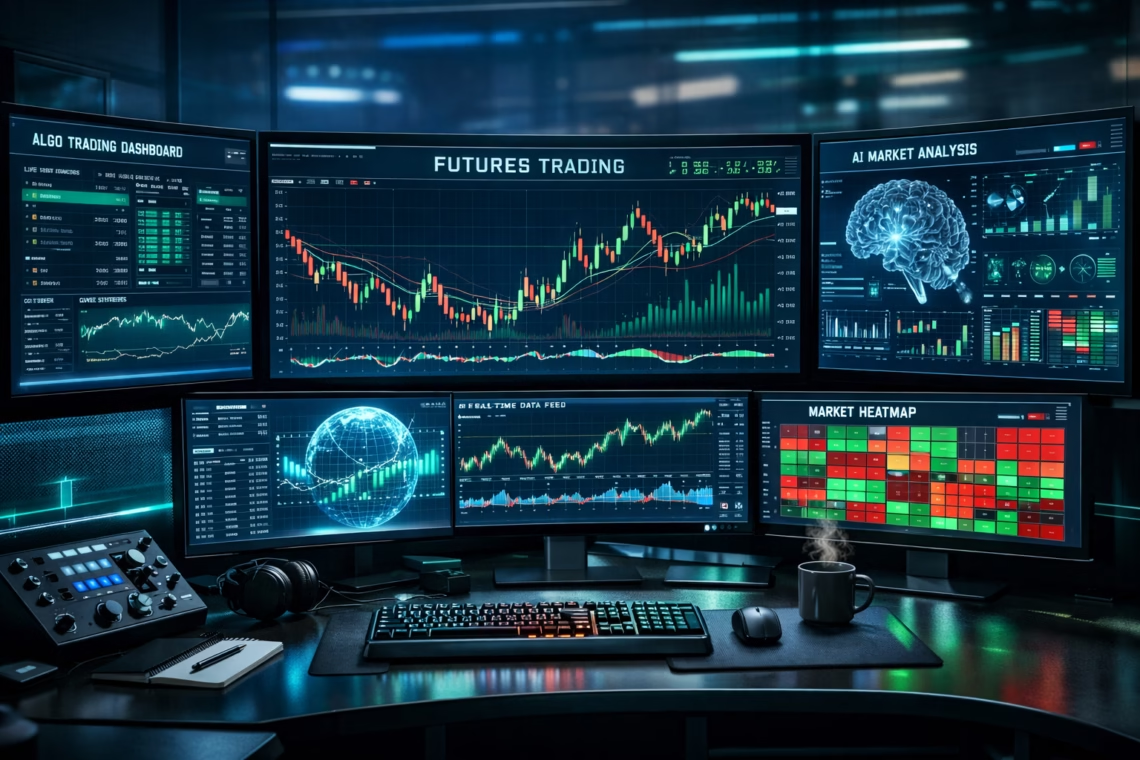
Automated trading strategies have become the backbone of modern futures trading. In 2026, speed, data intelligence, and system reliability define who wins and who falls behind. What was once reserved for hedge funds and proprietary desks is now accessible to independent traders who understand how to combine smart algorithms with the right technology stack.
This guide breaks down the most effective automated trading strategies for futures markets, explains how they work in real-world conditions, and shows how traders can optimize performance through infrastructure, testing, and risk automation.
Why Automated Trading Strategies Dominate Futures Markets
Futures markets are uniquely suited to automation. They operate nearly 24 hours a day, offer deep liquidity, and respond rapidly to macroeconomic events. Automated systems thrive in this environment because they:
- Execute trades in milliseconds without hesitation
- Analyze large volumes of historical and real-time data
- Apply consistent rules without emotional interference
- Manage risk automatically across multiple positions
Advances in artificial intelligence, cloud computing, and low-latency infrastructure have pushed automated futures trading into a new era—one where adaptability matters as much as raw speed.
Core Automated Trading Strategies for Futures Markets
Different market conditions require different approaches. The most successful traders often deploy multiple automated trading strategies, each designed to exploit a specific market behavior.
Trend-Following Systems
Trend-following remains one of the most widely used automated trading strategies in futures markets. These systems aim to capture sustained directional moves rather than short-term noise.
Modern trend algorithms typically incorporate:
- Adaptive moving averages that respond to volatility changes
- Multi-timeframe confirmation to reduce false signals
- Volume and market participation filters
For example, an automated system trading crude oil futures might only enter long positions when both the daily and hourly trends align and volume exceeds its recent average.
Mean-Reversion Algorithms
Mean-reversion strategies operate on the assumption that prices tend to return to equilibrium after extreme movements. These systems are especially effective in range-bound or highly liquid futures markets.
Common components include:
- Statistical bands (such as volatility envelopes)
- Momentum oscillators to detect exhaustion
- Time-based exits to avoid prolonged drawdowns
An automated mean-reversion strategy could target S&P 500 micro futures during low-volatility sessions, fading short-term price spikes caused by temporary order imbalances.
Breakout and Momentum-Based Trading
Breakout and momentum systems focus on capturing rapid expansions in price movement. These strategies are particularly effective around economic releases, session opens, or volatility regime shifts.
Advanced breakout models often use:
- Support and resistance derived from market structure
- Volatility expansion confirmation
- Real-time order flow or volume acceleration
Some momentum algorithms also integrate news or macro data feeds, allowing them to respond instantly to unexpected catalysts such as interest rate decisions or inventory reports.
AI-Driven and Machine Learning Strategies
Artificial intelligence has reshaped automated trading strategies by allowing systems to evolve rather than rely on static rules. Machine learning models can identify complex, non-linear relationships that traditional indicators miss.
AI-powered futures strategies may leverage:
- Neural networks for pattern recognition
- Reinforcement learning to optimize trade decisions
- Alternative data such as weather, freight rates, or cross-asset correlations
For instance, an AI model trading agricultural futures could incorporate satellite-derived crop health data alongside price and volume metrics to anticipate supply-driven moves.
Infrastructure: The Hidden Edge in Automated Futures Trading
Even the most sophisticated strategy fails without reliable execution. Infrastructure is no longer a secondary concern—it is a competitive advantage.
Why VPS Hosting Is Essential for Automated Trading
A trading VPS (Virtual Private Server) allows algorithms to run continuously in professional data centers located near major exchanges. This setup delivers:
- Lower latency compared to home internet connections
- Stable execution during volatile market conditions
- Protection from power outages and local hardware failures
For strategies that depend on precise entries—such as scalping or high-frequency futures trading—milliseconds can determine profitability.
Matching VPS Resources to Strategy Complexity
Not all automated trading strategies have the same technical demands. Choosing the right VPS configuration depends on factors such as:
- Number of charts or instruments monitored
- Frequency of trade execution
- Use of AI or computationally intensive models
Lightweight trend systems may run efficiently on entry-level servers, while machine learning strategies often require higher CPU counts and memory to process data in real time.
Optimizing Automated Trading Strategies for Long-Term Performance
Successful automation is not a “set and forget” exercise. Continuous validation and adjustment are essential.
Backtesting and Strategy Validation
Robust backtesting ensures a strategy performs across different market environments—not just ideal conditions. High-quality testing evaluates:
- Drawdowns and recovery periods
- Risk-adjusted returns
- Performance during extreme volatility
Techniques such as walk-forward optimization and Monte Carlo simulations help traders avoid overfitting and prepare for unfavorable scenarios.
Real-Time Monitoring and Performance Analytics
Live monitoring tools act as a safeguard against silent failures. Effective dashboards track:
- Execution quality and slippage
- Latency spikes or connectivity issues
- Key performance metrics such as win rate and drawdown
Alerts should focus on meaningful deviations rather than constant notifications, enabling traders to intervene only when necessary.
Click Here To Start Futures Trading Automation For Free
Automated Risk Management: The Foundation of Survival
Risk control is where automation truly shines. Well-designed systems enforce discipline automatically.
Key risk management features include:
- Predefined stop-loss and take-profit logic
- Dynamic position sizing based on volatility or equity curves
- Correlation checks to prevent overexposure
Daily and monthly loss limits provide an additional layer of protection, shutting down trading activity when predefined thresholds are reached.
The Future of Automated Trading Strategies in Futures Markets
Looking ahead, automated trading strategies will become increasingly autonomous, adaptive, and interconnected. The most successful systems will combine:
- AI-driven decision engines
- Cross-market data analysis
- High-performance infrastructure with near-zero latency
As compliance and transparency requirements grow, future platforms will also integrate audit trails and explainable AI, allowing traders to understand why algorithms make specific decisions.
In a landscape where opportunities disappear in seconds, the edge will belong to traders who align advanced strategies with reliable execution environments.
Key Takeaways
- Automated trading strategies are now essential for competitive futures trading
- Trend-following, mean-reversion, breakout, and AI-driven systems each serve distinct market conditions
- Reliable VPS infrastructure is critical for speed, stability, and uptime
- Continuous testing, monitoring, and automated risk management protect long-term performance
- The future favors adaptive, data-driven systems backed by robust technology
Automated futures trading in 2026 is no longer about chasing complexity—it’s about building resilient systems that execute flawlessly when it matters most.
Disclaimer:
This content is for informational purposes only and does not constitute financial, investment, or trading advice. Trading and investing in financial markets involve risk, and it is possible to lose some or all of your capital. Always perform your own research and consult with a licensed financial advisor before making any trading decisions. The mention of any proprietary trading firms, brokers, does not constitute an endorsement or partnership. Ensure you understand all terms, conditions, and compliance requirements of the firms and platforms you use.
Also Checkout: Connect Tradovate with Trading view using PickMyTrade


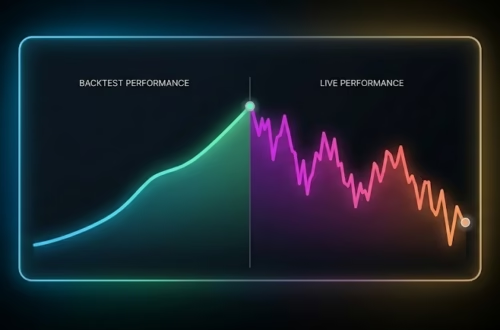






Good breakdown of why futures are such a natural fit for automation, especially with nearly 24-hour markets and fast reactions to macro news. One thing that’s becoming even more important in 2026 is regime awareness—strategies that worked in high-liquidity trends can quietly break during volatility spikes if they aren’t stress-tested properly. Pairing multiple systems with solid risk automation and ongoing validation seems just as critical as speed now.