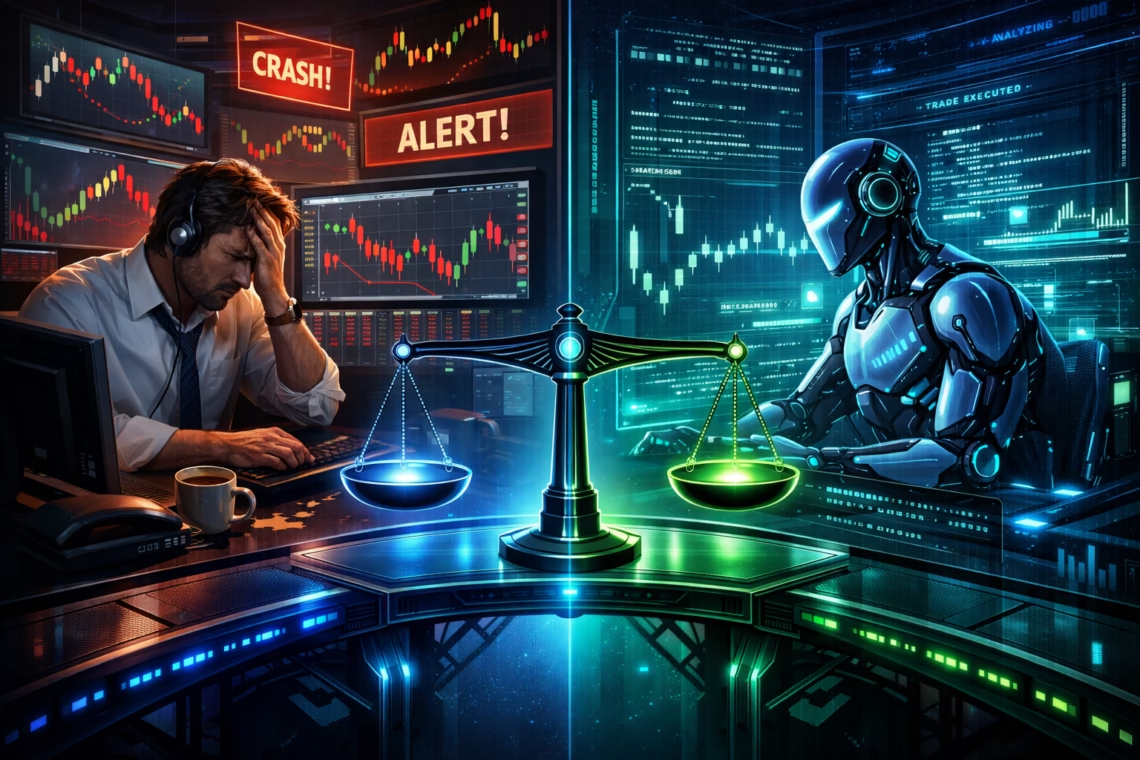
In the fast-evolving world of financial markets, the debate over human vs automation decisions continues to intensify. As algorithmic trading surges—with the global market projected to grow from around USD 57 billion in 2025 to over USD 150 billion by 2033—traders face a critical choice: rely on intuition and experience or embrace data-driven automation.
Recent advancements in AI, including agentic systems and reasoning models, have transformed automated trading, enabling faster execution, emotion-free decisions, and 24/7 monitoring. Yet, human traders still excel in adaptability during unprecedented events. This article explores human vs automation decisions in depth, backed by 2025-2026 insights, and highlights how tools like PickMyTrade bridge the gap for smarter trading.
What Are Human vs Automation Decisions in Trading?
Human vs automation decisions refer to the contrast between discretionary trading (human-led, based on judgment, experience, and intuition) and algorithmic/automated trading (rule-based systems executing trades via code or AI).
Discretionary traders analyze charts, news, sentiment, and macro events manually, adjusting strategies on the fly. Automated systems, powered by algorithms, AI, or machine learning, process vast data in milliseconds, executing predefined rules without hesitation.
In 2026, this divide isn’t binary—hybrid approaches dominate, where humans oversee AI for optimal results.
Advantages of Automation in Human vs Automation Decisions
Automation shines in consistency, speed, and bias elimination:
- Speed and Efficiency — Algorithms execute trades in milliseconds, capitalizing on opportunities humans miss. High-frequency trading now dominates 60-70% of volumes in major markets.
- Emotion-Free Trading — Humans suffer from fear, greed, and fatigue (the disposition effect, where traders sell winners too early and hold losers). Algorithms follow rules strictly, reducing costly errors.
- 24/7 Operation and Scalability — Systems monitor multiple markets simultaneously, handling vast data without breaks.
- Advanced Data Processing — AI analyzes patterns, sentiment, and historical data far beyond human capacity.
Recent 2025 studies show automated systems often deliver better risk-adjusted returns in volatile markets like crypto, with hybrid models outperforming pure discretionary desks by 15%.
Advantages of Human Discretion in Human vs Automation Decisions
Humans bring irreplaceable qualities:
- Adaptability to Unforeseen Events — During regime shifts, black swan events, or qualitative changes (e.g., geopolitical news), human intuition adjusts where rigid algorithms falter.
- Creative Strategy and Oversight — Experienced traders set goals, interpret nuances, and override in ethical or complex scenarios.
- Risk Management in Uncertainty — Humans excel at causal reasoning and “gut feel” from years of experience.
In 2025 experiments and real-world data, human oversight in AI systems yielded superior performance, emphasizing that AI enhances but doesn’t fully replace judgment.
Key Disadvantages: Human vs Automation Decisions Side-by-Side
Automation risks include tech glitches, lack of flexibility in novel conditions, and over-reliance on historical data. Humans face emotional biases, fatigue, and slower execution.
Here’s a quick comparison:
- Speed — Automation wins (milliseconds vs minutes/hours).
- Consistency — Automation (no emotions).
- Flexibility — Human wins.
- Scalability — Automation.
- Emotional Bias — Human disadvantage.
The consensus from 2025-2026 reports? Pure automation excels in routine scenarios, but hybrids—human + machine—often win overall.
The Future of Human vs Automation Decisions in 2026
By 2026, AI trading focuses on efficiency, ethics, and human control. Agentic AI, explainable models, and quantum-enhanced risk tools are rising, but regulators stress transparency and oversight.
The future isn’t human vs automation decisions—it’s collaboration. Successful traders use automation for execution while applying discretion for strategy and anomalies.
PickMyTrade: Bridging Human vs Automation Decisions Seamlessly
For traders seeking the best of both worlds, PickMyTrade stands out as a powerful automated trading platform. It connects TradingView alerts directly to major brokers like Tradovate, Rithmic, Interactive Brokers, and more—no coding required.
Key features include:
- Millisecond execution for precision.
- Unlimited strategies and alerts.
- Advanced risk management (stop-loss, take-profit, position sizing).
- Multi-account support for scaling.
- Setup in under 5 minutes.
PickMyTrade eliminates manual errors while letting you retain control—perfect for transitioning to automation without losing human oversight. Join 3000+ traders automating futures, stocks, crypto, and more.
Conclusion: Striking the Balance in Human vs Automation Decisions
In 2026, human vs automation decisions favors hybrids: automation handles speed and consistency, while humans provide judgment and adaptability. Tools like PickMyTrade make these accessible, empowering traders to outperform with precision and smarts.
Ready to evolve your trading? Explore automation today—your edge awaits.
FAQs
Will AI fully replace human traders by 2026?
No. AI excels in speed and data but lacks intuition for unpredictable events. Hybrids perform best.
What are the main advantages of automation over human decisions?
Emotion-free execution, 24/7 monitoring, faster trades, and scalability—reducing biases that plague most manual traders.
Is algorithmic trading still profitable in 2026?
Yes, especially with robust strategies. It reduces costs by 20-30% and outperforms in consistent conditions.
What risks come with full automation?
Tech failures, inflexibility in black swans, and over-optimization to past data—always include human oversight.
Disclaimer:
This content is for informational purposes only and does not constitute financial, investment, or trading advice. Trading and investing in financial markets involve risk, and it is possible to lose some or all of your capital. Always perform your own research and consult with a licensed financial advisor before making any trading decisions. The mention of any proprietary trading firms, brokers, does not constitute an endorsement or partnership. Ensure you understand all terms, conditions, and compliance requirements of the firms and platforms you use.
Also Checkout: Automate TradingView Indicators with Tradovate Using PickMyTrade








I like how you frame this as less of a binary choice and more of a hybrid evolution. Automation clearly wins on speed and consistency, but the point about humans handling regime shifts and truly novel events is important—models can struggle when the data no longer resembles the past. In practice, it feels like the real edge in 2026 comes from humans setting guardrails, interpreting context, and knowing when to step in rather than trying to out-trade machines tick by tick.