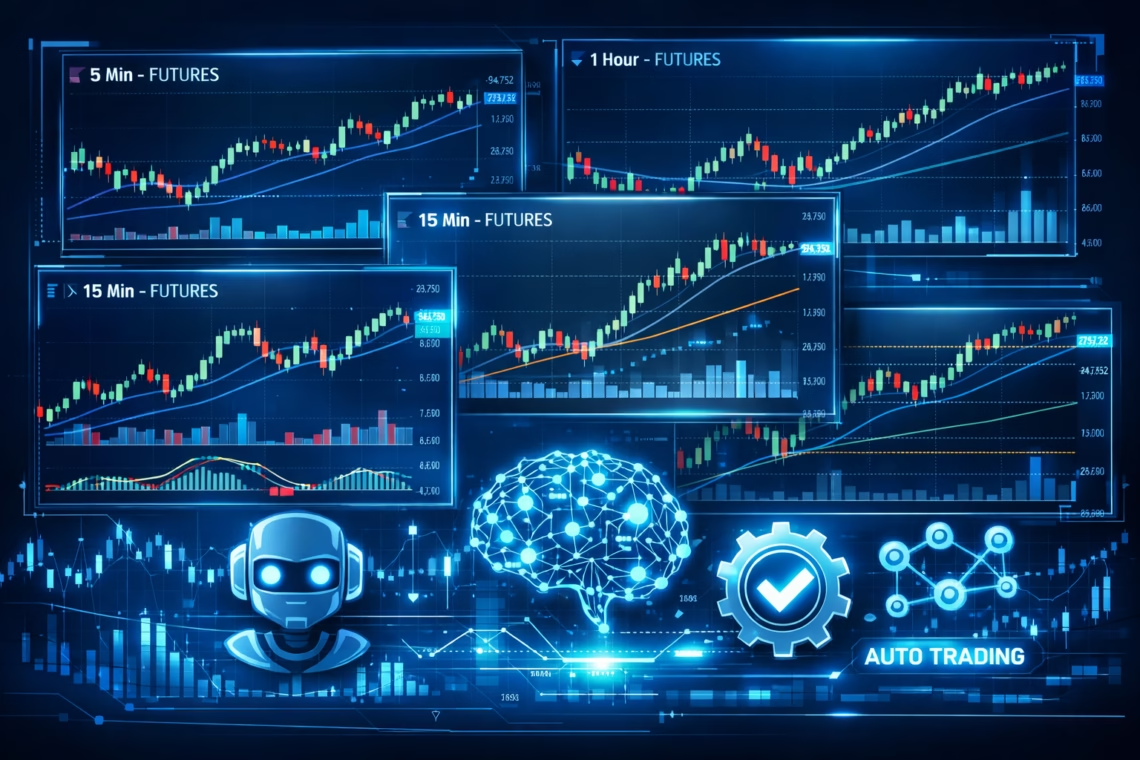
In the fast-paced world of futures trading, staying ahead requires more than just gut instinct—it’s about leveraging data across various horizons. Multi-timeframe futures automation has emerged as a game-changer, allowing traders to analyze trends on daily, hourly, and minute charts simultaneously while automating executions for precision and efficiency. As we step into 2026, advancements in AI-driven tools and platforms like PickMyTrade are making this strategy more accessible and powerful than ever. This guide dives deep into how you can master multi-timeframe futures automation to boost your trading edge.
Understanding Multi-Timeframe Futures Strategy Basics
Multi-timeframe analysis (MTFA) involves examining the same futures contract—such as crude oil, gold, or S&P 500 E-minis—across different time intervals to confirm trends and reduce false signals. For instance, a daily chart might reveal the overall uptrend, while a 15-minute chart pinpoints entry points.
At its core, multi-timeframe futures automation builds on this by using algorithms to scan these frames in real-time and execute trades automatically. This eliminates emotional biases and ensures trades align with predefined rules, like entering a long position when a 4-hour uptrend confirms a 1-hour breakout. Recent research from platforms like TrendSpider highlights how MTFA can improve win rates by up to 20% when automated, as it filters out noise from volatile markets.
Key Benefits of Multi-Timeframe Futures Automation
Why integrate automation into your multi-timeframe futures strategy? The advantages are clear and backed by 2025-2026 trading trends:
- Enhanced Accuracy: By cross-referencing timeframes, automation validates signals. For example, a strategy might require alignment across daily (bias), 4-hour (structure), and 1-hour (entry) charts, reducing drawdowns as noted in QuantPedia’s 2025 Bitcoin trend study adapted for futures.
- Time Efficiency: Manual analysis is tedious; automation handles it 24/7. Tools now incorporate AI to adapt to market volatility, a key update in 2025 from platforms like Optimus Futures, which introduced multi-panel timeframe syncing.
- Risk Management: Automated systems enforce stop-losses and position sizing across frames, minimizing losses during events like flash crashes. HighStrike’s 2025 guide emphasizes how this leads to better risk-reward ratios in futures.
- Scalability: Manage multiple contracts or accounts seamlessly. With rising volatility in 2026, as predicted by KraneShares’ emerging tech outlook, automation ensures you capture opportunities without constant monitoring.
These benefits make multi-timeframe futures automation essential for both retail and institutional traders aiming for consistent profits.
Click Here To Automate Futures Trading
How to Implement Multi-Timeframe Futures Automation Step-by-Step
Getting started with multi-timeframe futures automation doesn’t require coding expertise, thanks to user-friendly platforms. Here’s a practical roadmap based on the latest 2026 tools:
- Define Your Strategy: Start with a top-down approach. Use higher timeframes (e.g., daily or weekly) for trend direction, medium (4-hour) for support/resistance, and lower (15-minute) for entries/exits. Incorporate indicators like moving averages or RSI for confluence, as outlined in TradingView’s 2025 MTFA tutorials.
- Choose Automation Tools: Select platforms that support multi-timeframe scanning and execution. For instance, Build Alpha offers futures data across all timeframes with algorithmic backtesting, while ATAS provides volume-based MTF analysis updated in 2025 for better footprint charts.
- Integrate with Brokers: Connect to brokers like Tradovate or Rithmic for seamless execution. This is where PickMyTrade shines—it’s an automation trading platform that bridges TradingView alerts to these brokers without coding. As per their 2025 updates, PickMyTrade now supports multi-session automation for futures scalping, allowing you to run strategies on unlimited accounts with real-time risk controls. Their futures scalping guide highlights how it captures micro-moves in volatile markets like Nasdaq futures.
- Backtest and Optimize: Use historical data to test your automated setup. Recent 2025 enhancements in MultiCharts .NET include C# strategy building with minimal latency, ideal for multi-timeframe futures automation.
- Monitor and Adjust: Even automated systems need oversight. Leverage AI sentiment tools from 2026 trends, like those in Yahoo Finance’s reports, to refine parameters amid increasing market speed.
By following these steps, you can deploy a robust futures automation system tailored to 2026’s dynamic environment.
Recent Updates in Multi-Timeframe Futures Automation
The landscape of futures trading automation has evolved rapidly. In 2025, QuantVPS reported that modern strategies now validate signals across timeframes using AI to fine-tune sensitivity based on volatility— a must for commodities like oil amid geopolitical shifts.
Key 2025-2026 updates include:
- AI Integration: Deloitte’s Tech Trends 2026 predicts AI will drive adaptive automation, with platforms like RapAlgo offering multi-timeframe signals for $AI futures.
- Platform Enhancements: Optimus Futures rolled out one-click multi-timeframe charting in late 2025, while GOAT Funded Futures upgraded dashboards for profit factor analysis in funded accounts.
- Regulatory and Tech Shifts: The TRADE’s 2026 predictions note faster post-trade automation and MiFID II-regulated crypto perpetuals, influencing futures strategies. Grayscale’s outlook emphasizes institutional adoption, boosting tools like PickMyTrade for scalable automation.
- Scalping Focus: PickMyTrade’s December 2025 guide on futures scalping automation introduces unlimited sessions in one setup, perfect for strategies in high-volatility periods.
These advancements ensure futures automation remains cutting-edge, with AI reducing non-stationarity risks as per recent econ papers.
Real-World Examples and Best Practices
Consider a gold futures trader using multi-timeframe futures automation: On a daily chart, spot an uptrend; confirm structure on 4-hour; enter via 15-minute breakout. Automated via PickMyTrade, this executes instantly across accounts, as seen in their 2025 case studies yielding 15-20% monthly returns in simulated environments.
Best practices: Start small, use demo accounts, and diversify across assets. Avoid over-optimization—focus on robust rules that hold in 2026’s bull market broadening, per KraneShares.
In conclusion, multi-timeframe futures automation is transforming trading by combining strategic depth with technological speed. Platforms like PickMyTrade make it plug-and-play, positioning you for success in 2026’s volatile markets. Whether you’re a beginner or pro, adopting this approach could be your edge.
Most Asked FAQs
What is multi-timeframe futures automation?
It’s a strategy that analyzes futures contracts across multiple timeframes (e.g., daily, hourly) and uses automation tools to execute trades based on aligned signals.
How does PickMyTrade fit into multi-timeframe futures automation?
PickMyTrade automates TradingView alerts for futures brokers, supporting multi-account execution and scalping strategies ideal for timeframe-based trading.
What are the risks of multi-timeframe futures automation?
Over-reliance on automation can lead to losses in black-swan events; always incorporate manual oversight and backtest thoroughly.
Which timeframes are best for futures automation?
Commonly, daily for bias, 4-hour for structure, and 1-hour/15-minute for entries, as recommended in 2025 TradingStrategyGuides.
Disclaimer:
This content is for informational purposes only and does not constitute financial, investment, or trading advice. Trading and investing in financial markets involve risk, and it is possible to lose some or all of your capital. Always perform your own research and consult with a licensed financial advisor before making any trading decisions. The mention of any proprietary trading firms, brokers, does not constitute an endorsement or partnership. Ensure you understand all terms, conditions, and compliance requirements of the firms and platforms you use.
Also Checkout: Connect Tradovate with Trading view using PickMyTrade








I really appreciate how you highlighted the role of AI in multi-timeframe trading. The idea of combining different time horizons to confirm trends is powerful, but automation to cut down on human bias and improve precision seems like a game-changer!